
Mysteries of Black Holes: A Cosmic Enigma
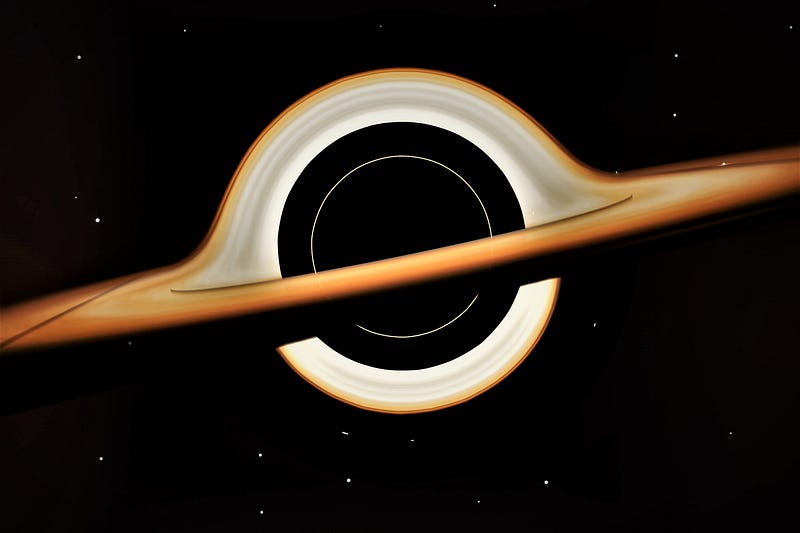
In the vast cosmic tapestry of the universe, few phenomena captivate our imaginations as profoundly as black holes. These enigmatic objects have puzzled scientists, philosophers, and science fiction enthusiasts alike for decades. Despite our advancements in astrophysics, black holes continue to remain one of the most mysterious and intriguing cosmic entities. In this article, we will embark on a journey to explore the enigma of black holes, shedding light on what we know and the lingering mysteries that still shroud these cosmic anomalies.
The Birth of a Black Hole
Black holes are born from the remnants of massive stars that have exhausted their nuclear fuel. When such a star can no longer counteract the inward pull of gravity, it undergoes a cataclysmic event known as a supernova. During a supernova explosion, the outer layers of the star are expelled into space, while the core, now devoid of nuclear energy, collapses in on itself, forming a singularity — a point of infinite density — and thus, the heart of a black hole.
Event Horizon: The Point of No Return
One of the defining characteristics of a black hole is its event horizon, a boundary beyond which nothing, not even light, can escape. This phenomenon results from the extreme gravitational pull exerted by the singularity at the center of the black hole. The event horizon marks the point of no return for any object or information falling into the black hole, effectively rendering the interior of a black hole invisible to the external universe.
Singularity: A Cosmic Paradox
The singularity at the core of a black hole is a perplexing concept. It defies our understanding of physics, as our current theories break down under the extreme conditions present there. Classical physics, which governs our everyday world, fails to provide a coherent description of the singularity’s properties. This inconsistency between general relativity and quantum mechanics remains one of the most significant mysteries surrounding black holes.
Hawking Radiation: The Slow Evaporation
Stephen Hawking’s groundbreaking work in the 1970s introduced the concept of Hawking radiation. This radiation suggests that black holes are not entirely black; instead, they emit particles and radiation over time. The process is slow, causing black holes to gradually lose mass and eventually evaporate. This revelation raises intriguing questions about the ultimate fate of black holes and the conservation of information.
The Information Paradox
One of the most perplexing mysteries concerning black holes is the information paradox. If black holes eventually evaporate through Hawking radiation, what happens to the information contained within the objects they’ve consumed? According to quantum mechanics, information cannot be destroyed, leading to a paradox that challenges our fundamental understanding of the universe.
Supermassive Black Holes: Galactic Giants
While the collapse of massive stars gives birth to stellar black holes, another class of black holes exists on an entirely different scale: supermassive black holes. These giants lurk at the centers of galaxies, exerting an immense gravitational influence that shapes the galactic dynamics. The formation of supermassive black holes remains an ongoing puzzle in astrophysics, as it requires the accretion of vast amounts of matter over cosmic time scales.
Conclusion
Black holes continue to be one of the most alluring mysteries of the universe, pushing the boundaries of our understanding of physics and cosmology. As we delve deeper into the realms of astrophysics and theoretical science, we inch closer to unraveling the secrets they hold. Yet, the mystique of black holes remains undiminished, serving as a reminder of the vastness of the cosmos and the limitless questions that await our exploration. As scientists continue to grapple with the enigma of black holes, our journey to understand these cosmic wonders promises to be an adventure that stretches the frontiers of human knowledge and imagination.