
Myanmar’s Protests Should Inform Our Discussion on Gun Rights
It will eliminate the claim that an armed citizenry will stop repressive regimes
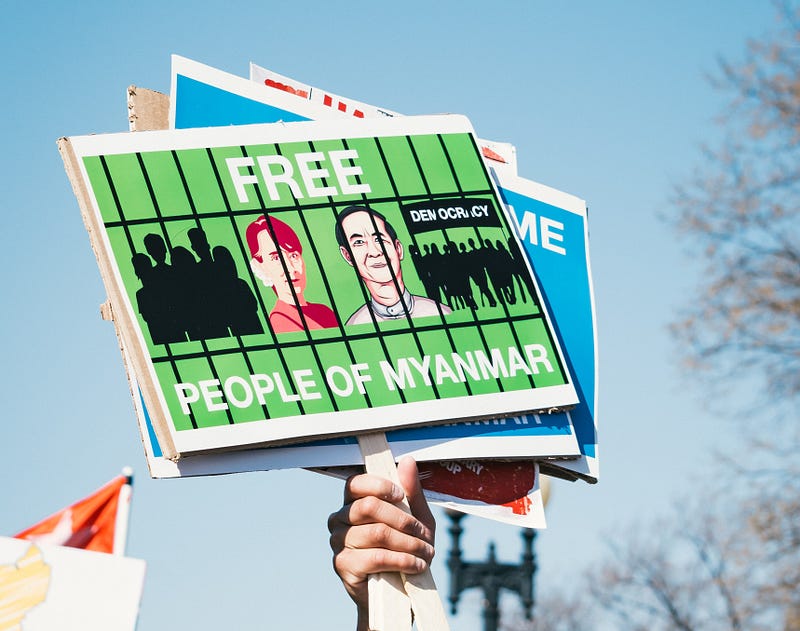
In February, there was a coup in Myanmar, one of the countries in southeast Asia. The military, known as the Tatmadaw and which had relinquished some of its absolute control in order to make the country seem more democratic, was soundly defeated in the 2020 election. So it announced that there was rampant voter fraud, arrested members of the winning party, including State Counsellor Aung San Suu Kyi, and took back control of the country.
Thousands of protestors took to the streets. The Tatmadaw cracked down, killing around 100 people on March 27, alone. The death toll has since passed 700.
The protesters who initially set out to peacefully protest the military’s takeover of the government have increasingly begun taking up arms to defend themselves against the junta’s heavy-handed and repressive response.
We are about to see what difference this will make.
Myanmar’s protestors are slowly arming themselves
As the Tatmadaw’s tactics become more brutal, civilians are increasingly turning to arms, themselves. So far, though, that has been limited to slingshots, homemade smoke grenades, old hunting rifles, and do-it-yourself air guns. These do little more than throw marbles or small rocks at the military, and then conceal the protestors’ escape.
As time passes, though, the armaments have become less rudimentary. Protesters are getting better at making weapons and are finding and buying guns, swords, and knives to fight the military.
American gun rights advocates say guns stop repressive regimes
A common refrain in the U.S. about gun rights is that an armed citizenry keeps the government in check. Second Amendment enthusiasts and the National Rifle Association (NRA) insist that when people are armed, it deters government overreach.
The idea is straightforward: If enough normal citizens had guns, then the government would be wary of infringing on their other rights.
The idea is also obsolete. In order to be an effective deterrent, citizen armies or militias would need at least enough firepower to put up a stand against the military. Even if each member of the militia was armed with an assault rifle, they would still be no match for a military that has tanks, fighter jets, drones, artillery, and a navy.
As the pandemic has shown, the concept is also, to an extent, absurd. Armed militias came out in force to protest perceived infringements to their civil rights, falsely believing that they had a constitutional right to not wear a mask during a pandemic.
Nevertheless, the argument that gun ownership, especially of military-grade weapons, will deter repressive government actions has continued to circulate in America.
What’s going to happen: the Myanmar military will kill more people
The situation in Myanmar is going to test this argument, to predictable results.
As the people of Myanmar arm themselves, they are going to be perceived as more of a threat by the Tatmadaw, which is going to react in more repressive ways. They are going to kill more and more people, singling out the very people who use weapons to fight back.
This is not even a hypothetical. It has already happened.
A group of armed civilians in the town of Kalay set up barricades and resisted when the Tatmadaw reacted. The military attacked with machine guns and rocket-propelled grenades, killing at least 11.
When another armed group resisted the military in Bago, the military attacked, again, killing 82.
The Tatmadaw then used the incidents to release propaganda about the protestors, citing the incident as a reason to use more force in the future and to portray the pro-democracy resistance as violent.
In an interview with The New York Times, Anthony Davis, a military analyst, predicted that, “Once you see firearms and grenades on the side of the protesters, the Tatmadaw’s gloves will come off. At that point, they will not hesitate to blow houses down. The Tatmadaw will react viciously and immediately.”
Why more guns is not the answer
A predictable counterargument by gun advocates is that the real problem was that the people of Myanmar were not already armed before the military coup. If the people already had real weapons, then the military would not be so repressive.
The problem with that argument is that it would only escalate the violence more quickly. If Myanmar’s citizens already had assault rifles, like so many people do in the United States, then the Tatmadaw would just have to turn up its own firepower more quickly to get the upper hand. The death tolls and mass killings that we are likely to see in the coming months will have just happened, sooner.
The only way that an armed citizenry could counteract a military like the Tatmadaw is if they were enough of an equal match that it could make the armed forces hesitate to initiate the violence, in the first place. This, of course, would be an incredibly inefficient way for a country to organize its armed forces. Even then, though, the deep resources and the international relations that governments have could easily and quickly be tapped to take the lead in an arm’s race against civilians.


