
My Wife Wanted to Die in My Arms and That Saved Me
But Blind Willie’s wife remained crack cocaine
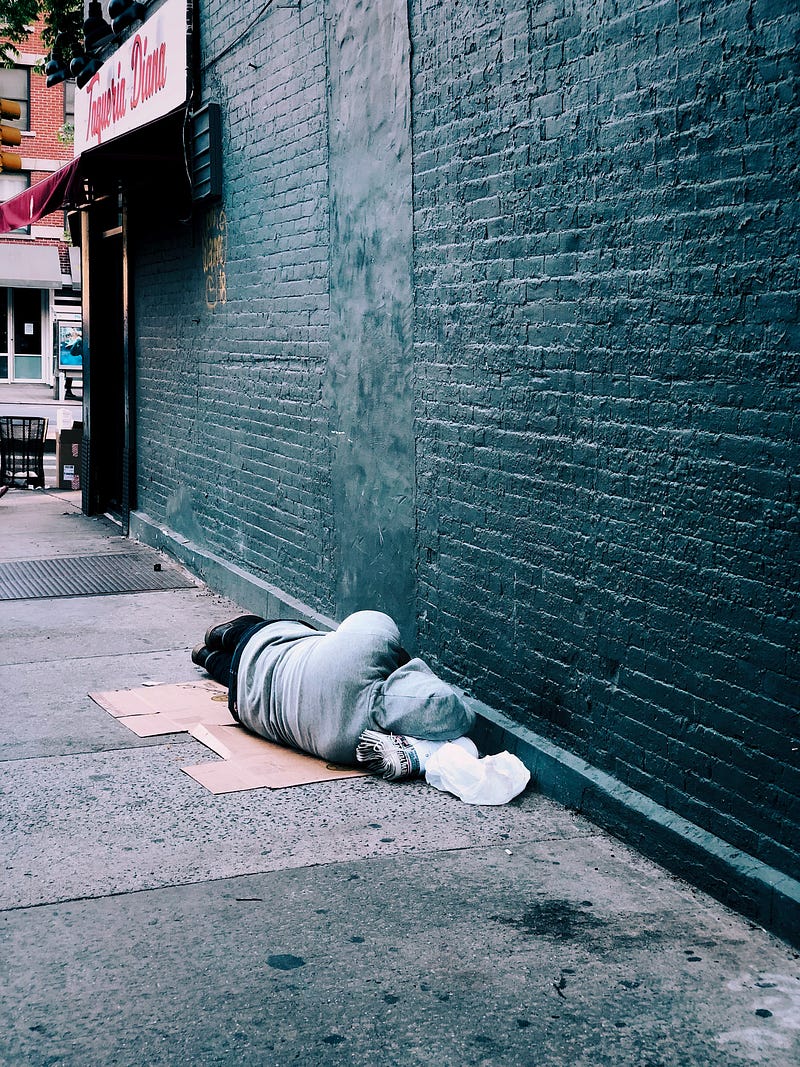
Homeless. Heat wave. I trudged through the haze shimmering off asphalt on Sweet Auburn Street, passing the markers of my former life. I glowered and muttered obscenities at the law office on the corner of Edgewood Avenue where I had worked long hours as a senior partner — marble stairs, stone façade, an architectural landmark. Two statues of lions guarded the entrance door. The inaccessible fortress of wealth and power mocked me.
I passed my favorite British pub where I used to eat a Cobb salad and read the Wall Street Journal every Wednesday. Patrons sitting near the windows stared at my ragged “Che Lives” t-shirt and unkempt beard. Their blue pinstripe suits and faces with blank blue eyes reminded me of cold stained-glass mobiles hanging in and framed by the windows. Now poverty banished me from the high-profile pub. I was living on the fumes of my memories.
Further down the street, I gyrated in front of a mannequin striking a pose in the Macy’s storefront display. The indifference of the perfect plastic face enraged me. I wheeled around and pointed at the pedestrians approaching me. “You’re nothing but walking mannequins,” I shouted.
I wanted to make a scene and become confrontational and disruptive. If I could erupt from the shadows and challenge them with the angry self-respect of futile defiance, maybe they would notice me, and I would become visible. But the pedestrians stepped to the side and kept moving like a river flowing around a rock jutting out of the surface of the water.
The oppressive heat prodded me toward Piedmont Park. After splashing fountain water on my face, I sat on a bench in the shade. From my backpack, I pulled a journal, a pencil, and a broken radio, my favorite possession — magically musical. I scribbled a mantra in my journal:
If I silence my mind, I can hear angels chanting on my broken radio.
My soul burst into flames as the boundary lines between reality and my delusions blurred, merging into a unified canvas. My soul enveloped the couple eating lunch on a blanket near the fountain. I felt certain they could hear the chanting angels. A sense of awe overwhelmed me.
Suddenly, a policeman loomed beside the bench. “Move along. No loitering in the park,” he barked.
“Do you hear them, my guardian angels?” I asked.
“I said move along.”
I stuffed my belongings in my backpack and fled the park searching for a place to regain my anonymity and escape into the oblivion of crack cocaine. As I footslogged through the humidity, my former life seemed insubstantial like the heat quavering off the street. I passed the Marta station. The northbound train would take me near my house where my wife and children still lived. I had tried returning home on occasion, but my shame, psychotic delusions, and addiction kept funneling me back to the streets of downtown Atlanta.
My life narrative had narrowed to survival and ecstasy. Survival depended on hustling for food, shelter, clothing, and chump change. Ecstasy required a pint of Jack, a crack pipe, and a dime of cocaine. Smoking crack took me outside the emotional pain. Each hit felt like I was inhaling God and exhaling the scar tissue of trauma.
A young evangelical missionary hunted and hounded me down the street. “Today can be the day of your salvation. You can be set free from your sins.”
“Leave me alone. What do you want?” I asked as I tried to scurry away from the hunter.
“There is a plan of salvation that can release you from your misery.”
“You don’t even know my name.”
“We have all sinned and fallen short of the glory of God.”
“But we have names on the street: Theo, Blind Willie, and Big Man. We’re not the same.”
The missionary shook his head and turned away, searching for easier prey. I wondered how God could create the sunrise and abandon the homeless and mentally ill to their suffering. I raged at a God I wish didn’t exist.
I found my hidden space in a back alley behind some stacked crates. I leaned the back of my head against the red brick and marveled at the swiftness and brutality of my fall from grace. In 2004, a car accident left me with a traumatic brain injury (TBI) and newly disabled from the practice of law. After the injury, I went through periods of deep depression and delusional manic episodes. I turned to alcohol and drugs to ease the pain of losing my identity and roles of attorney, father, and husband. My TBI, bipolar disorder, and addiction consumed my previous life story and precluded the development of a new narrative beyond my illness identity. I grieved the losses as deaths and fled to the streets to find comfort in hard drugs, but the grieving never ended. I slammed my hand against the wall.
I picked up a glass whiskey bottle and shattered it on the ground. A shard tempted me with suicide. I could make two deep vertical cuts on my wrist and ride those rails far away from the suffering, far away from the remembrance of home.
I felt the crack pipe and a bag of crack in my pocket. I ritually prepared the pipe and took a hit. Dopamine nirvana. The Shekinah glory of God descended upon me. The Spirit indwelled my body. I was a coward: refusing a decisive and brutal suicide for the slow-motion death of addiction. Besides, crack cocaine was my mistress, and she brooked no rivals.
***
That evening in the alley was one of those rare moments when the choice between life and death directly confronted me. I wanted to commit suicide, but I couldn’t do it. The meaning of my life seemed hidden in the silent catacombs deep within the dark spaces of my soul. What kept me from slicing my wrist? My former identity was dead, and my life story had been severed from my existence. I had no reason to go on living. Why didn’t I end the pain that evening? I struggled with so many questions that seemed like burnt-out torches in the darkness of the catacombs.
One afternoon in the park, I saw a father and son playing catch with a baseball. I wept, yearning to toss a ball with my son in the front yard of my house. But how was I going to get home? The distance between my family and me seemed like a chasm that could no longer be crossed.
That moment of yearning in the park, however, kindled the realization that even within the deep suffering, a flickering but defiant part of me longed to live. I wanted to enter a treatment facility, get back on my medications, walk my daughter to school, and feel my wife’s leg draped over my body in the morning. I would attend an AA meeting, go to the dentist to fix my toothache, read the Bible, and create a new identity. I stood at the crossroads again, but I still couldn’t choose life or death.
By default, I was stuck in the death of homelessness, mental illness, and addiction. The choice of life felt out of my reach. Loneliness and alienation isolated me in my pain and oblivion. Maybe the walking mannequins erased me into invisibility because they knew I was an empty body without an identity or narrative, but the “saviors” also seemed incapable of witnessing my suffering or seeing me as a unique individual. An empathy gap existed between the social workers, doctors, ministers, missionaries, and volunteers and my pain. I raged at the lack of connection.
The social programs and strategies for addressing homelessness, mental illness, and addiction seemed irrelevant to my actual life. I needed to feel connected with another human being in order to gain traction in recovery on a personal level. I ached to touch the flesh of another human being without that person pulling away. I craved for someone to sit on a bench beside me and listen to my lament and grief. Someone needed to bridge the empathy gap. That hope seemed like a pipe dream.
***
Five months after I hit rock bottom in the alley, winter roared into the city. A cold front kept the temperatures below freezing, and I huddled most of the day and night underneath three blankets or waited in line for a place in a shelter. One night I heard my wife’s voice in the alley. She was moving from blanket to blanket, showing each person a picture of my face, and asking if they had seen me. Finally, a street musician named Blind Willie pointed to my spot. Mariam rushed to me, kneeled beside my blankets, and clutched my hand. “Thank God, I found you, Theo. It’s not safe out here in the cold.”
“Dusk is the deathbed of a dying day,” I mumbled.
Mariam cocked her head at me. “I don’t understand.”
“The blankets line the alley like stitches of despair.”
Mariam squeezed my hand. “Oh, Theo. You need help. Let’s go to the treatment facility and then you can come home.”
I broke free from Mariam’s grip and clutched my radio. “I feel safe here. I can hear my guardian angels within the silence.”
“You’re struggling, Theo. Let me protect you. I just want my husband back.”
I began shadowboxing with my upper torso, juking jabs, and throwing a wicked right hook at an imaginary opponent. I was fighting off the demons forcing me into a corner. “I don’t need another savior, Mariam. I’m not your husband anymore. You don’t even know me. You don’t understand.”
“I know you’re bipolar and have a drug addiction.”
“Those are labels.”
Mariam touched my face. “Okay. You’re probably hurting and in pain. It must be horrible.”
“See! See! You paint me with a broad brush, thick with assumptions and guesses.”
“Then tell me how you feel, Theo. I’m trying.”
I ripped the blankets off my legs, revealing my bare feet. “There’s a thieving ghost in the shelter. Stole my kicks in the dead of night. There’s a thieving ghost in the treatment facility. It wants to steal my life force, make me comfortably numb. There’s a ghost in your words. I refuse to be silenced because you don’t understand. The system is broken, man.”
“How can I walk in your shoes, Theo, when you don’t have any kicks.”
Mariam’s odd words pierced my resistance. She was speaking my language of images and metaphors. I took a risk. I showed her a passage from my journal:
The night played the sultry, silent rhythms of my unconscious desires, and the frigid wind howled in the wind tunnels of the skyscrapers as if those dreams were full moons.
Mariam gasped. “What are the rhythms of your unconscious desires?”
“They’re staccato, syncopated, and improvisational.”
“It sounds creative.”
I couldn’t tell her it was also self-destructive. I felt the pipe and bag of dope in my pocket. I wasn’t sure I could leave before I smoked the crack.
“What does the frigid wind feel like on your cheeks?”
“Loneliness. I’m frostbitten, Mariam.”
“The thawing will feel like death, but we can thaw together.”
“My dreams are so personal,” I admitted.
“Like what?”
“I miss our dream dances at night in bed,” I whispered.
“Yes, the dances are choreographed by our years of intimacy.”
“I want to kneel side by side and plant white azaleas in our garden.”
“Let’s plant perennials that will bloom every year,” Mariam responded.
Mariam had bridged the empathy gap. She had become an aspen leaf quavering to the slightest emotional breeze. She clutched my hand. “I have my own full moon dreams, Theo. Years from now I want to die in your arms or you in mine. I want to break the generational curse of mental illness and addiction that threatens our children.”
Mariam wept. The tears were the hopes that caught in her throat. “I imagine us ten years from this moment, sitting on the swing in the garden, celebrating a long-haul marriage of thirty-six years.”
“That spring day will be light and joyful,” I confessed.
I glanced at Mariam’s jet-black hair cascading midnight down her back. An unrestrained palette of memories overcame me. I remembered the evening twilight-colored Lake Petit azure blue, magenta, and deep purple. We tipped our canoe. It was as if Mariam broke stained-glass when she surfaced. She slicked her black hair back and splashed lake shimmer in my face as we treaded water.
We kissed in the shelter of the overturned canoe. She tasted dangerous, like childhood. The lifeguard’s whistle blared at us. We had dared to flout the rules, to claim laughter, with an adolescent flair.
Suddenly, a painting knife of loneliness layered the memories on the canvas of my mind. They were thick and impasto beautiful. Our souls rushed to each other like a flash flood, a surge of images running hard through a dry riverbed. Mariam leaned away from me. She flashed me a smile the size of the crescent moon. “Are you ready to come home now, Theo?”
***
Yesterday, as I sat down to finish this story, I flipped through my journal from my days on the street and was captivated by the lyrics Blind Willie played on the corner. I decided to track his story through his brilliantly disturbing songs.
Blind Willie was a beautiful man…six feet four inches of liquid muscle. He also was my drug dealer, and we shared a pipe from time to time. At first, his lyrics were confrontational and infused with a sense of survival and self-determination:
I’m playing frostbit chords with frostbit fingers. It’s cold as a morgue or the tomb of God in the flesh.
Ain’t no oracles on the street, blood on your blade counts. Lone wolf got to gnaw through bone to escape the hunter’s trap to keep on suffering.
Gradually, Blind Willie’s lyrics changed. He seemed resigned to his fate in the back alleys:
I’m shedding parts of my soul as I sing.
I’m nothing but a silhouette etched in pitch black.
My vision is darkened by my voodoo mom’s curse.
Night music is the Doppler shift of sirens screaming down Sweet Auburn Street.
After I returned home, I kept visiting Blind Willie on the corner. His songs began to ache with loneliness:
Only warmth I can find are the neon signs of the strip clubs blaring “Girls, Girls, Girls.”
I spend my days staring at the alley wall, it’s my Wailing Wall.
Hope is stuck in my throat, never spoken.
Suddenly, however, awe seemed to catch flame in Blind Willie:
Yesterday, during the golden hour, sunlight glinted off the glass of the scrapers — startled me human.
Yesterday, a red-tailed hawk kited over the park — startled me human.
Yesterday, a social worker with sun in her hair whispered words soft as piano chords — startled me human.
After playing that evening, Blind Willie approached me and said, “I’m ready to give it a go and get straight. Will you take me to the treatment facility tomorrow morning?”
I agreed. As I left, Blind Willie stopped me. “I gotta tell you though, Theo. I don’t have anywhere to lay my head.”
Tomorrow never came for Blind Willie. They found him overdosed in an alley. The needle dangled from his vein like an icicle clinging to a black gutter.
As I typed these words, the rage of futile defiance rose in me. There’s a damn thieving ghost in society that stole Blind Willie’s ability to choose life or death.
“Man, the fucking system is broken.”