
My visit to the ashram of Amma, the “hugging saint” or “hugging guru” (Part 1 of 2)
Settling in to the ashram life
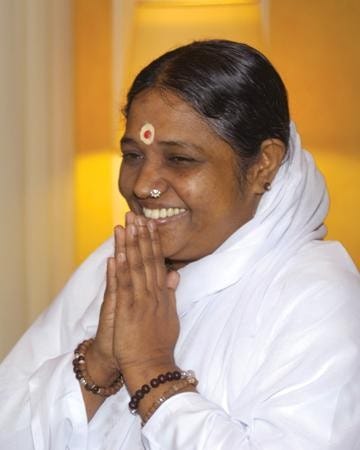
I had heard about Amma, but must say that I had never considered the possibility of visiting her or getting one of her hugs. That is until I mentioned on Facebook that I was going to be visiting India. My friend Angelo told me that he was already there, staying at Amma’s ashram, and he invited me to come and stay with him.
All right, then! I thought. I am going to make this visit and treat it as if I am a cultural anthropologist! I would observe and not get emotionally involved in the experience. Let’s just see how that goes.
Kochin to Amritapuri
Monday
I had been staying in Kochin, along the same (west) coast of India, about 74 miles away, to the north of my destination.
After taking the ferry to Ernakulam, I got a driver there to take me to the Ernakulam Junction railway station. I had no idea what the train schedule was, so I simply asked for the next train to Kayamkulam. Luck was on my side! There was a train leaving in about ten minutes, at 10:00. The clerk selling me the ticket said that the arrival time in Kayamkulam would be 13:00. The ticket for this three-hour ride was 25 INR/$.40.
There were no reserved seats on this train, so I had to take my chances in second class. Fortunately there were plenty of seats, so I didn’t have to stand.
At 11:11 we arrived at Allepuzha (Alleppy) and I was tempted to be impulsive by jumping off there, taking in the sights, and then getting a later train to Kayamkulam. But I had already been texting with Angelo and he was expecting me at 13:00.
At 11:59 we arrived at the largest station I had seen since leaving Ernakulam. I took a look to see the name of the station and to my great surprise, it was Kayamkulam Junction. The ticket agent working for the railway didn’t even know the arrival time of her own trains! No complaints, though, as I was happy to shave 1/3 of the time off the trip.
This was especially good because it meant that Allepuzha was only 48 minutes away, not an hour and 48 minutes away, so that would cut down on the travel time if I were able to take a day trip there.
The ashram is about twelve kilometers from the train station, and the taxi route was anything but straightforward. There seems to be a standard price of 230 INR. Angelo said that the drivers don’t overcharge here, and I have seen that to be true in Kochin, as well.
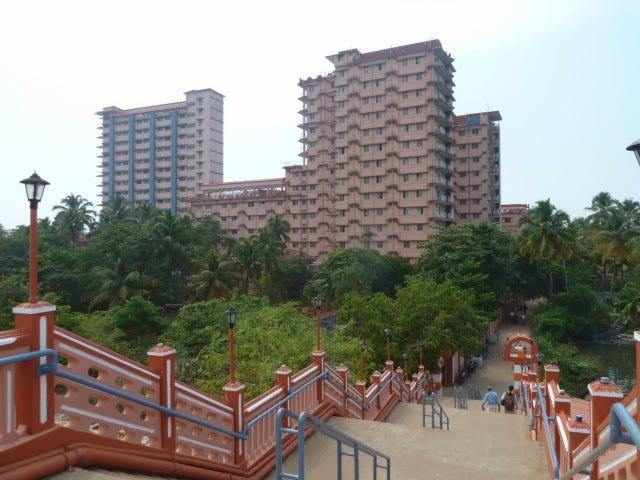
The driver let me off on the other side of a footbridge from the ashram — one that requires climbing a hefty set of stairs on one side and then descending on the other. Two boys (possibly about high school or university age) saw me struggling with my luggage and offered to help me with it. That was nice.
The first thing I noticed when I entered the ashram’s grounds was the signage prohibiting photography of any kind. It’s a pity, too, because that means I am going to have to be a lot more descriptive than usual, without the ability to illustrate with photographic examples.
Angelo had pre-registered me, so they had my information in the computer system at the International Desk. Part of the system here is that they keep passports in their office. That is fine with me, since I like knowing that my passport is in a secure place.
There are three thousand full time residents at the ashram, as well as thousands of short- and long-term visitors. The ashram accommodates some people who come for only one day; my stay of four days is considered to be short.
I received a little piece of paper with my room and building number, as well as the combination for the lock on the door. I was surprised at how far away the building is from the main gate. I would say it is the equivalent of at least three to four blocks. It’s a very large campus, which includes the main temple, prayer hall that is used as dining area, clinic, student dorms, and buildings with apartments for residents and visitors.
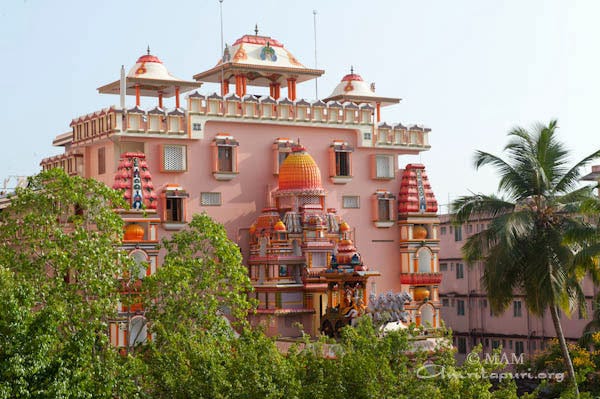
Along the way, every area I saw is under construction of some sort. There are new buildings going up; some buildings, such as mine, which are two stories high, are getting a third story.
I knew in advance that I would be sharing a room. It’s something that didn’t faze me when I was younger. But at my age, I would prefer to have a private room. There are some available, but I decided to go along with the program and be one of Angelo’s two roommates.
When I entered the room I could see what must be Angelo’s bed. At least he has a bed! The rest of the floor space was taken up by two mats on the floor. The one near the window had been taken, so that left me the one in the center of the room.
I opened my suitcase and, to maximize the amount of available floor space, slid my open suitcase and backpack under Angelo’s bed.
A quick shower was in order. In taking one, I could see that there were only two options available for the water: on or off. No hot or cold. Just on or off.
Once settled into my room, I headed to the large hall where lunch was being served. There is a huge amount of variety on offer.
The first option is the basic Indian meal, of which there is always one available at no additional cost because it is included in the daily price of the stay (250 INR/$4.03 — yes, you can really have full room and board here for under $5 a day). If for some reason that does not appeal, there is Indian food for which you can pay, and the cost is extremely reasonable.
On the Western side of the serving area, there are two meal options, and each of them is available at a cost: a basic daily menu in the Western canteen that changes daily and a cafe from which speciality items are available by the order (pizza, omelets, sandwiches, and an array of baked goods).
For this meal, I checked out the free Indian lunch, just to see what it would entail: rice with two kinds of sauces over it. I found it to be tasty. Somebody told me that many of the Westerners find it too spicy for their tastes, but I thought it was just right.
I made my visit to the seva desk to register for my seva (pronounced SAY-vǝ, meaning volunteer work that people perform every day). I was hoping that there would be a decent choice available, and there was.
My assignment is going to be to dry breakfast dishes from 8:30 to 9:30 each day. That sounds completely within my skill set. (How hard could that be?)
A posted quotation by Amma refers to the necessity for seva: “In this age of selfishness, selfless service is the only soap that truly purifies.” I concur. I like being part of a community where people see the need and value in volunteer work.
It is fascinating to take stock of the clothing that people are wearing. There is a variety of people as well as a variety of sartorial choices.
Basically, you have Indians and Westerners. Some Indians wear Indian clothing and some wear Western styles. The same goes for Westerners: some in clothing that would be typical of their home, and some in various types of Indian clothing.
Amma is always dressed in white. Many of her devotees follow her lead and wear all-white clothing.
The male Indian garment that is typical of the southern part of the country is the dhoti, which looks something like a skirt. Some men wear it full length so that it comes to their ankles, while others wear it half-length, taking the bottom and bringing it up to tuck around their waistlines.
I attended orientation at 16:00 and learned the basics of how things work around here. The guide showed us where the ATM is, as well as the laundry service. It’s nice to know I won’t have to wash my own clothing in a bucket.
Our guide also made a distinction between which water was drinkable and which was not. They are clearly marked as such. I wanted to be sure about something, so I checked in with him: So you mean we are washing our dishes with water that we should not be drinking?
Yes.
At the end of the orientation, we were led to the beach, where Amma was expected to make an appearance. There were already hundreds of people waiting there quietly, some in chairs and many on the ground. After a while we heard the announcement, “Let us meditate for some time.”
It was a calm atmosphere and beautiful, with the sun beginning to make its descent.
I was sitting with my eyes closed, when I could tell that there was a change in light. Even with eyes closed, I could see that there was less light now. It was because people were now standing up; Amma was arriving. She appeared with her entourage of more than a dozen people, including uniformed guards.
We sat for a while. I can’t remember how long; it must have been more than thirty minutes.
After the meditation concluded, we were invited to ask questions of Amma.
For the first question, a young man — evidently an animal rights activist and possibly a vegan — compared the treatment of animals to the treatment of people in concentration camps during World War II. He cited this animal cruelty and made it an issue because eggs and milk are allowed at the ashram. He wanted to know why Amma endorsed such treatment.
Until this point I was not sure what languages Amma uses and understands. The question took a lengthy translation, and the answer from Amma, in Malayalan, was also quite long.
Amma began by saying that concentration camp treatment is beyond comprehension; grief is still fresh in many people’s minds.
(Personally, it felt to me unnecessary for the guy with the question to cite any concentration camps to invoke mistreatment of animals for the production of animal-based food. The inhumane treatment of animals for the production of food is fairly common knowledge, though people who eat animals don’t like to think about it, or don’t care because they think that animals are on this earth for them to eat and enjoy.)
Amma said she never wants any beings hurt. She said that the eggs and milk are available only in the Western canteen because it is requested by what she referred to as her “Western children.” Some are on a diet as prescribed by their doctors. The eggs used here are only non-fertile, which she sees as not being a cruel practice.
She said that there is no fish here. The milk is not ahimsa (meaning that it is not injurious) — first the calf drinks from its mother and then the milk used at the ashram comes from the leftovers.
She went on to say that everyone walking and breathing is killing, though the animals we are killing when we walk and breathe are frequently microscopic. Even eating vegetables is killing.
Amma recommends avoiding eating meat because of water used and the greenhouse emissions caused. She concluded this question by saying that you can only advise people; you can’t force them to change their habits.
After the session on the beach, there was a gathering in the great hall for bhajan, which is the singing of songs, many of which were written by Amma.
Song lyrics were displayed on several screens around the large room. They were translated from the Malayalan, Hindi, and Tamil, to name a few languages. All had English translations at some point.
Some of what I saw were as follows:
“We seek shelter in the Mother who gives in abundance to all those who seek her with a burning heart.”
“O Holy Mother of Vallikkavu, we seek refuge in you….” (I didn’t get the rest of the lyrics.)
“Hail to the Lord of Shiva’s attendance. Hail to the Destroyer of obstacles.”
Upon seeing these lyrics, I realized that this was a point where I departed from the thinking on display. I see these “gods” and “goddesses” as fictional characters. It is my belief that it is useless to pray to beings that do not exist. If you have an obstacle, if you have a problem, it is your responsibility to take care of it to make your life better.
I didn’t have patience to sit very long through the bhajan, though I have to admit it may have been more enjoyable if I hadn’t seen the translations of the lyrics.
I headed to my room to settle in for the evening. I met my third roommate, Tanaka, a Japanese guy who didn’t offer his first name, just his family name. He also doesn’t speak much English. There are not many Japanese people for whom I would say that my Japanese is better than their English, but this is one of them.
By the same token, I have to admit that my best understanding of Japanese is only when I am the one speaking it.
Now, getting ready for bed, I was face-to-face with the most difficult aspect of my stay here: sleeping on a thin mat, in a room with others, under 86ºF/30ºC heat, with only a feeble ceiling fan.
Continued in Part 2


