
My Two Years as an Author
My book was published two years ago.
In January of 2021, I published Changing How We think About Difficult Patients: A Guide for Doctors and Healthcare Professionals. I have learned a lot since then, and I want to share a few thoughts.
It's never too late to develop an idea into a lecture, an essay, or a book. I took a lecture that I had written decades earlier and expanded it into a book after my friend Elaine suggested this notion to me as an aside. I had never considered writing a book before, and I did this at the age of 62.
The book was published by the American Association for Physician Leadership which has a small budget for promotion and marketing. Because the book was released during the Covid-19 pandemic and before the release of the Covid-19 vaccines, no in-person events were possible. Most medical conferences were being held virtually and I went about pitching myself, person by person, to as many as I could.
I published pieces related to the theme of the book in various places including the Washington Post, ACEPNow, Medium.com and Kevinmd.com. There were over 500 comments made in response to the Washington Post article in the first three days. After that, which was still before it appeared in the print version of the Health Section, no more comments could be added.
I never read those comments because I know from some previous experiences that people will use the opportunity to air their personal grievances and haters gonna hate. I already know that the expression of my world view on this topic will not please everyone. A lot of folks mis-interpret my titles and take umbrage at being labelled difficult. This is precisely my point; they should not be.
One lady, I’ll call her Deborah, sent a lengthy hand-written note to my home address. She explained, in earnest, why after a traumatic experience of abuse at the hands of a medical professional, she became anxious and yes, difficult. As she is aware of her unique needs, she notifies her healthcare providers about her needs to have a chaperone and open doorways. With communication and improved understanding, her requirements can be respected and met.
Deborah illustrated the very point that I try to illustrate in my lectures and writing on this topic. The fussy behavior or non-compliance in our patients or their families stems from the incorrect assumptions that we make about them and a general lack of curiosity. Why can’t Deborah be seen in a closed room?
Why doesn’t Mrs. Jennings make her dialysis appointments? Why does Mr. Collins not take the medication as prescribed? There is a reason. To find out, doctors and nurses must ask.
Dr. Bob Singer, a retired family practitioner, sent me a lovely essay titled: “Is Your Patient Non-Compliant? Or is Your Plan Incomplete?” I wish that I had thought of this myself. He writes,
“Non-compliance” is a chance to listen to your patients, to seek more information, to find out what they really think about your advice.
It is a chance to discover what your patients fear about your advice, what their lives makes following your advice difficult, what values they have that preempt your plan.
Believe it or not, your advice is usually not the highest priority in your patients’ lives.
You need to find a way to fit your advice into the schedule and priorities of your patient.
That is what it means to be patient centered.”
I am encouraging Dr. Singer to publish his essay so that his message will reach more physicians.
I am available to speak in person or remotely to groups of residents, nurses, and physicians continuing medical education conferences. My mission is to lessen the suffering around difficult patient interactions and to keep more of our colleagues practicing clinical medicine and nursing. For those of you who like to listen to your books, it is now available in an audio format narrated by a professional.
For non-medical folks who have a daughter, son, or nephew in the business who seems to be struggling, the book would make an excellent gift. It is so difficult to watch the discouragement of young people who have sacrificed so much and worked for many years to achieve the goal of an advanced medical or nursing degree. There are some useful behavioral changes they can learn about.
The struggles in the healthcare system that our country has adopted fall inordinately on our healthcare workers. I wrote about the moral injury they suffer when they know that the systems or practices, they are asked to perform are not correct or in the best interest of some sick or injured patient. Your nurses and physicians answer the call anyway.
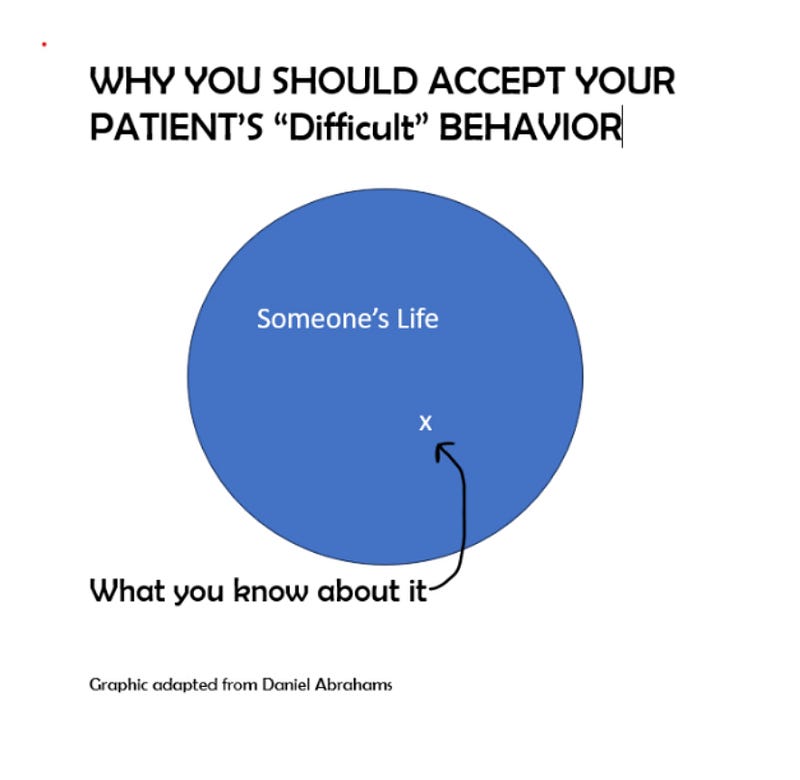
I adapted a graphic that I saw online, to sum up my take on this one issue of difficult patient interactions. It is natural for doctors and nurses to become defensive and judgmental towards the people who do not comply question us or act out. We need to ask more questions. With more understanding and practice, we can change our thoughts so that there are no difficult patients.


