THE MASTERPIECE INTERVIEW
“My Travel to Iran Made Me Realize How Wrong Our Perception Can Be About a Country if We Only Rely On the Media”~ Agnes Simigh
We should not judge any country based on its regime.
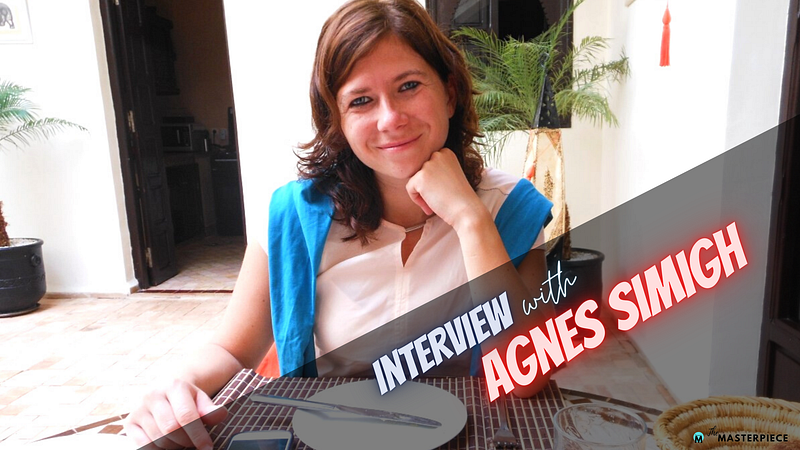
Hello and welcome everyone to another episode of The Masterpiece Interview.
Today we have Agnes Simigh with us. Agnes is a very passionate traveler who has already visited around 40 countries. She has been working as an international tour guide for the last ten years.
Though born in Hungary, now Agnes is living in Germany with her husband and waiting for the end of this pandemic madness to resume her traveling. We are very excited to talk to her.
So, let’s start the conversation right away.
Welcome to The Masterpiece Interview, Agnes! We are very happy to have you with us. How are you?
Agnes Simigh: Thank you for inviting me. I’m okay, but with many challenges ahead of me since the pandemic.
No doubt, the pandemic messed up everything! So, where are you living right now, and how are you dealing with the pandemic situation?
Agnes Simigh: That is a bit complicated. I worked as an international tour guide before the pandemic — taking Hungarian groups to countries like India, Malaysia, Iran, Israel, etc., for the last ten years. Suddenly my last trip had to be shortened. I literally escaped with my group from the United Arab Emirates as there were rumors that the country cancels all international flights as of the day after. Since I worked as self-employed, it meant that I had no job from the day I arrived home. In the beginning, I think we all thought it would last only maximum few months, and then everything would back to normal. But it turned out to last long, and I had to look for a job. My husband is German and had worked already for a year in Bonn. So it was evident that at least I stay with him, and I came to Bonn.
In summer, I started to look for a job, and now I’m working in an office full time. It is not what I really like, and I do miss traveling a lot, but at least I have found something to overcome this period while many face much harder times in less developed countries. I have friends in many countries, and I know how difficult it is for them.
It’s wonderful that you’ve finally got a job. As you’ve mentioned, many people lost their jobs during this pandemic, and it nearly ruined the travel and tourism industry. In my country, after losing jobs, many people even left the big cities and went to the countryside to survive and maintain their families. Anyway, can you tell us about the work you’re doing now in Germany?
Agnes Simigh: Yes, sure. I am not going into details on purpose as it is not something that fits my interest. I work in the call center of a fun park, making reservations and providing information. It was also affected by the pandemic, but I did not lose my job, and the government gave some support. Now, as the situation is better in Europe, we opened up again and work even overtimes. Things change quickly. There is nothing to be ashamed of about what I do now, but work is an essential part of my life. And I think it also remains when I will have a child.
Once you were lucky enough to regard your work as a passion, you know how rewarding is that. Work affects my mood, my relations with my family and friends, and my whole well-being.
At the same time, I benefited a lot from this period too. For example, I started a blog, and I invested in improving myself. I began to write, read a lot, and did courses about blogging.
You’re doing excellent. And it’s really admirable what the government is doing for its citizen in this dire situation. Anyway, as you said that you were self-employed for the last 10 years. That means you were your own boss. Now being in a job, how difficult it is for you to work under someone else’s supervision?
Agnes Simigh: Yes, it is totally different. I’m used to having big responsibilities and managing groups alone. Now I landed in a new country, and I never worked in the German language before. I only learned it in high school. Although my husband is German, we mostly speak English. It is financially much riskier to be self-employed but gives so much more freedom. Here, my holiday has to be approved and can get rejected. I just follow now. It just confirmed that I do not really want to work at a place where I’m just a “number.” But as it is all temporary, I can live with that.
Very well-said, Agnes. A free soul must struggle to cope up with an official environment and all those strict rules. We’ve noticed that you have a wonderful blog site, “Voice Of Guides” where you share your traveling experiences and insights. We’ve seen that you visited Asian countries extensively. Do you have any fascination for Asian countries (for any particular reasons)?
Agnes Simigh: My first far destination as a tour guide was India. It was not my choice; my boss assigned it to me when I was 26 years old. But I’m so grateful for that. I loved it. It is an incredible place with a strikingly different culture and taught me so much. It was the point when I became interested in far countries. Then I had a dream to go to Iran. I do not even know why. I just could not get it out of my mind. I traveled there alone as a backpacker, and I had a great time with one of the friendliest people on earth. Such hospitality is unknown in Europe.
My travel to Iran made me realize how wrong our perception can be about a country if we only rely on the media, and we should not judge any country based on its regime. Since then, I got attracted to less-touristic destinations. Often, they are more rewarding, because it something completely new.
I believe that every country is worth a visit and can teach you something. I do not travel just to see a famous monument but more to experience the life there. Again, my travels to Asia were not my choice, but I was happy about that.
You are so wonderful with your words and thoughts. You’re so right that what media portrays is not always right, and we must explore different lands to know people as they really are. I went to India six times; I can say that it’s a place of diversity and the people are amazing. Actually, people in every country have something to offer. I heard a lot about Iran’s and Pakistan’s hospitality (seen many videos as well), though never visited. Anyway, can you put light on some of the major differences in people’s mindsets between the two parts of the world — Europe and Asia? How are they different from each other?
Agnes Simigh: I do not think it is good to generalize the people in one country because there are different people everywhere. And traveling is the best way to change your mindset, become open-minded and respect people of all color and religion. Besides, Asia itself consists of contrasting countries. For example, India is a far cry from Singapore. Let’s take India as an example that is so special in every respect.
There is less privacy in India, for example, where more generations often live together, but family ties are also stronger. Lonely people are rare in Asia, while in Europe it is a big problem. They keep in touch with family members that we in Europe do not even know.
I have an example of how important is family for them. My friend in India had a brother who did not have a child for a long time, and the years just passed. My friend already had one and decided to have another baby and give it to his brother and wife. Since then, they are a happy mother and father. Such a sacrifice is not imaginable in Europe.
Also, even poor people are so generous with the guests. They invite you, offer you meals, give you a gift and take it as a pleasure. They are admirably selfless.
Men and women relations are very different. Europeans cannot imagine having an arranged marriage without deeper feelings. But the statistics do not prove that a love-marriage is more successful as every 5th of them end with a divorce.
Women in India are mainly subordinate to their husbands and men. They are often housewives, and the men and women roles are clear. In Europe, women have more chances to pursue a career, and they are mostly financially independent. In Asia, a friend, a family member is always welcome, while in Europe, you cannot pass by without announcing it in advance.
I also think that people in Asian countries are more satisfied with a simpler life, while in Europe, there is a rush for luxurious cars, apartments, the best TV, etc.
Well, there are probably a lot more differences but these may be the most obvious ones.
Very insightful! You’ve mentioned some of the core mindsets that people have in Asia and Europe. And the story of your friend you shared is absolutely amazing. Yeah, it’s right that all the people are unique in their own way and all that makes the world a beautiful and diverse place to live in. Anyway, now we want to ask more about you. May we know about your childhood, your parents, and the country you belong to?
Agnes Simigh: I was born in Eastern Europe, in Hungary. I’m 36 years old now. I had a perfect childhood with stable family background. I studied Economics in Budapest, the capital of Hungary, and worked as a tax advisor at a multinational company for a few years. I did not know what I wanted at that age, and I had good notes in every subject. Also, I was told to choose something secure and stable. So that is why I studied economics, which was in high demand at that time. I liked my job as a tax advisor, but I, even more, wanted to make travel a lifestyle. So I gave it up and became a tour guide. I never regretted it. I like it so much.
It is hard work but so much fun at the same time. I got to know my husband through my work as well. He was working in Switzerland in a hotel where I stayed with my group.
I had a very close connection to my father, who taught me to drive a car, to swim, to do ice-skating, even to play soccer, and took me to do horseriding. Unfortunately, he died seven years ago, which was extremely painful to me. You can say a “never healing wound.” But fortunately, I still have my mother, brother, and other family members around me.
I’m proud to be Hungarian, but there are some disadvantages to that. My language is not spoken in any other country, except the Hungarian community in the neighboring countries. It has no link to the languages of other Eastern European countries either. As English is not my mother tongue, it is an extra challenge for me. And we even need to learn more foreign languages to get along.
You’ve studied economics, worked as a tax advisor but finally decided to be an international tour guide. Fascinating! And, of course, deep respect for your lovely father. Losing a parent means losing an entire world. By the way, we are wondering — why did you get interested in traveling. Is it the freedom and the excitement of exploring the world? From your blog, we know that you traveled solo a lot. How difficult is it to travel solo? Can you share any interesting or dreadful event while your solo traveling?
Agnes Simigh: I was guiding already during my university time, so it was not new to me. My boss offered me the chance to make it a full-time job. And when I was in the office doing an extremely lot of overtime, including full Saturdays and till late in the evening, I just thought I’m still young, and that is the best time to explore. I was excited to be abroad. But I must say, it sounds much easier than it is in reality, both physically and mentally. It took a while until I decided to travel solo. But then I started with an uncommon destination, Oman. I was completely unprepared; I have to admit. It was a last-minute idea. I did not know that tourism is in its infancy in Oman, and public transportation almost did not exist. So on the spot, I had to rent a car, which I do not favor. First, it is not the best way to immerse in local culture. Second, it is stressful, especially driving and finding your way alone. But there was no choice.
The problem was that I got an automatic car that I never saw before. The agent who delivered the car promised to teach me quickly. So we made two rounds, and then he let me go. I did not notice that I got the car with an almost empty tank. Usually, it is not a problem, I stop at the next petrol station, right? But in Oman, there is only one in every 2–300 km, as I learned later. So I stopped at a hotel along the highway, and they gave me some petrol. Apparently, it is a common issue for foreigners. Omani people are very friendly. Later, I was even invited to a local family, and everything was fine.
This was my first solo travel, which gave me enough confidence to continue. It is not difficult to travel solo. As a woman, you should be more cautious, of course. But I do not remember ever having been harassed, and I only had a few unpleasant experiences. For example, I caught somebody trying to take something out of my jeans pocket, which could happen anywhere. Twice, I slept at the airport on the ground because my flight was canceled.
Solo travel improves your problem-solving skills and confidence. But it is not for everybody. You have to be that type of person who doesn’t mind being alone sometimes. Although, traveling solo does not mean that you are lonely. Quite the contrary. When you are alone, especially as a woman, locals will approach you, they are curious about you and offer their help. In Iran, I was invited several times by families to their homes. During bus journeys, they always talked to me, offered some food, and I got special care.
Especially in Iran, the kindness I experienced was overwhelming. But if you are not alone, locals will not “disturb” you; they think it is a couple who is just doing fine and does not need any company. So there is a real advantage in traveling alone.
I always take part in some local tours because it helps you understand the place more than just reading your guidebook. Some of these local tours are unforgettable. For example, a former policeman took us around in Sarajevo and told us about his memories of the Balkan war.
You are right that solo travel improves problem-solving skills and confidence. I do also prefer traveling solo. Before the pandemic, I traveled solo on an 11-day trip to South India. I think traveling solo opens up a lot of doors to explore the local culture. Though it can be lonely at times, overall it’s an amazing experience everyone should try at least once.
Agnes Simigh: I fully agree.
Now, tell us more about your husband. You were saying that you met him in a hotel while staying in Switzerland. Can you share the first meeting experience and how you two eventually developed feelings for each other (when you obviously had a huge language barrier)? What I know that Germans don’t really bother to learn English. Is that correct?
Agnes Simigh: Many times, yes. But as he had been working in tourism for a long time, he speaks English fluently. And he speaks French as well, almost like a native speaker. Honestly, I did not really notice him at first. He was a manager of one of the several hotels that I went to with my groups. He contacted me on Facebook, but I did not go to that hotel for a year after. When I went to the hotel again, he invited me for a drink. I did not show a lot of interest in the beginning, but then, things changed.
He is a very calm person who supports me in whatever I start to do. He motivates me and never expects me to give up my dreams. In the end, not a lot of men could accept a wife who is traveling a lot and sometimes does not see her for weeks.
I know it is something extraordinary, and I’m very grateful for him. Of course, the pandemic changed everything, and now we live like a normal couple.
He is indeed a lovely human being; supportive and caring. Now tell us about your writing journey. Exactly when did you start your blog VOG? Were you always passionate about writing or it’s just the pandemic situation that made you write online and create a blog?
Agnes Simigh: I did not really think about writing before. I never thought of being talented for that. Although by now, I understood that it is more a matter of practice. It is the pandemic that made me start a blog. I just thought I want to share my knowledge with others. There are countless travel blogs nowadays, but I thought as a tour guide, I may have a deeper insight that could make a difference.
First, I started in Hungarian and English, but it was too much work alone, and I made the conclusion that even if I’m not a native speaker, writing in English makes more sense for me. In some ways, it is easier for me because lately, I read much more in English than in Hungarian. I plan to make a full-time living from that. I probably cannot stand out with my writing style, but I hope the content can help others.
Being a full-time writer is amazing, though it takes way much time and hard work at first. But as you said — it takes a lot of practice and dedication. We really like your writings. I can recall a write-up that you’ve written about your visit to Comuna 13. It was brilliant. Anyway, have you tried other freelancing platforms like Upwork or Freelancer?
Agnes Simigh: I’m so busy managing my blog and try to publish on Medium that I did not think about that. But it is a good idea. I heard about them but haven’t checked yet.
It can be a great platform (especially Upwork) to find good clients and make a living by only writing. You can work on that later. Now tell us — when do you usually write? As you have a full-time job, it must be hard for you to find time to write for your blog and Medium.
Agnes Simigh: I had more time before when the park where I worked closed. Fortunately, the pandemic situation is better. So since the last few weeks, I’m back to full-time work. It is difficult now, but I use early mornings, evenings, and my days off for that.
As you traveled a lot, we think you have so much to share with other people. Do you have any favorite travel writers?
Agnes Simigh: You will be surprised that I seldom read books by travel writers, even if I’m interested. I’m more reading the books written by journalists that uncover the complexity of the conflicts in the Middle East, North Korea, Cambodia, Saud Arabia, and whatever I know less about. I like understanding the background of events and how people live in that circumstances.
It seems that you are very curious about world politics!
Agnes Simigh: Yes, I am. And to be a good tour guide, it is essential to understand the main events that shape the country. Even as a travel writer, sometimes just writing about a monument requires more profound understanding.
Now, we are at the end of the interview. Let’s have some quick questions.
Did this pandemic teach you any hard lesson that changed or enhanced your worldview? If yes, what is that? Agnes Simigh: The hardships forced me to create and learn something new, which hopefully will have a lasting effect on my life. It stimulated me to improve myself and opened new perspectives, which I wouldn’t have thought of otherwise. It also taught me who I can count on in tough times and how important it is just to ask each other: how are you doing?
It enhanced my opinion that it is essential to stay curious about different cultures, which gives a more complex way of thinking that I would not have without leaving my country. It is even more critical now when right extremist parties and groups get stronger enhancing racism.
How many countries you’ve traveled to so far? And which country would you love to go to again and again? Agnes Simigh: Not so many. Because due to my work, I return several times to the same places and I never counted. I would estimate it around 40. I would go back to India and Iran again and again. But I prefer discovering new places whenever I travel on my own.
What do you find most challenging while visiting a new country? Agnes Simigh: It depends on the country. In India, the traffic, noise, and crowd, in Senegal the quality of roads, in Albania the lack of a timetable for public transport, and many times the language. But everything is manageable.
Do you have any dream country that you are yet to visit? Agnes Simigh: I have a lot. I even want to visit your country, Bangladesh. But I’m afraid I have to wait a little bit with that. I would like to go to Lebanon, Armenia, Algeria, Azerbaijan, Pakistan, Ethiopia, and well, almost everywhere where I have never been to. As I said, every country has its value and is worth a visit.
Wow! That’s lovely, Agnes. Please do let me know when you come to Bangladesh. I would love to meet you in person. Agnes Simigh: Thank you! I will!
Do you have any life philosophy that determines your actions? Agnes Simigh: It is better to try something and fail than regret that you never tried when it is too late.
Tell us about your favorite foods Agnes Simigh: I like almost everything in every part of the world. But as I cannot get it so often here in Europe, I would say it is seafood! And to mention a Hungarian specialty, I look forward to having a fish soup again.
Now tell us about your hobbies. Agnes Simigh: Sorry, cooking is not one of them. I like doing sports like playing squash, horseriding, even playing soccer, but lately, I just went running as all that was not possible. I’m reading a lot and writing is my new hobby.
Favorite color? Agnes Simigh: Blue
Share your idea of a happy life. Agnes Simigh: Spending time with family and friends and getting new memories, collecting experiences rather than objects, always staying curious is vital to keep being motivated and having a young spirit, not being afraid of facing challenges and failing, always trying to improve yourself, being sensible for others’ problems and trying to help them.
That’s really insightful!
Anyway, that’s all. Thank you a lot for your time and patience, Agnes. You are an amazing person to have a conversation with.
Agnes Simigh: Thank you so much for the opportunity.
Dear readers, We hope you’ve enjoyed the conversation with Agnes Simigh. You may read her writings by visiting her Medium profile. You can also visit her blog site to know more about her travel experiences.
If you want to read amazing conversations like this one, you may check out other interviews by clicking the below image.

You can also share your outstanding stories and inspire others. Just click the below image and be a writer for The Masterpiece.