
My Top Ten Words to Use in Your Writing — Part 1
Go on, I dare you!
If you’re reading this, you’re obviously a Reader.
And, if you’re on Medium, there’s a pretty good chance you’re a Writer too.
Writers are always looking for the perfect words to illustrate exactly what they want to say, in the best, most efficient way possible. In fact, for a writer, finding the perfect word is sometimes akin to striking gold.

Well, guess what? I’ve found Ten of them.
If you’re writing history, you’ll find them easy to include in your article or your story.
But, even if you’re not, why not stray from the literary path and scribe dangerously?
#1 — Wanton Buffoonery
This is a phrase rather than a word, but it’s a perfect example of onomatopoeia, in that it sounds just like the thing it is describing: deliberate, unrestrained, sexual and ridiculous behaviour.
I fell in love with it when I studied the Black Death, the most serious outbreak of the bubonic plague in Europe from 1347–1351. I’m pretty sure the phrase was used in Boccaccio’s The Decameron when he describes the various reactions of the population to the plague.
Some decided to become ultra-religious and flagellated themselves with whips to atone for their sins. Some took advantage of the resulting anarchy and indulged their criminal propensities, while others turned to performing good works in the community.
But a select group of the population preferred to drink wine, behave licentiously and ‘engage in acts of wanton buffoonery’.
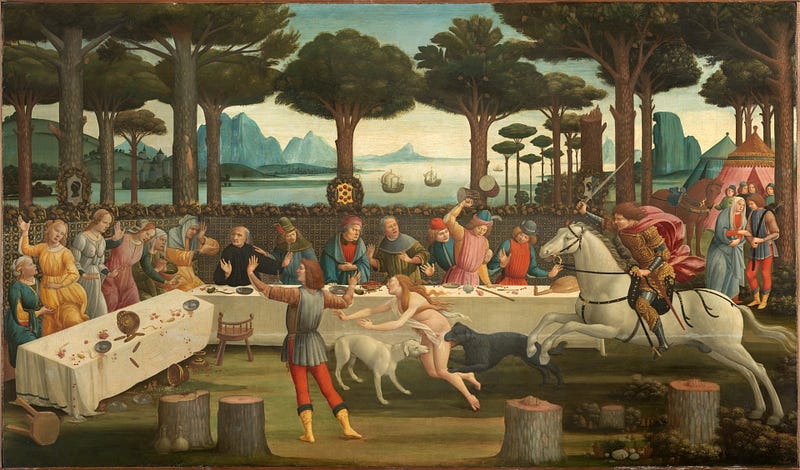
I loved this phrase so much, I actually used it in my novel An Abnormal Woman when my protagonist, the uptight Elizabeth, bemoans the unruly behaviour of the trial attendees at Martha Needle’s sentencing in 1894:
“There is a different atmosphere in the courtroom today — more buoyant, ebullient even… Men wink boldly at ladies sitting across the room and people call out greetings as though they are long lost friends.
I fold my hands in my lap, determined not to participate in such wanton buffoonery. There is a strong possibility that Martha Needle will be found guilty today and sentenced to death and this attitude of ghoulish, delighted expectation disgusts me.”
#2 — Jiggery-Pokery
Jiggery-Pokery describes dishonest and deceitful behaviour, and I found a number of references to it in old newspapers decrying the antics of certain politicians in the 1950s.
I also found a newspaper article from a West Australian newspaper in 1923 that reported the following:
“ARE THE PEOPLE’S PREMIUMS SAFE?
The jiggery pokery that goes on in the insurance world by which some people are able to live in luxury without working was partly exposed last week in the Melbourne Bankruptcy Court when a man named George J Bond applied for a certificate of discharge…”
#3 — Pratfall
Have you ever fallen down in public, landed on your bum and felt so embarrassed, you wanted the earth to swallow you up? That’s a Pratfall.

And the Pratfall Effect is a psychological phenomenon where making a klutzy mistake — rather than making you a laughing stock — can actually make you more attractive to others.
Social psychologist Elliot Aronson conducted a series of experiments in 1966 and discovered that people considered highly capable and accomplished became more likeable when they had a pratfall and embarrassed themselves in public. He concluded that because these ‘superior’ people were regarded as ‘superhuman’, a red-faced moment enabled others to see them as more ‘human’ and therefore appreciate them more.
Interestingly however, this phenomenon applies mostly to males. Women, on average, tend to prefer the less awkward and, unfortunately, if a person is already considered a bit of a boofhead, they actually became less attractive when suffering a pratfall.
For me, anybody who laughs at themselves after a Pratfall always get my vote!
#4 — Bumfuzzle
This word was used relatively recently by President Bill Clinton where he was quoted in The New York Times in 1999 as saying:
“I can imagine the American people must be totally bumfuzzled; keep announcing surpluses and we keep having budget fights. That’s what’s going on here.”
Bumfuzzle is another great example of onomatopoeia as its definition is exactly what it sounds like: to bamboozle, to confuse, to fluster, to perplex.

How about you? Have you been Bumfuzzled lately?
#5 — Blatherskite
We all know one of these.
Blatherskites suffer from diarrhoea of the mouth and constipation of the brain.
The official, kinder definition of a Blatherskite is “a person who talks foolishly at length.”
In 1899, The Catholic Press in Australia referred to a certain ‘canting crank’ who went by the name of Mr Champness and appeared to have ‘taken up the sorry calling of an itinerant blatherskite.’
The same newspaper accused Champness of ‘intruding his personage on the public and inflicting the people with empty harangues about his own great merits.’
He sounds a lot like some of the politicians I know! 😉
The next five words are coming soon…