
My Top 5 Skills to Future-Proof My Career
I recommend these needed human skills that AI can’t replace

Like others, I think much about the future of my career, my children’s careers, and the careers of those whom I coach.
- How to stay ahead of massive workplace shifts induced by AI?
- How to best use our time now to prepare for future uncertainties?
- Will entrepreneurship be a good option for everyone?
Having worked as a LinkedIn data science manager for almost 12 years, and as a career coach, I believe strongly in the value of continuous learning for people to stay agile and grow in their careers. However, some skills are more worthwhile to learn than others.
Whether you’re pursuing entrepreneurship or staying an enterprise employee, let me share with you what I’ve researched and concluded for the best skills to learn to future-proof my career, and probably yours too.
Skills Selection
I want to choose skills that will last a lifetime. I want to prioritize things and activities that compound to grow exponential effects over time. Some skills are more useful than others.
What skills do you think will still be important to people 100 years from now? What skills were important to people 100 years ago? Those distinctly human skills will always be important to people no matter the changes in technology and society.
I like how Dale Carnegie studied people and summarized the value of timeless human communication and leadership skills.
“They came to me because they had finally realized, after years of observation and experience, that the highest-paid personnel in engineering are frequently not those who know the most about engineering. One can, for example, hire mere technical ability in engineering, accountancy, architecture or any other profession at nominal salaries. But the person who has technical knowledge plus the ability to express ideas, to assume leadership, and to arouse enthusiasm among people-that person is headed for higher earning power.”
― Dale Carnegie, How to Win Friends & Influence People
Research Into the Future of Work Augmented by AI
Even now in the new age of AI, think tanks, researchers, and employers all point to the importance of workers to develop key soft skills as AI augments technical capabilities.
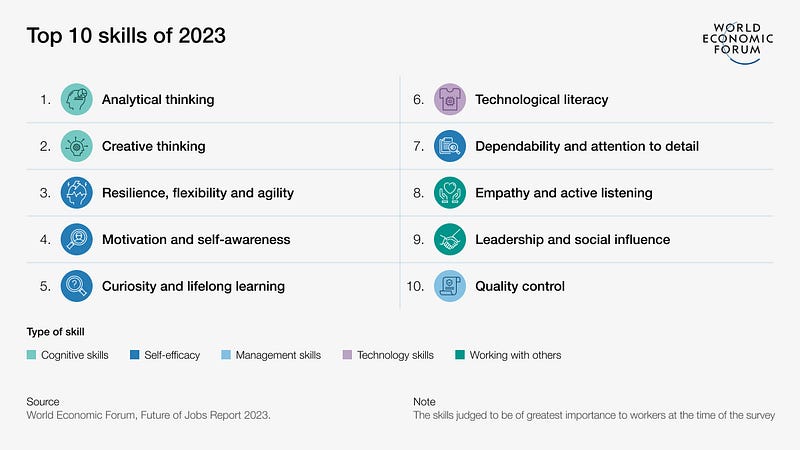
World Economic Forum’s “Future of Jobs” report (Apr. 2023): Top skills in 2023 are analytical thinking and creative thinking according to companies.
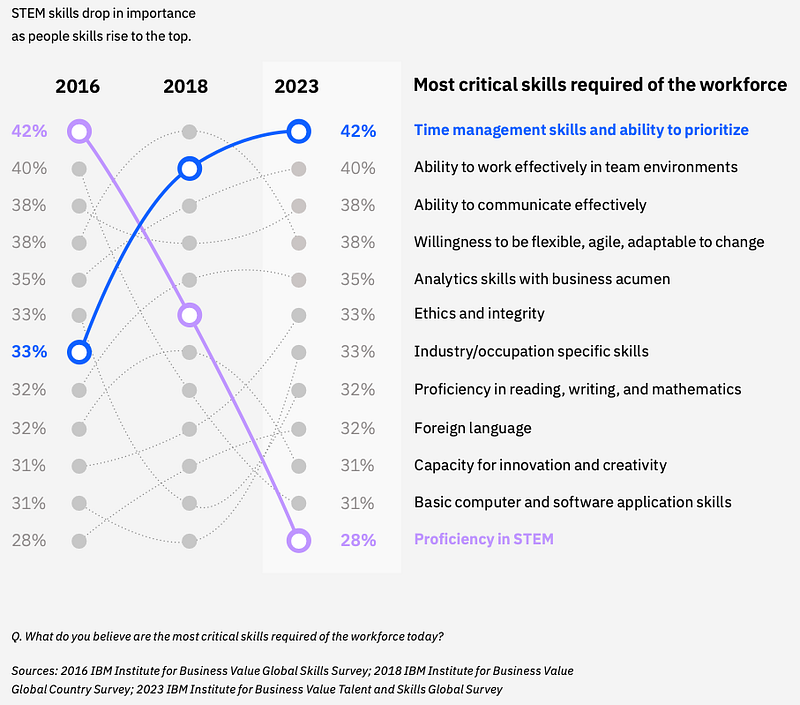
IBM’s “Augmented work for an automated, AI-driven world” report (Sept. 2023): Executives no longer prioritize STEM skills (science, technology, engineering, math) as they did in 2016. Instead, in 2023, executives value people skills as the the most critical skills required of the workforce today, while STEM and technical skills drop down to 12th place as AI capabilities advance.
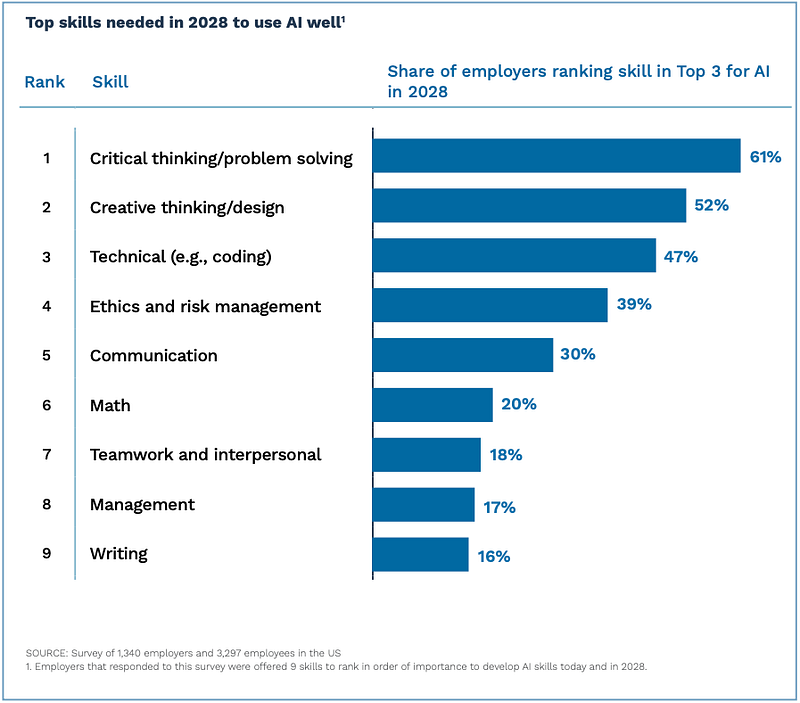
Amazon’s “Accelerating AI Skills” report (Nov. 2023): Employers say “Critical Thinking/Problem Solving” and “Creative Thinking/Design” are even more important than technical skills in using AI well.
Top 5 Valuable In-Demand Skills to Learn
With those research data, here’s how I would prioritize the skills to learn to future-proof all our careers. I believe these are the top 5 best in-demand skills that AI cannot replace:
- Prioritization Skills
- Leadership and Teamwork Skills
- Communication Skills
- Analytics and Critical Thinking Skills
- Agility and Creativity Skills
1. Prioritization Skills
As we’re always limited by resources and time, a permanent core skill is the ability to prioritize well.
Businesses need workers at all levels, from executives to interns, to prioritize limited resources and time.
- Which projects to fund?
- Which budgets to slash?
- What do I work on today?
Ethics in society is also often a matter of prioritization and tradeoffs between competing interests and values. How do you prioritize different goals between different people and different needs, such as national security versus individual privacy?
Even when assisted with AI, we still need people to judge and prioritize good outcomes versus bad outcomes. Is that AI-generated image of a 6-legged dog an aesthetically pleasing artwork or an absolute abomination?
Beyond art, AI designers face a life-or-death decision when they consider the trolley problem for self-driving cars, that need human prioritization.
We’ll always need humans to make the tough prioritization decisions.
Learn more: How to Make Prioritization Decisions
2. Leadership and Teamwork Skills
Wherever there are people, organizations require leadership and teamwork skills.
Both the global corporate executive and the neighborhood grassroots sustainability champion use leadership and teamwork skills. They both need to influence and collaborate with others to achieve something bigger than their individual selves.
We don’t need a manager job title to be a leader. In any case, we need to build trust to bring people along with us in a shared common vision.
People trust people. Authenticity matters. AI can’t replace these human EQ and relational skills for leadership and teamwork.
Learn more: 6 Leadership Skills You Need for Business Success
3. Communication Skills
Our ability to communicate with people will amplify our prioritization, leadership, and teamwork efforts. This skill is always needed.
Generative AI tools will generate more quantity of content for everyone, with the quality regressing towards the average. A skilled communicator will still be essential for brands to rise above the noise.
Skilled communicators know how to use ethos, pathos, and logos from classical Greek rhetoric to persuade people. Generative AI will not automatically produce credibility and authenticity for people, but can assist those who use it effectively.
Effective communication includes not just writing and speaking but also listening and empathy. Listen intently to others, including coworkers, customers, and collaborators, and they will consider you to be a skilled communicator.
These communication skills will help us with any career of the future.
Learn more: ‘Soft skills’: The intangible qualities companies crave
4. Analytics and Critical Thinking Skills
The world today runs on data. The volume of data in the world will grow exponentially to 175 zettabytes by 2025 per IDC. Businesses need to sort through all that growing data for actionable insights to drive business outcomes.
All business functions, whether operations, R&D, sales and marketing, finance, IT, HR, or even legal, will need people with data skills. Basic data literacy will be expected of all workers, from nurses to paralegals to video producers.
Businesses will need descriptive, diagnostic, predictive, and prescriptive analytics to make sense of the collected data and to put them to good use.
Our analytics skills will combine with our prioritization, leadership and teamwork, and communication skills to understand and optimize the best outcomes for the business.
AI and other advanced data techniques can make data collection and processing easier, but we’ll still need people to analyze the data with critical thinking skills and to drive business relevance.
Learn more: What is Business Analytics? Core Skills and Career Paths
5. Agility and Creativity Skills
In an increasingly fast changing world, businesses need agility to respond to new market conditions.
Employers expect 44% of workers’ core skills to change in the next five years per the World Economic Forum Future of Jobs Report (2023). Employers will value workers who embrace continuous learning with a growth mindset, and who are flexible to adapt to new technologies, processes, and even roles.
Aside from agile learners, individuals who can lead during times of chaos will be indispensable to the business.
“The linchpin is an individual who can walk into chaos and create order, someone who can invent, connect, create, and make things happen. Every worthwhile institution has indispensable people who make differences like these.”
-Seth Godin, Linchpin
Beyond traditional functional work like engineering and marketing, I anticipate enterprises will dabble and embrace new organizational structures relying on AI bots to perform creative tasks. Be ready for functional knowledge workers to transform into a new breed of product managers to dream up new creative ways to lead virtual teams of AI bots to create new innovations for the company.
“New enterprises of the future may resemble a coalition of internal entrepreneurs who use virtual teams of AI agents to quickly develop products to serve new niches with the backing of the overall enterprise.”
-Jimmy Wong, AI Jimmy
Agility and creativity would be crucial for enterprise employees, as well as entrepreneurs, to adapt quickly to ongoing business changes.
Learn more: The impact of agility: How to shape your organization to compete

My Personal Experience
Since the late 1990’s, I’ve learned to build web apps using PERL, then PHP, then JavaScript, then Python, and now with no-code systems. My thick how-to books on each new programming language and framework quickly went obsolete.
Amazingly, software code can now be generated using ChatGPT and Copilot and other AI tools, using a natural language interface for prompt engineering.
For me, each technical programming skill was needed for only a few years before new higher-level technologies became available.
Starting in college, I also accumulated business, leadership, and communication skills through leading clubs and volunteering in organizations. These soft skills enabled me to become a technical business manager. Continuous learning in these areas, including volunteering and leading in Toastmasters clubs, allowed me to compound and grow valuable lifelong skills.
From my experience, certain skills are useful for relatively short periods of time, while other skills continue to grow in usefulness for an entire lifetime. As we need to have a balanced mix, I also recommend people to build skills as a T-shaped or Pi-shaped professional to balance their depth and breadth of skills.
Final Thoughts
I tell myself, my children, and the people that I coach that we must grow certain skills in order to stay relevant in the fast-changing industry.
With AI increasingly being used for repeatable technical work, professionals should consider developing their soft skills such as empathy, communications, leadership, prioritization, and critical analysis in order to stay relevant.
We’ll always need people to prioritize problems worth solving and to dream up new ways to solve them. Launching those big ideas will also require people skills.
In summary, my strategy is to pick in-demand skills that will serve me for a lifetime. I recommend people to future-proof their careers with these valuable lifelong skills:
- Prioritization Skills
- Leadership and Teamwork Skills
- Communication Skills
- Analytics and Critical Thinking Skills
- Agility and Creativity Skills
Whether or not you agree with these specific skills, cultivate a growth mindset for continuous learning anyway. Always be learning at any age, to prepare for a better future.
Enjoyed Reading This Story?
Get notified when I publish a new story: subscribe for free
Originally published at https://www.aijimmy.com. Feature Image by wayhomestudio on Freepik


