
My Top 10 German phrases
That are hilarious in English
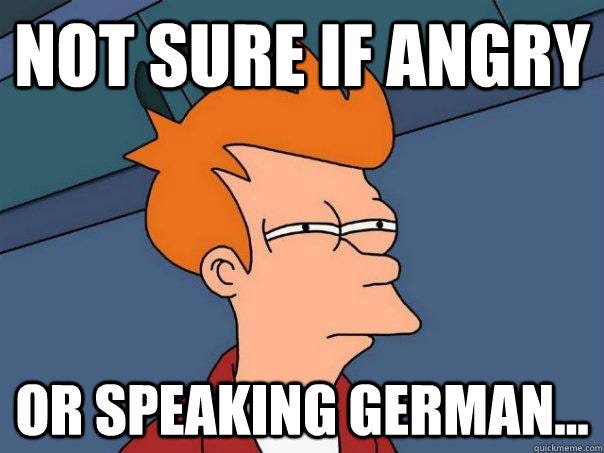
So, you have spent sometime online and most probably know by know that the internet loves to joke about how unfunny German language is and how it sounds very angry and serious.
I remember this video in which multiple people say the word “hospital” in their native language, French, Spanish, English, Italian and then comes the German with his Lederhosen and beer and screams “KRANKENHAUS” to the camera in a very exaggerated way. After seeing such videos you would think to yourself: “Wow, with such an angry language no wonder Germans have no humour!”. Well my friend, you are very wrong!
My experience with German has multiple phases, the most iconic two phases are: This is such a systematic language!, This language is just funny!
To explain the systematic aspect of the German language you should know that in German you derive new words by means of compounding (that sounds complicated, I know). A word in German can be built by combining two or more words (written together with no spaces in between). For example:
Handschuh (glove): Hand (hand) + Schuh (shoe) — Gloves are called hand shoes in German.
Schildkröte (turtle): Schild (shield) + Kröte (toad) — shielded toad is the official name of a turtle in German. But for some reason a slug is just a naked snail:
Nacktschnecke (slug): Nackt (naked) + Schnecke (snail).
This makes German a very easy language to understand for new learners, because they can guess the meaning of the compounded words, from the original ones. This also allows Germans to be creative with their words, “Donaudampfschifffahrtselektrizitätenhauptbetriebswerkbauunterbeamtengesellschaft” is considered one German word with 80 letters (because the Germans can).
But for some reason, Germans use the weirdest idioms in their daily life. If you are new at learning German and you hear these idioms, either you will laugh uncontrolled or you will have the weirdest most bizarre look on you face. and here are my top 10 idioms in German:
Du gehst mir auf den Keks
English: you go me on the cookie
Meaning: you drive me crazy
Ich verstehe nur Bahnhof
English: I understand only train station
Meaning: i don’t understand
Das Leben ist doch kein Wunschkonzert
English: Life is not a request concert
Meaning: you can’t always get what you want
ich zeig’s dir, wo der Frosch die Locken hat
English: I’ll show you where the frog has its curls
Meaning: I’ll show you how it is done
Unter aller Sau
English: under all pig
Meaning: it is very bad
Ich glaube, ich Spinne
English: I think I spider
Meaning: I cannot believe
du hast nicht alle Tassen im Schrank
English: you don’t have all the cups in the cabinet
Meaning: you’re crazy
ich glaube, Mein Schwein pfeift
English: I think my pig whistles
Meaning: Blow me down
Alles für die Katz
English: everything for the cat
Meaning: all for nothing
Klappe zu, Affe tot
English: close the lid, the monkey is dead
Meaning: end of story!


