
My thoughts on DataCamp after 58 courses and more than 305k XPs
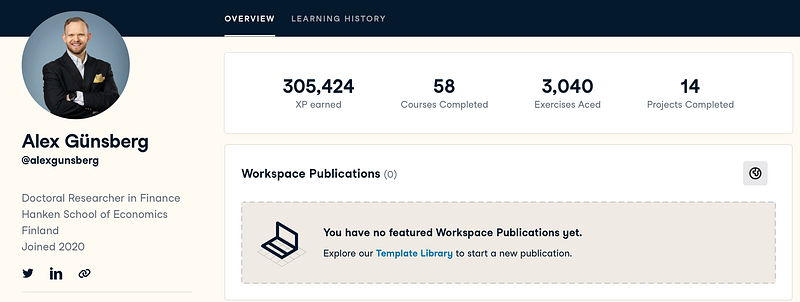
In 2020, when I started my journey as a Data Scientist, I was completely new to coding and Python. Just like anyone, I also had many doubts in my mind: am I cut out for it? I always get excited initially, but does the excitement run off before I’m good enough to have any actual use of the skills? What would be the optimal way to learn? How long will it take to be good enough?
I read tons of reviews and reasoned that I could become good enough in Data Science within one year to get hired into a position. After all the reviews, I became aware of the different learning platforms. DataCamp felt like the most convenient platform to get something done every day. In my opinion, a low threshold to earn some XPs every day is one of the keys to success. It’s all about learning a habit of doing.
Nevertheless, I felt a lot of uncertainty about their teaching methods throughout the way
Many reviews criticised DataCamp because users only fill in blanks here and there. They argued that it wouldn’t be enough to learn Python. I can happily say that it was an unnecessary worry, but it planted many doubts in my mind back then. Honestly, in practice, the programming side of Data Science is primarily knowing the essential things like syntax, comprehending the code that you read and having the ability to restructure it for your particular case. The rest is mainly about knowing the correct key terms to make good google and StackOverflow searches. Some comments and reviews from people from a Computer Science background fail to see this side of things.
I can’t write enough praises about DataCamp. It has been the foundation of my journey to becoming a Data Scientist. However, writing about the positive sides is inherently dull for curious minds, so let’s focus on the deficiencies DataCamp possesses. These are the things you’ll need to learn outside of DataCamp.
Let’s start by taking a glimpse at how DataCamps is structured
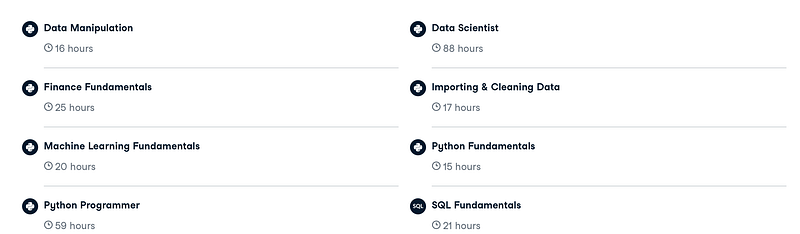
As DataCamp proclaims the required hours to complete Skill and Career Tracks, my work sums up to 261 hours. In addition to these Career and Skill Tracks, I’ve done courses outside of the tracks and completed 14 projects:
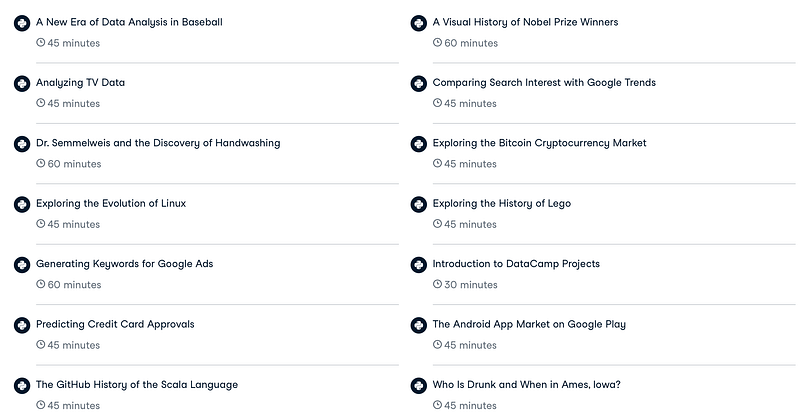
I won’t cover each of the courses separately here. Still, if you’re interested, you can review them in my DataCamp profile https://www.datacamp.com/profile/alexgunsberg under the Completed Courses section.
The estimated times to complete Tracks or Courses on DataCamp are severe underestimates
The Skill and Career Tracks include several overlapping classes counted towards the total hours, whether you’ve only done them once. On the other hand, most courses take significantly longer (50–100%) than four hours to finish, given that you genuinely want to learn and understand the code. In rare cases, a course can be very fast to complete, but mainly only when you do a Track that includes some elementary modules.
With very few exceptions, DataCamp claims that all Python courses take four hours to complete and typically include four modules. The first module is accessible to free and paid subscriptions, so I think the first module is made very much lighter than the rest of the course modules by design to work as bait to free users to upgrade.
The things you shouldn’t expect from DataCamp
All-around responsibility for your learning path and development
- Most learners are used to schools and universities that take full all-around responsibility for the student’s development. Hence, learners rightfully expect the same treatment from DataCamp, but unfortunately, that is not the case.
- DataCamp limits contents to cover only things they can contain 100% in their environment. It’s understandable to a degree as they are doing business. Still, educating people comes with a great responsibility, which sometimes requires educators to see beyond maximum short-term profitability. After all, the top learners will be brand ambassadors for the rest of their lives if they are happy enough.
Use of internet resources like Google, Stackoverflow, Google Colab, Datalore etc.
- Yes, searching for the right things with the proper terminology is a considerable skill and arguably the most crucial skill for a Data Scientist.
Being outside of the comfort of the DataCamp environment.
- The new Workspaces feature in DataCamp might have alleviated the issue a bit. However, I still remember how intimidating it felt even to look at how to set up a simple Python environment on my computer. I hadn’t even heard of Google Colab or JetBrains Datalore at that point because DataCamp completely omits all practical things.
- The same issue applies to cloud-based infrastructure like AWS Sagemaker and other similar Data Science tools, which are hugely popular in most workplaces around the globe.
Object-Oriented Programing
- Currently, there’s one course about Object-Oriented Programing, but that will only give you a very shallow understanding of it. In real life, you won’t be able to apply the OOP principles to any of your projects after solely relying on courses on DataCamp.
IDE use
- When and why it is sometimes a brilliant idea to use an IDE?
- How to use an IDE efficiently?
- Is there a difference between IDEs from a Data Science perspective?
- Are there some best practices for IDE use for Data Scientists
Statistics and Math skills
- Although I think the expected statistics skills in average Data Science positions are relatively low, you still need more than you get from DataCamp.
- It would be responsible for DataCamp to recommend lessons on Khan Academy, Brilliant or YouTube as a part of their curriculum.
Lack of specialised skills in packages like Pandas and NumPy
- Functions like”’ .apply’”, “‘.applymap’”, “‘.map’”, “‘np.where’”, or matrix operations in NymPy are on their own hugely important and you’ll need to learn them from other sources.
As a more general note, the direction of the DataCamp curriculum development has deviated from the initial purpose
- I signed to DataCamp for the sake of Python. Back then, DataCamp had focused very heavily on R and Python, but these days they have started to shift resources to some more mainstream data analyst content like Tableau and Spreadsheets. The shift in focus is a deficiency for more advanced learners as we are hoping for more advanced content. Especially now that I’m in academia, it would be fantastic to get more Python content related to Scientific Research and perhaps means how we can avoid the need to switch over to R.
Concluding thoughts on DataCamp
After reading all this, some of you might be discouraged to sign up for DataCamp, but don’t be. I’m still a satisfied paying member and a fan, and I still take courses on DataCamp.
Also, thanks to DataCamp, I landed my first Data Science trainee position after a few months of intensive studying. Even though it undoubtedly helped to some degree that I had a background in statistics via my M.Sc. in Quantitative Finance, DataCamp was the real key here. It took less than a year for me to land a very well compensated full-time Data Science job, and I mostly have DataCamp to thank for it.
Now that I’m doing my PhD and my time for other studies is minimal, I haven’t been able to do as many XPs on DataCamp as I hoped. Nevertheless, I’m still an active Pythonista, and without the Python skills, I wouldn’t have survived my Doctoral Studies. At least in our program, you need Matlab, R, Python or Stata. There is no way around it.
When I think about the past and compare it to my current viewpoint on DataCamp, my perspective has changed entirely. Now that Python syntax feels like my second nature. I use DataCamp to get an overview of the most common features of packages that are new to me or whenever I want to recall some of the libraries that I don’t use that frequently. Commonly, packages include some quirky things and package-specific terminology that are impossible to guess, yet they might be completely essential. Knowing what terms to use in your google searches will save you countless hours when you run into problems with your code. Doing reasonable google searches might sound like low-value stuff to you right now, but I can’t emphasise enough how vital that is.
Would I do something differently?
I would consider doing the Data Engineer Track instead. At least here in Finland, currently, the job market might be even better for them. The engineering skills will unlock new possibilities for you to work on your personal projects. Also, in my experience, many employers hire Data Scientists without knowing that Data Engineering is a different job, so you are expected to do a lot of the stuff anyway.
Another thing to consider is your current abilities in statistics. If a company is looking for a genuine Data Scientist, then the need for statistics skills is much higher than you’ll learn on DataCamp or in a short time. Blindly applying statistics or Machine Learning without understanding the intuition or skills to interpret results won’t get you far. So if you are not already beforehand somewhat proficient in statistics, I would highly recommend that you start with the Engineering Track and then expand your knowledge to Statistics and Machine Learning.
Besides the above considerations, I think my path is a straight copy/paste path for anyone.
I’m currently focusing my studies on the statistical details of the Machine Learning Models, especially from a Finance perspective. I’m interested in learning more about OOP on the Python side, which will unlock a whole new efficiency level.


