
My Tattoo
One-breasted women are beautiful, too
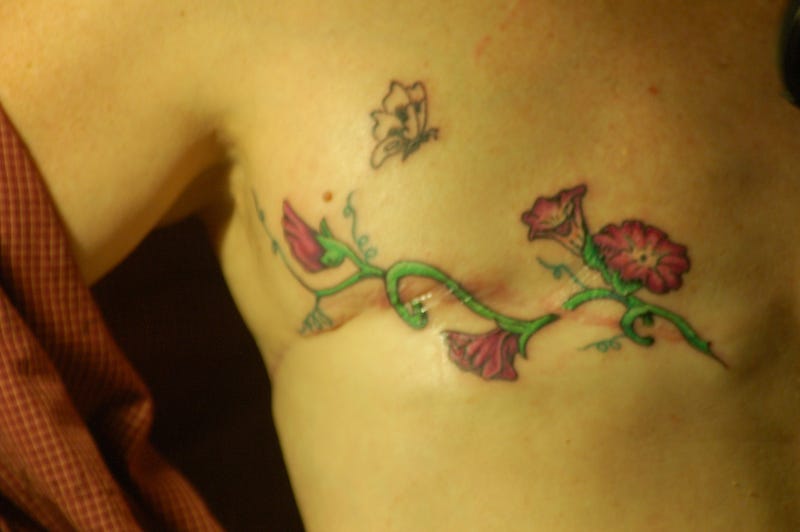
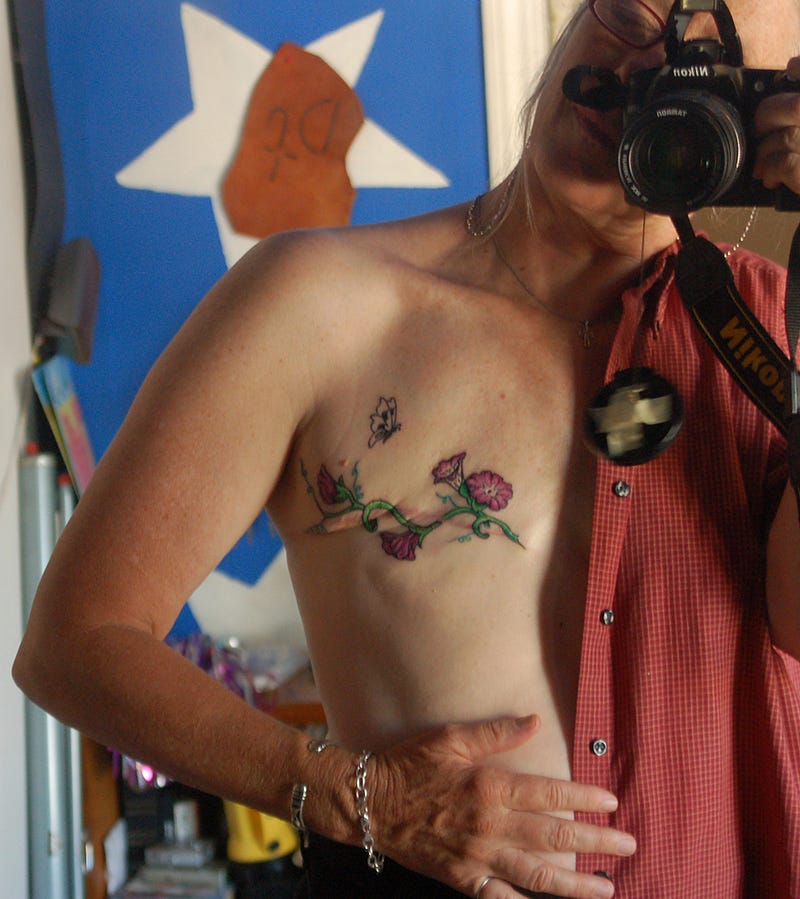
My favorite (and only) tattoo covers my mastectomy scar. When the doctor told me 14 years ago that I had cancer in my milk ducts and would need to have my left breast removed, I was given the option of a reconstruction, but after looking at pictures online and talking to women who’d had them, I decided against it.
One problem was it extended the expected time in surgery by five or six hours. I was already frightened to be put under anesthesia for hours while they removed my breast, and I didn’t trust that no mistakes would occur if they doubled my time in the operating room.
Another problem was women reported that they had no feeling in their reconstructed breasts. One said she felt like she had been hit by a truck; her entire chest would be numb for the rest of her life.
There’s also the fact that some reconstructed breasts become hard. I remember hugging my friend’s mother in my youth and feeling two hard lumps poking me from under her blouse after she got her breasts enlarged.
And then there’s the nipple. They can’t put it on right away. So signing up for reconstruction is signing up for two surgeries, minimum, unless you want nipple-less mounds like Barbie. And if anything goes wrong, it can take many more. One woman showed me her beautifully reconstructed breasts, done by a top plastic surgeon, then told me it had taken 17 surgeries to get them. That was more than I was prepared to endure.
I was also bothered by the potential loss of my belly button. One way to surgically make a breast is to take the fat in your belly and move it up to your chest. Then the surgeon fashions you a new button. Although I almost never think about it, I realized while considering this option that I feel a loyalty to my bellybutton — the physical manifestation of my former connection to my now-dead mom.
The other way to surgically make breasts is to insert baggies of silicone into your chest. Mastectomy patients must go in multiple times for doctors to put in larger and larger spacers which stretch out your skin. Once the right size is achieved, you still aren’t done. You must get the baggies swapped out every 10 years or so. Plus, the nipple (see above).
None of this sounded appealing to me. But there was a medical reason for my decision, too. If they found my cancer had spread, and I’d had the reconstruction, they would have to wait longer before starting chemotherapy, which would put me at greater risk.
I remember discussing breast reconstruction with my family after the surgeon mapped out the options. “If it were me, I would get the reconstruction, because I’m still young and my sex life is important to me,” my daughter said. “But I don’t think you should, Mom, in case you need chemotherapy right away.”
“My sex life is important to me, too!” I cried. And of course, it is. A big fear I had at the time was that my husband Mark would no longer find me sexually attractive with only one breast. He assured me that he would, but how could he know? I remembered hearing that my father had vomited after seeing my mother’s one-breasted chest the first time. But lucky for us both, Mark’s prediction proved true. One night, years after the surgery, I asked him if he wished I still had two breasts. “No,” he said. “That would be confusing.” :)
There were times, at first, that I missed my left breast and considered again getting reconstructive surgery. In California, you can decide that you want reconstruction at any time, even decades after a mastectomy, and your health insurance company is required to cover it, thanks to Representative Jackie Speier. But now, 14 years after my surgery, I don’t miss my breast any more. I often pass my hand over the flat area of my chest affectionately. And recently, when I went skinny dipping in the little north fork of Big River near Mendocino, I noticed that I didn’t feel self conscious at all.
I owe that body acceptance to my tattoo. It was inspired by a wonderful photograph I’d seen of poet Deena Metzger, with her arms flung joyfully to the sky. She had just one breast, and one beautiful tattoo. The poem she wrote to go with it begins, “I am no longer afraid of mirrors…”
Thank you, Deena, for sharing that image and that poem back in the dark ages, when women were more ashamed of their bodies. It lifted and held me in my own dark time, and prompted me to design my own restorative tattoo, wrapping greenery around my scar, and visually proclaiming my allegiance to life.
My tattoo features morning glories, a prolific purple flower that I love, and sweet peas, which the artist suggested because she was good at drawing them. And there’s a butterfly, too, to bring me luck and signify transformation from illness to health. Now, 14 years later, I’m not only a breast cancer survivor, I am an unashamed woman with an non-standard body and a beautiful tattoo.
**For more by Patsy Fergusson, visit Fourth Wave.