
My Take on The Divisive “Saved by the Bell” Sequel
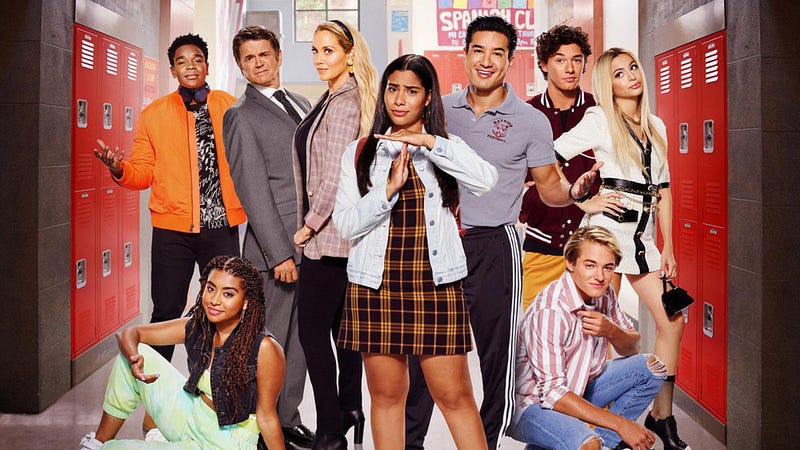
Last month, NBC/Universal’s new streaming service Peacock debuted a sequel series to the iconic teen comedy Saved by the Bell, which ran in various iterations from 1987–2000. Developed by Emmy-winning 30 Rock writer Tracey Wigfield, the sequel has the same setting and brings several familiar faces back, but its markedly different style and tone have been divisive, with some giving raving reviews and others decidedly unimpressed. Here’s my take.
The Origin
Although it may have seemed wildly out-of-left-field and woefully unnecessary to some, there are actually three reasons that reviving Saved by the Bell in 2020 actually makes a lot of sense.
- Reviving sitcoms from the 1980s and 1990s has been a major trend over the past few years. Roseanne (subsequently The Conners after the star’s firing), Will & Grace, Fuller House, and Murphy Brown are just some of the examples. It was only a matter of time before Saved by the Bell was considered for revival.
- This past summer, NBC/Universal entered the very crowded streaming market with their new service entitled Peacock. Although we are still learning about what factors lead to the thriving or withering of new streaming services, we know that new content that builds on pre-existing brands and content that appeals to multiple age groups are helpful for success. A revival of Saved by the Bell ticks both boxes.
- The show has endured in popular culture. A pop-up restaurant dedicated to the show called Saved by the Max has been a hit in both Chicago and Los Angeles. Debates about the series’ merits and values continue to proliferate on social media (for example, see the popularity of the satirical web series Zack Morris is Trash). And, importantly, much of the cast has shown a willingness to revisit the series as evidenced by their reunions in in recent years for events like a People Magazine cover shoot and skits on The Tonight Show with Jimmy Fallon.
With this context considered, it is not particularly surprising that Saved by the Bell was revived this year. What was surprising to many, is how it was revived.
Click below for other articles about Saved by the Bell by this author:
Nostalgia Done Right: My Night at the “Saved by the Bell” Pop-up Restaurant
The Setup
The new version of Saved by the Bell is not a simple revival, in which we check in on the same characters many years later (a la the aforementioned Will & Grace, Roseanne, and Murphy Brown series). Nor is it a reboot in which either the same premise and setting is preserved but the focus shifts to new characters or a whole slate of new actors taking over the roles of the same characters (like in countless comic book TV and movie franchises). It is officially called a sequel and is in essence a hybrid of revival and reboot in which some original cast members return but are secondary to the new batch of students.
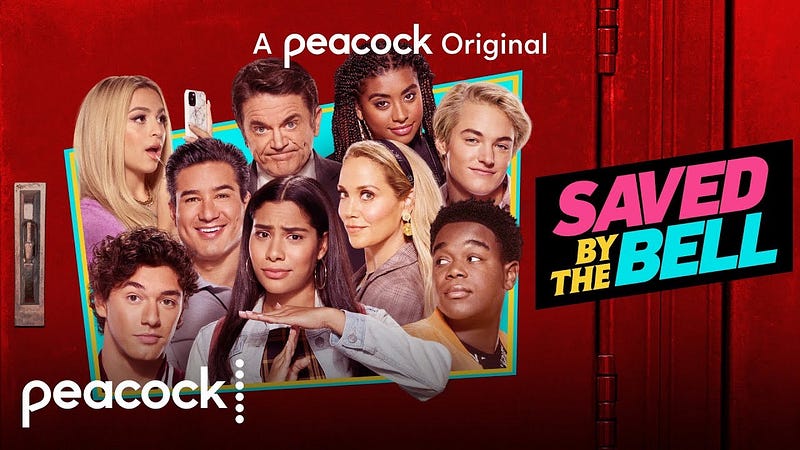
But the introduction of numerous new characters is not the only way the new series differs from the original. There is also a major shift in style and tone. This is not surprising given that it was developed by Tracey Wigfield, an Emmy-winning writer of 30 Rock, Tina Fey’s fast-paced, zany, audacious, and highly satirical NBC sitcom that wrapped in 2013. Wigfield brings the same approach to the Saved by the Bell revival. As opposed to focusing on gentle humor aimed at pre-teens and using familiar tropes and set-ups, it features rapidly paced, sharply observant, and occasionally aggressive humor that makes pointed social commentary and frequently mocks the original series.
To illustrate the differences, let’s compare the setups of the two series. The original Saved by the Bell was about an unlikely sextet of high school friends dealing with a variety of academic, family, and social stressors. They were overseen by a kindly but flustered principal and some occasionally present parents. The new Saved by the Bell has a much more complex and edgy plot. Zack Morris, now the right wing-leaning governor of California, has controversially cut the education budget leading to many underfunded schools being closed. This results in a number of marginalized students (mostly those who are poor and racial/ethnic minorities) being forced to endure long bus rides to ritzy (mostly white) Bayside High where the integration proves challenging. Sure there is still a sextet of high school friends dealing with a variety of academic, family, and social stressors. But they are doing so in a much more complex and controversial context.
I believe firmly that whether people enjoy the new series (spoiler alert: I did enjoy it immensely) will largely be determined by the following three issues:
- The nature of their nostalgia for the original series. Many people have deep affection for the original series. After all, that’s why it’s being revived. But most people realize that it is hugely dated and has highly problematic themes, an over-reliance on juvenile humor, and illogical plot progression. Those who were fine with this and want to see more of the same will be disappointed. Those who concluded that in order to exist in 2020 the show required a huge makeover will be more open to it.
- Their preferred style of humor. The rapid pace, zaniness, pop culture references, visual gags, and elaborate satire that marked 30 Rock and mark the new Saved by the Bell are certainly not everyone’s cup of tea. There’s a reason why the shows that have heavily relied on that style (Arrested Development is another example), were awards magnets and cult favorites, but never gigantic hits in the ratings.
- Their comfort with putting diversity front and center. The fact that the U.S. public education system (and the country in general) remains economically and racially segregated is a touchy subject. And based on the number of people who turned out to vote for the Trump/Pence ticket, many don’t believe that it exists or see it as a problem. Putting these issues front and center is a bold move and will certainly turn off many.
The New Class
As mentioned, although the show does feature many familiar faces the focus is largely on seven fresh faces. Although all seven characters are very well cast and performed, there are some problems with the way they are conceptualized and written. Let’s go from weakest to strongest.
The most problematic are rich kids and Bayside veterans Jamie Spano (Belmont Cameli) and Mac Morris (Mitchel Hogg). The writers heavily over-rely on one-note characterizations of them as beautiful but dumb and spoiled and scheming (respectively), with minimal character development. At best, they come off as amusing but hard to root for. At worst, they are genuinely unlikeable. Both characters get some nice moments toward the end of the season, but it’s a struggle.
Then there are the ones that generally work quite well, but still have room for considerable improvement. These include the main character, overachiever Daisy Jimenez (Haskiri Velazquez); her best friend, female football star Aisha Garcia (Alycia Pasqual-Pena); and hapless but well-meaning Principal Ronald Toddman (John Michael Higgins). All three have a unique comic persona, come off as fairly likable, and get moments of texture and depth.
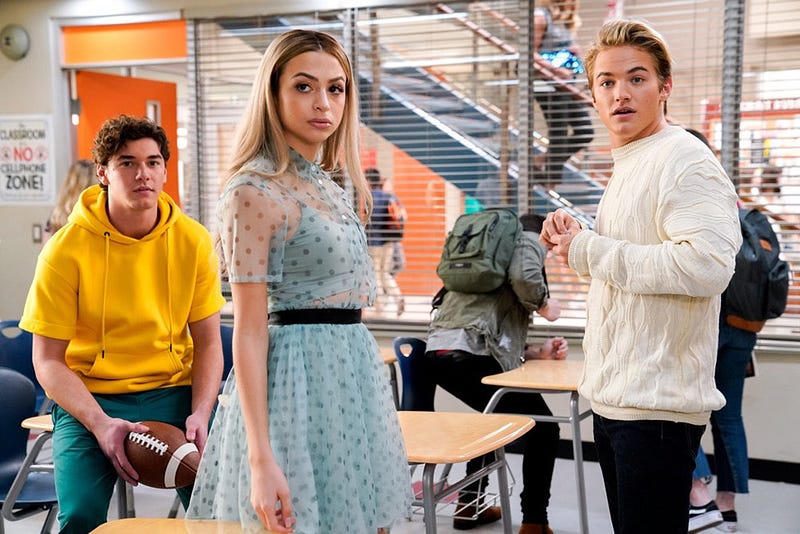
The two best — by far — are Lexi Haddad-DeFabrizio (Josie Totah, who co-produces the series) and Devante Young (Dexter Darden). Lexi identifies as transgender and recently transitioned, but even though that makes her a rarity in the television landscape, that’s actually one of the least interesting aspects of her character. She is a major influencer with big Hollywood connections who has exceptionally clever schemes and a cutting pop culture reference for every situation. The first season follows her evolving journey to be a better and more authentic person and Totah nails every single moment. Devante has the look of a linebacker, a beautiful singing voice, and a history as a troublemaker, but the first season follows his desire to break free from his self-protective isolation and learn the benefits of being vulnerable. Although he is way too old for the role (the actor is 29 playing a high school sophomore), he nails it.
The Alumni and the Throwbacks
Explaining who from the original series does and does not come back is a bit complicated. Let’s first start with those that return in a full-time capacity — Elizabeth Berkley as Jessie Spano and Mario Lopez as A.C. Slater. Both integrate into the sequel in natural and interesting ways.
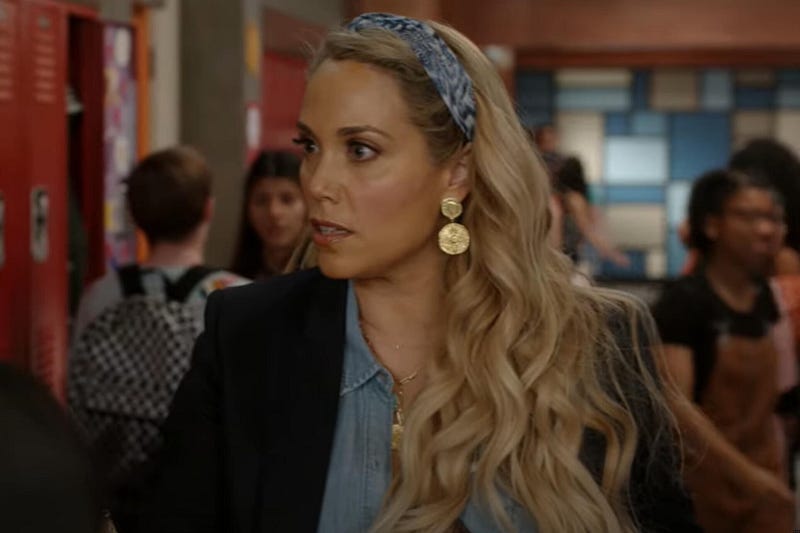
After the events of the original series, Jessie went off to get her doctorate in education and has now returned to her alma mater to be the guidance counselor. Although she seems wildly overqualified for the role, it makes a bit more sense when you see how overly enmeshed she is with her son Jamie (who attends Bayside and is one of the main characters). She is in a rapidly disintegrating marriage with a self-centered writer (recurring guest Cheyenne Jackson) and remains close with high school sweetheart Slater. Although Berkley’s reputation took a nosedive with her Razzie-“winning” role in the notorious 1995 bomb Showgirls, a recent rewatch of the original series reminded me of how charismatic and talented she has the capacity to be. She is remarkably winning in her return to Bayside, appearing more relaxed and demonstrating sharp comic timing and well-calibrated dramatic instincts.
Slater doesn’t appear to have done much since his time at Bayside, where he is currently the football coach. Mario Lopez (who, it must be said, has aged spectacularly) does a strong job of playing a man at a crossroads. He is finally coming to the realization that his cocky, narrow-minded machismo and inability to move on from the “glory days” of high school are preventing him from moving forward in life. He is charming and surprisingly tender in his scenes and is chemistry with Berkley remains firmly intact.
Mark-Paul Gosselaar and Tiffani-Amber Thiessen return in a trio of episodes as the iconic couple Zack Morris and Kelly Kapowski. They don’t get nearly the screen time or character development that Jessie and Slater do, but they are integrated into the show in two important ways. As mentioned above, Zack is now governor and it is his policies that have led to the school integration that serves as the catalyst for the show’s conflict. Furthermore, he and Kelly are the parents of Mac, one of the show’s main characters. The little character development Mac gets involves his desire to get attention from his father.
The characterization of Zack and Kelly in the sequel sparked anger in some. They are portrayed as out-of-touch elites, consumed by romantic passion and a desire for fame and power at the expense of their child, their former best friends, and the well-being of their constituents. Kelly, clearly having given up on her dream of going to medical school, is a self-help guru pushing pseudoscience (naturally enraging Jessie). When Zack and Kelly reunite with Jessie and Slater for the first time in years and come face-to-face with the heartbreak of their son in their final two appearances, they get some texture, but they are generally a bit vapid. Yes, it can be sad to see characters you loved go down a bad path. But, it is by far the most realistic outcome. Zack has always been an out-of-touch elite whose desire for power and money came at the cost of morality and ethics and Kelly has always been too willing to give up her dreams and follow him. As unsatisfying as it may be, it is definitely not some radical re-characterization.
Lark Voorhies FaceTimes in for a fun cameo in the eighth episode, briefly reprising her role as Lisa Turtle. Lisa appears to be living her best life as a prestigious (and polyamorous!) fashion designer in Paris. Screech and Mr. Belding are never seen, but are mentioned. We never find out where Mr. Belding is, but Slater notes that Screech and his robot Kevin are currently residing at the International Space Station. And then there are some bit characters from the original series that re-appear. Max, the magician who runs the ubiquitous local burger joint and Mr. Dewey, the droll teacher, appear a couple of times. And Troy Formin, who recurred as dumb jock Ox toward the end of the series, has a cameo.
There are also some truly wonderful references to memorable moments from the original series. These include, but are certainly not limited to, Zack’s giant cell phone, Kelly’s fling with Jeff, Slater’s dancing, the times Casey Kasem showed up, the oil spill, Jessies addiction to caffeine pills, the gang’s trip to Hawaii, and Jessie’s activism. The sequel may not re-evoke all of the same emotions as the original, but the show has clearly been brought to life by people with a deep knowledge of (and appreciation for) the original.
My Take on the Show … and its Future
I have gone through a variety of stages regarding the idea of a Saved by the Bell revival. When I wrote my article about my visit to Saved by the Max, I explicitly said I had no interest in seeing the series revived. Admittedly, though, when they announced the revival and its exceedingly clever premise, I became intrigued. Well let’s say it was cautious optimism. When I read good buzz about the series shortly before it’s launch, I finally became excited.
Ultimately, I truly enjoyed the new Saved by the Bell. It is certainly not perfect. It took me a while to warm up to most of the characters and a few of them still need a lot of work. Admittedly, I was also disappointed that outside of Jessie and Slater, the original characters don’t get much screen time. There also isn’t a single episode that coheres perfectly; each is a bit uneven in its own way.
But there are pluses. A lot of them. The majority of the cast is quite strong, with Josie Totah, Elizabeth Berkley, and Dexter Darden giving truly inspired turns. Also, the episodes are genuinely funny. Even when the shtick with the students veers too juvenile or broad, there are enough absurdly satirical moments and clever pop culture references to elicit laughs. And, as mentioned, the throwbacks to the original series can sometimes be subtle and brief, but they are there in abundance for die-hard fans of the original series.
Ultimately, I believe this is the best (and, frankly, the only) way that Saved by the Bell could have been brought back in 2020. The original was too much a product of its time and most of its fanbase has far outgrown its themes and humor. Tracey Wigfield and colleagues have kept the setup, the setting, and some of the characters while sending it tonally, thematically, and aesthetically straight into 2020. The show is an audacious experiment and the fact that it comes so close to working so well is an achievement in and of itself.
I am optimistic that the Saved by the Bell sequel will be given at least one more season. It looks like Peacock is successful enough to stick around but it hasn’t launched any major originals (Brave New World, the high-profile show they launched with, is already canceled). Right now the Saved by the Bell sequel is the only original series with buzz on the streaming service, so it seems like they will give it another round.
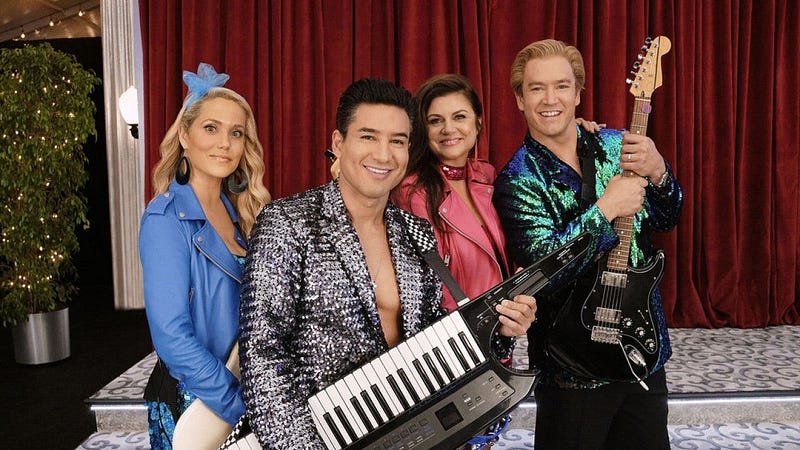
If there is a next season, I would like to see it develop the teen characters personalities, back stories, and inter-relationships more. At the end of the day, how appealing and invested viewers become in the new characters is what is going to determine the show’s success. I would also like to see them push the envelope even further with their subject matter, humor, and satire. They have already skillfully executed something quite risky, and they have little to lose and much to gain by pushing them further.
Regarding the original cast, I would love to see the hypothetical next season show Jessie and Slater fumbling toward reunion as Jessie navigates a comically messy divorce. I would love the show to explore the dynamics of the Zack and Kelly’s family with more nuance and show them getting closer to Jessie and Slater. An arc where Lisa returns to LA and interacts with the gang would be mighty welcome. Dennis Haskin’s Mr. Belding could come back for a one-off as he as honored as the school’s longtime former principal. And, Hell, I’d even take a return from Dustin Diamond’s Screech — maybe he could come back to Bayside to do a talk to the kids about his time in space.
But, honestly, what I really want to see is Leanna Creel’s Tori return in a satirical episode that delves into one of the original series’ greatest mysteries — the disappearance of Kelly and Jessie for ten episodes and their replacement by the school’s motorcycle riding newcomer. (Zack mentions her in one of the season’s final episodes and it is one of the cleverest moments of the sequel). I’m still not over that yet.
In sum, the new Saved by the Bell is certainly not for everyone. But is is audacious, clever, nostalgic, and edgy. And, for the most part, it works.
Click below for recent articles about television and streaming by this author:
A Festive Guide to 2020’s New Christmas Streaming Options
Love, Victor: A Precious Pride Month Gift