
My Strange Technology Career
Lessons learned from bottle to bus, Babbage to boat

You never know what life will bring you. I didn’t. I’m going to tell you a little about my career and the lessons I learned. Those lessons may help you, especially if you want to run your own business.
It’s a long-ish read because I’ve been around the block a few times and so it’s a road trip, but if you don’t have the time for a full read then I’ve summarised my lessons learned at the end of this article.
1974. It was a time of change and excitement. I had a bachelor’s degree in Physics and a master’s in Oceanography. And no career. I was working as a short order chef in a restaurant while I pondered the future.
None of the obvious career options attracted me and I didn’t have the intellect for research. Others had insight into Schrödinger’s equation. I didn’t, but I could empathise with his cat.
I was newly married and needed to pay the bills, so I followed in the family footsteps and became a milkman. Borrowed money and bought a small business. Maybe madness, maybe not, but it started me on a journey.
By 1978 the business was growing and I was bored witless, physically punished by the 2 am starts and the physicality of almost 40 miles a day on my feet.
I see the light and start my journey
Then one day I saw the light. I wasn’t on the road to Damascus. And it wasn’t really a light. It was a magazine in a newsagents shop. I can’t remember the name of the publication, but it started me on a journey, my strange technology journey.
I started researching hobby computers. In my small town nobody knew what they were. I read everything I could about them, devouring all the magazines, the only source of information in those days. Then I discovered that the local technical college was running a course on Information Technology. Cobol and punched cards.
I’d had some contact with punched cards during my masters degree, using Algol mainframe programs and paper data tapes to analyze sea water salinity/temperature/depth profiles in the Irish Sea. Leading edge stuff. Then. Something to do with the risk of Russian nuclear subs hiding under a thermocline, although I didn’t know that at the time.
But I now had an almost all-consuming intellectual interest in hobby computers and finally, I made the decision to buy a machine. The first Apple was on the UK market. Way too easy. I’d always done things the hard way. And I still had milk to deliver.
The S100 bus
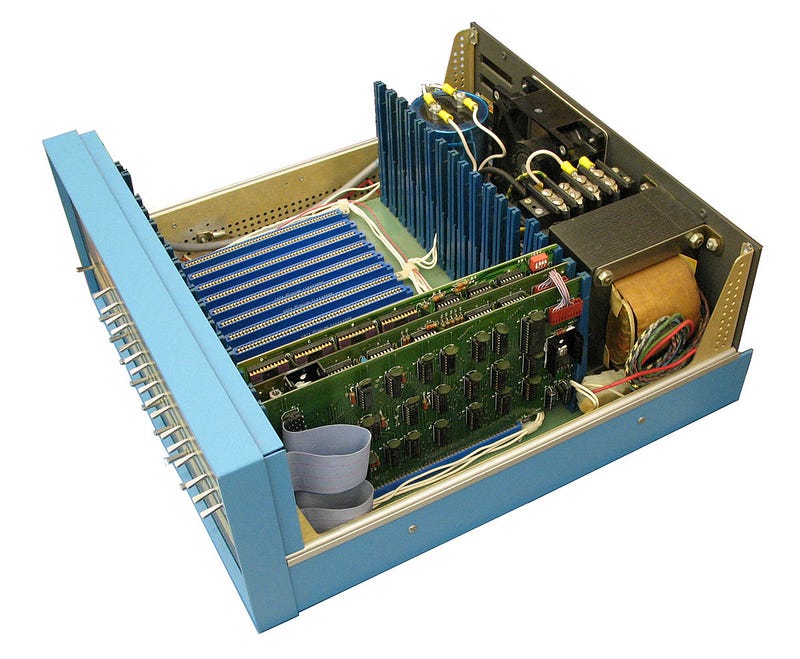

I opted for the S100 bus design. I liked the idea of plug and play — that is, buy a back plane and plug a selection of boards in. Altair, North Star and Digital Research were big names in those days. A local company had started importing the boards and selling kits to universities.
So, I bought and built. I soldered every dip mounting to every board, every capacitor, resistor and dipswitch. Yes, dipswitch, not dipstick as some people called me. I inspected each joint with a magnifying glass, I slotted in all the memory chips and the CPU. Then I assembled the cabinet and fitted the power supply, mounted the disc drives.
What a spec! Twin 8” double-sided floppy discs and 8K of RAM. Yes. 8K of RAM (4 million times less than I now have in my phone). With a Z80 CPU and the CP/M operating system to run it all.
It took a couple of months of work to put it all together.
And it worked first time, but I had no software to run on it except a stone-age version of Startrek. To boldly go…In 8 K of RAM it was a very small universe indeed.
Into retail
Things went on from there. I got myself some more RAM (wow 16 K now); I started writing code in Microsoft Basic on my S100 machine developing a software package for the dairy industry. Getting to grips with random file access and learning to save every byte.
I planned the code as I planted bottles on doorsteps, then started using the software in my business. It was successful and my rounds-people loved it, but like all great inventions it was too early in the wider market.
By now I’d opened a retail outlet for PCs and started selling the BBC Micro plus a load of other PCs such as the Commodore VIC (never the Spectrum), but I didn’t enjoy being a shopkeeper and home computers were becoming a commodity. Margins were thin and working capital demands painful for two businesses. And the mid-life crisis was looming. It came and went, and I moved on. Another step on the journey.
And all the time I was devouring information, reading textbooks, learning.
The focus moves to B2B
My eyes had been opened. Again. Business to Business, B2B, was the way to go. I liked the idea of selling my time as well as hardware and software. Time has good margins. I set up an IBM PC Dealership with a computing friend (and others) who’d been developing business software on IBM System 36 minis. He knew what multi-user was. I didn’t. More courses were required to get the dealership— IBM PC Sales and Marketing, PC service engineering. I did whatever was necessary — and more.
TABS? Who remembers them? They were the first software company to advertise in the UK’s Sunday Times Magazine. I think their advertising strapline was ‘Keep TABS on your business’. It was groundbreaking stuff. I did their qualification courses and learned about accounting systems stock control and order processing, then started selling their software and writing mods to their business suite; I developed a specialised order processing system for an electronics manufacturing client, with BOMs and components requirements forecasts. But it was still single-user. Networking was very new and very flaky. TABS couldn’t make multi-user work reliably over networks.
I saw that the only way forward for us was true multi-user. We weren’t geared up for IBM or other minis with their proprietary languages and the need for high capital investment to buy a dealership and send people on more courses on technical sales.
So, next came Unix System V on the Altos 68000 platform, and by now — 1984 — I was writing code in ‘C’ and we became a dealer for a leading Unix software suite in the UK, Tetra. More courses. A local manufacturer bought a multi-user system project from us. We developed an MRP package for them then built it out for distribution with truck loading schedules, manifests and routing.
And I learned some tough lessons in programming, almost stopping their factories because of a coding error, my coding error. Well, the US Atlas program blew up a rocket because of a misplaced semi-colon. If it was good enough for them, then…
Major change
By now I’d sold the dairy business. Knowing more about accounting at an earlier stage would have made that business experience much less painful. If you aspire to running your own business then learn about accounting early on. Strangely though, the hours were still punishing with overnight test-runs, lest I stop any more production lines. And I’d also fallen out with my partners. Another lesson — make sure you have control else the business strategy becomes a camel — that is, a horse designed by a committee. So, more new steps. International steps now.
I joined the local office of an accounting firm. They wanted someone who could talk IT to their small business clients. I could do that in spades, I could empathise with the small business entrepreneurs — after all, I’d slept nights with 2 bank overdrafts. The firm sponsored me for an MBA.
I did some projects with public sector clients — the Health Service and government agencies. There’s a saying in rugby ‘forget the ball and get on with the game’. In other words, the politics was more important than the organisation’s objectives. At least that’s how it looked to me, coming from a small business background.
Opportunities led me to many countries with manufacturing clients, governments and even a royal family. My time was now a commodity sold by a large international firm. There were many interesting projects such as testing a Wang-based dual English/Arabic personnel and payroll system for a government in the Middle East. Try that for size — hit a button and the screen is in Arabic. Then I worked on share auction systems in Moscow after the USSR collapsed and their industries were being privatized. Yet another foreign language to try to learn.
When asked why he robbed banks, John Dillinger famously replied ‘Because that’s where the money is’. And so I started working in Scandinavian banking systems for a US software company. I was also hoping that I might experience some of that much-vaunted ‘Swedish free love.’ No such luck. And I did not rob anyone!
It was at that time that I nearly met my end off Long Island. I was on my way back to London, 2 planes behind flight TWA800. I’ve read a lot of the technical stuff surrounding the event, and the official version just doesn’t stand up as far as I am concerned. The plane was hit by a missile.
After that came several years of projects in investment banking and manufacturing & distribution as a freelance.
And now I live on my boat and write. I write articles, techno-thrillers and, occasionally, marketing material and sales proposals for IT consultancy companies. So, I’m still on the technology road, but certainly more cynical. And now I’m definitely worried about our future with AI in the ascendency. And I don’t mean artificial insemination. Or maybe I do.
So it has been a strange — and lucky — technology journey for a milkman. And for a writer, too, I guess.
And the lessons
These are the main takeaways from my (sometimes painful) personal experience:
- Grab at every learning opportunity — courses, books, videos. You never know when the knowledge will come in handy
- If your employer will not give you raise then try to get them to sponsor you for an MBA. Some would say MBAs are devalued, everyone has them. The knowledge and techniques you learn will prove invaluable if you want to run your own show. And you get to meet interesting people and new ideas
- Be flexible. If you have the chance of overseas work then take it. The assignments will add breadth and maturity to your ‘legend’
- Don’t shy away from learning a few words in a foreign language, or even mastering one
- If you’re working in IT development then adopt the mantra ‘Test, test, test, then test again’. If you don’t work in IT then still remember the importance of testing in all business processes
- If you aspire to running your own business then learn about accounting, as a priority or neglect it at your peril
- Understand the different management styles and use one that suits your personality
- Make sure you maintain control of your business in the early years.
- Remember, it’s never to late to change course — I was 35 years old before I stopped being a milkman.
- And do try to maintain a healthy work/life balance.
I write on a variety of topics including humour, tech and travel, together with daily news events and the minutiae of daily life; I also write techno-thrillers. I’ve been a writer in various guises for many years (including commercial copywriting) and now live on a boat, travelling and writing.
You can follow me on Facebook Twitter @jamesmarinero . On Pinterest you will find many of my research photos from around the world. Check out my website where I occasionally have a free book on offer.