My Six Best Six Of The Best: Part One; “The Slipper”.
Now then, now then riding crop pickers welcome to Top Of The Strops, a “hit” parade, episodic, showcase of the six best, “whacking”, legally administered, child beatings and assaults I had bestowed upon me which, most definitely, never did me, or anyone, any harm. Or did it?
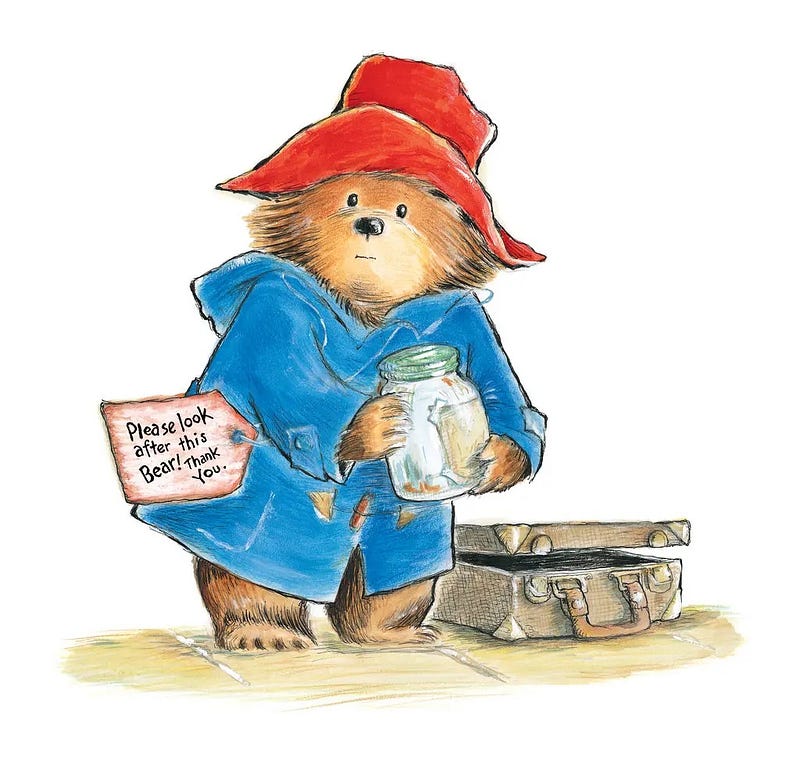
6: Primary school headmaster, Mr Rushton, was a very tall, slender fellow who spoke with, what was to me, a very posh voice. I had a fondness for Mr Rushton. He was very serious, ultra-professional and had a matter-of-fact, exacting, yet subtly kind, demeanour. There was a period of time when every Friday, about twenty minutes before we went home, he would come to our classroom and read us a chapter or two of “A Bear Called Paddington” by Michael Bond. I was always fascinated by how, uncharacteristically, he was able to exuberantly emphasise the narrative and even adapt to the idiom of the various cast members, of the book, we all know and love.
There was a brief period, around the time I was about nine years old when, for some long-forgotten reason, it was popular among boys to fit segs to their shoes. For those who don’t know what segs are, they are pieces of metal, roughly the size and exactly the shape of a single segment of a tangerine. They had small spikes on one side and they would be driven into the rear underside of your shoe’s heel and/or the front of the sole. The reason being, to prevent rapid wear on the shoes and, ultimately, the need for regular and expensive repair. Looking back now, I think it is that we just liked all the clickity-clacking noises they made, like when Luka Brasi walked through the corridor of the Hotel Edison, 47th Street in Manhattan, toward his assassination at the hands of Bruno Tattaglia, Virgil Sollozzo and an unidentified, surprise from the rear, henchman with a garrotte, in Mario Puzo’s “The Godfather”.
I came from a family which was relatively poorer than most, so it was rare that I could enjoy the luxuries, that many of my peers were accustomed to, like sweets, ice cream and pop, so the potential for possession of segs was vanishingly small. My solution was to harvest some drawing pins (USA Translator: Thumb Tacks) from the notice board near the school entrance and fit them where the segs should go. Unbeknown to me I had been observed, committing said crime, by Perry Fielding, a boy considered by most to be a bully and a snivelling twat.

Halfway through the next lesson I was called to the headmaster’s office, had my shoes inspected and encouraged to assume the position of someone about to be beaten; bent over his desk, arms outstretched, hands gripping the opposite edge, legs slightly apart, grim-faced, buttocks tensed, finally in receipt of four strikes with “The Slipper”.
To anyone who isn’t familiar with the term “The Slipper”, in regard to corporal punishment, you might be fooled into thinking that it sounds somewhat harmless, if not rather delightful in the imagery of its nomenclature. After all, slippers are nice aren’t they? Comforting things. Cosy. Warming. Protection from neglectful Lego® discard in the dark. An increased likelihood of royal matrimony to the most snugly fitting foot. A heel tap initiated, return journey to Kansas. In the context of this retelling, such comforting thoughts serve only to enhance the horror of the outcome. As though a cute childhood fluffy stuffed doll had come to life, gone rogue, and you walk, unexpectedly, into the room to find it crushing the skull of your pet budgie between its sweet little textile paws. Mr Rushton’s “Slipper” was anything but comforting.
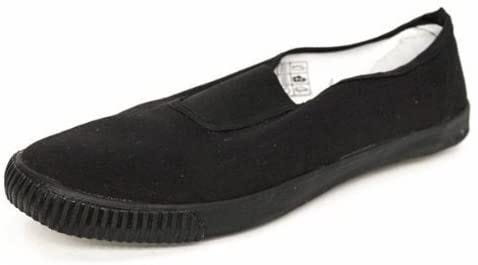
Mr Rushton’s slipper was one of those black, slip-on plimsolls that every person alive will have owned at some time, during their tenure in the British education system. The thing that set Mr Rushton’s “Slipper” apart from normal people’s experience was that, unlike the VAT-free children’s size thirteen a nine-year-old might wear, it looked like the kind of plimsole Young Master Shiny would wear at clown school, while studying to attain the required qualifications to run away with a big top travelling circus, thus fulfilling his ambition to become Old Mr Shiny, flinger of flans, clumsy bearer of ladders and driver of spontaneously collapsing cars. In other words, Mr Rushton’s “Slipper” was fucking massive.
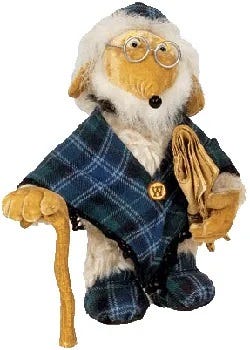
Now, I’m no expert in the science of physics, but I understand that circular motion increases in speed the further it is away from its central rotational axis. For example, if you were to play the vinyl album “Wombling Songs” by The Wombles at the requisite 33⅓ RPM, the opening track, “The Wombling Song (Television Version)”, will be moving quickly, where the track meets the record players needle. Track five “Tobermory”, however, will be moving much slower relatively. It is this scientific principle one needs to apply to reach a more accurate appreciation of the force involved in Mr Rushton’s slipper impact delivery, on the surface of my arse. As mentioned earlier, Mr Rushton was a very tall man, therefore his arms were proportionally longer than say, Orinoco off of the Wombles. Looking back from my upper bodily inclined stance I could see Mr Rushton limbering up. He resembled an Olympian discus competitor in the initial stages of their throw. Upon reaching the optimal momentum Mr Rushton unleashed his first blow. Trust me, reader, this would have been a very different story if I had been slippered by a Womble.
To say I was surprised by the degree of pain, endured during those four gluteal insults, would, of course, be an understatement of some prolific significance. Legend has it my screams could be heard in the infant’s school on the opposite side of the playground. Over the next twenty-four hours, sitting down was problematic and my peach-resembling arse turned a deep purply plum colour. That would have made for an interesting Roald Dahl book title, wouldn’t it? “James And The Giant Bruised Arse”.

When I reflect on the memory of, my very first encounter with, state-sanctioned child abuse, I find myself wondering about Mr Rushton and how he lived with his actions that day, and all the other times he carried out such corrective assistance. When he went home did he look upon his own children and feel at ease with the image of them meeting with his brand of guidance? Did he have grandchildren that transgressed the code of acceptable behaviour? Did he spare the rod or spoil the child?
Time plays tricks on us and when I think about him I see an old man. He may have only been in his late forties or early fifties but to a nine-year-old me he seemed ancient. Having said that, if he was fifty, at the time, that would put him at one hundred today. In all likelihood, he’s no longer with us. I never hated him, nor would I wish torment upon him, he was, after all, a man of his time. In that respect, I feel a slight sadness that a man, who could so passionately entertain children and teach them constructively, could also cause them so much harm.