My Selection — The Great Train Robbery
A dramatized account from court records by Michael Crichton
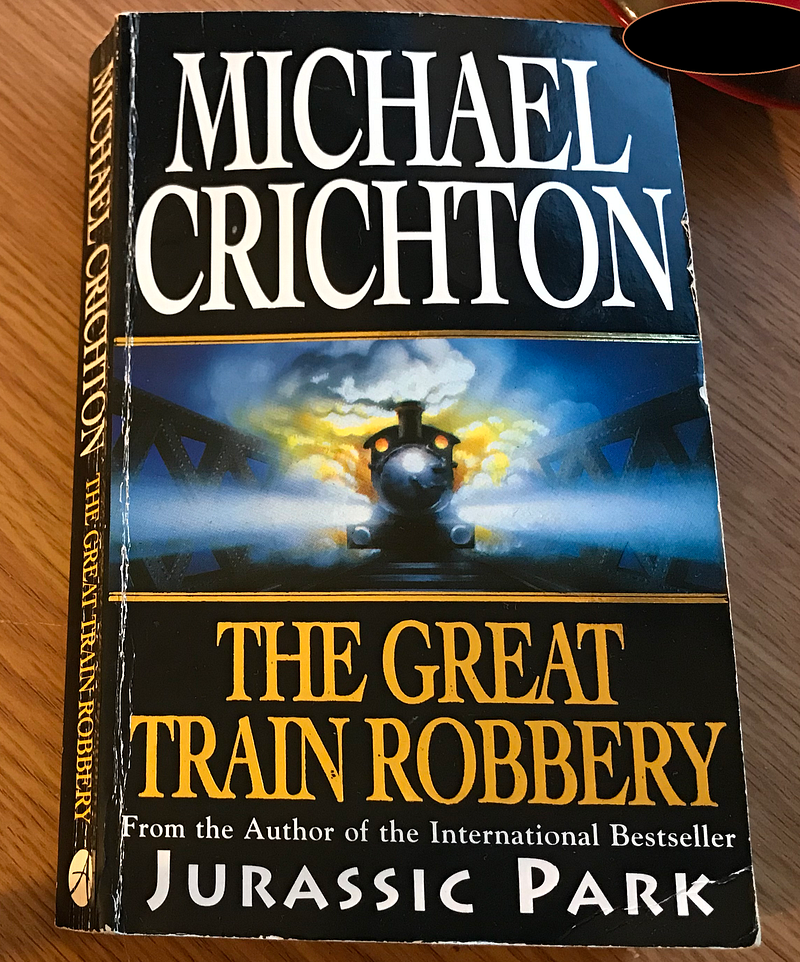
I didn’t want to read this book. I actively didn’t want to read this book. But wow, am I glad I did!
It wasn’t that I didn’t like Michael Crichton as a writer. I’d loved The Andromeda Strain which I’d read during an avid sci-fi phase in the 1970s some 20 years previously. At the time I first picked up The Great Train Robbery, Crichton was being lauded for Jurassic Park which was a book but not yet a film. That makes it the very early 1990s when I reached out, reluctantly, and plucked The Great Train Robbery from the shelf.
I was in a waiting room. I can’t remember where, but I know I was faced with an unexpectedly long wait and had brought nothing with me to read. In the early 1990s, the days of a smartphone in my pocket with access to ebooks were still some way off.
The waiting room was well equipped with magazines but closer inspection made my heart sink; motor racing and football, the types of publication that were largely pictures with very little of the written word, and nothing to tempt someone who wasn’t a fan of either sport.
And there was a lone battered paperback book. I picked it up.
Michael Crichton of Jurassic Park fame? Hmm, I really wasn’t in the mood for Sci-Fi or dinosaurs. The Great Train Robbery? Hmm, I assumed the reference was to the infamous crime of 1963, which had been analysed to death in all the newspapers, and which would continue to surface as ‘news’ until the last of the perpetrators was recaptured after 36 years on the run.
However, my choice was the battered paperback or pictures of cars and footballs, so I sat back and opened the book.
I was captivated from the start. This wasn’t the 1960s Great Train Robbery but one a century earlier in Victorian England in 1855. Crichton had taken the voluminous courtroom testimony from the trial of three of the perpetrators and woven it into a coherent account of the planning and execution of a crime that shook Victorian Britain to its foundations. When finally in the dock, Edward Pierce, the mastermind behind it, was frank in his testimony, keen to shine a light on what had been a considerable achievement. Although not a record-breaking theft in financial terms, it was the people behind it and the sheer audacity of its execution that astonished those who thought they understood the workings of the criminal mind. As Crichton says:
What was really so shocking about The Great Train Robbery was that it suggested to the sober thinker, that the elimination of crime might not be an inevitable consequence of forward-marching progress. Crime could no longer be likened to the Plague, which had disappeared with changing social conditions to become a dimly remembered threat of the past. Crime was something else, and criminal behaviour would not simply fade away.
Crichton’s scrutiny of the different levels of society in Victorian England is fascinating in itself, leaving me with the feeling that I understood better some of the anomalies in modern British society. But in addition, he has worked his magic on the story of the crime, using the details of court testimony to recreate what happened as a tense thriller, alive with drama all the more incredible for being true.
In the hands that crafted Jurassic Park, The Andromeda Strain and the TV series ER, The Great Train Robbery becomes a gripping page-turner that will keep you at the edge of your seat as it shines a light on the multi-layered world of Victorian England.
I couldn’t finish The Great Train Robbery the day I picked it up as a battered paperback, but I was well over half way through when my wait came to an end. Frustratingly, I had to leave behind a half finished book. There are some crimes that no reader (or writer) should ever commit, and taking books from waiting rooms is one of them, though I will admit I have never been as tempted as I was that day. I obtained my own copy the old-fashioned way through a book shop and waited an agonising two weeks before I could read to the end.
Crichton starts the book with two quotes that shine a light on the hypocrisies and conflicting moralities of Victorian society, and it is with these quotes that I shall finish:
Satan is glad — when I am bad
And hopes that I — with him shall lie
In fire and chains — and dreadful pains
(from a Victorian child’s poem, 1856)
“I wanted the money.”
(from Edward Pierce’s courtroom testimony, 1856)