
My Radioactive Childhood:
Growing up on the Wrong End of the Manhattan Project
Peering through welding goggles while standing in the middle of a desert in New Mexico, a small group of men stood together and witnessed what they had wrought: Trinity. What they saw was not, however, religious in nature. Trinity was a bomb. A plutonium implosion fission bomb. Trinity was the first nuclear bomb to be detonated by humankind. The equivalent of 22 kilotons of TNT. Trinity was the biggest, baddest bomb ever.
The men watching, a group of scientists hired by the United States government, briefly celebrated the success of their mission before getting back to work, measuring radiation levels and concerning themselves with how to manufacture more of Trinity’s fuel: Plutonium-239 and Uranium-235. The date was July 16, 1945.
Astounding as it must have been to be present for the birth of the nuclear age, it really wasn’t a long time in the making. Trinity was a product of the Manhattan Project, conceived merely three years earlier in June 1942. Based on intelligence from German expatriate scientists, the United States began to fear that Germany would develop a successful nuclear weapon.
Under the authority of the United States Army, the Manhattan Project was a secret research and development undertaking that involved the nation’s top scientists, research institutions, military leaders, a myriad of government agencies, transportation infrastructure, mining and manufacturing businesses, and no less than 129,000 American workers. Not only did we need to build a bomb quickly, goddammit, but first we had to figure out how to build that bomb.
In an amazing feat of government efficiency and expedience, research laboratories at top universities were studying isotope separation and diffusion and nuclear reactor technology. Meetings of theoretical and experimental physicists were coordinated and convened across the country. Engineers in charge of construction found sites for production plants near water and electricity sources. Residential communities for workers were built. Land was acquired by eminent domain. Citizens were relocated. Laboratories and plants were built. Existing manufacturing facilities quickly changed processes to produce whatever was needed for the Project. Uranium and thorium ores were sourced. And it was all top secret.
One company that contracted with the government to aid in the war effort was Linde Air Products. Linde converted its Ceramics Plant in Tonawanda, New York into a uranium ore and nickel processing plant. Between 1942 and 1946 the process of converting uranium ore to Uranium-235 for use in nuclear bombs created 8,000 tons of radioactive sludge known as “tailings”, as well as 37 million gallons of liquid radioactive waste.
The radioactive tailings were hauled away to various dump sites around western New York, a significant portion of which ended up a couple miles away from Linde at the Tonawanda landfill. Linde dumped the liquid radioactive waste into shallow wells on its property, acknowledging its motivation to avoid being blamed for subsequent contamination. Their hope was that when the waste ultimately leaked into the labyrinthine subterranean watershed (which it did), it would be more difficult to hold Linde responsible.
The processing at Linde, as well as the 30 other locations involved in the Manhattan Project, required workers. Lots of workers. The government stepped in to help here, too. Near Linde and other Manhattan Project plants, the Federal Public Housing Authority quickly constructed residential communities to house workers and their families. Across Sheridan Drive, within walking distance to Linde, the government built the Sheridan Parkside Housing Project.
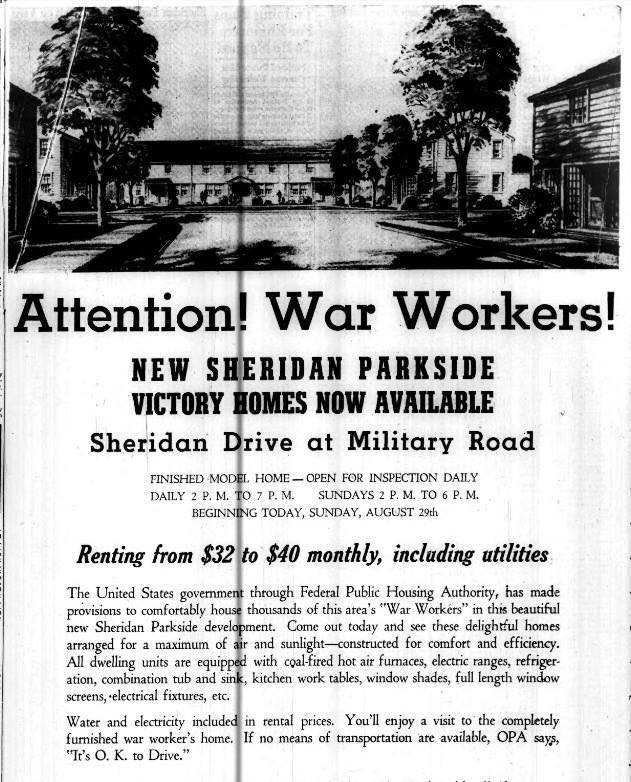
Twelve hundred housing units were built in Sheridan Parkside. In August 1943, the 2, 4, and 6 family units were touted as modern and efficient, with water and electricity included in the $32 to $40 monthly rent. The streets are all named after famous writers, laid out in small sections, little literary neighborhoods. Longfellow and Lardner. Dickens and Dumas. Whitman and Whittier and Walpole. Browning and Burns and Balzac. Thirty-five streets in all, full of dedicated war workers. Sheridan Parkside is bordered on the north by the Tonawanda landfill, on the south by Linde Air, on the east by the CSXT railroad tracks, and on the west by Sheridan Park.
Just two years after Sheridan Parkside began renting to war workers, Germany, whose scientists had discovered nuclear fission and had provoked the need for the Manhattan Project, surrendered on May 8, 1945. Still, work on the atomic bombs continued. Two weeks after detonating Trinity as a successful practice run, the United States dropped “Little Boy” on Hiroshima, Japan on August 6, 1945 and “Fat Man” on Nagasaki, Japan on August 9, 1945. Six days later, Japan surrendered.
World War II was over. The Manhattan Project was over. Sheridan Parkside was sold to developers. The radioactive waste in Linde’s wells continued percolating, leaking into the groundwater. Linde continued hauling away radioactive sludge, although the grounds and buildings of the plant were just as thoroughly contaminated.
Thirty years after that flash in the New Mexico desert, I was growing up in the “T” section, on Twain Court, just north of Tarkington, Thackery, and Thoreau. The “Proj”, as it had come to be known, hadn’t been much improved upon since the war. Most of the units had been sold to real estate companies who were simply absentee landlords. A small handful of people owned their homes, remnants of the once proud “Victory Homes”. By then, there were enough families with kids to require two elementary schools. Older students were bused to nearby Kenmore schools.
The economy in the 1970’s and 1980’s left industry struggling and unemployment high. The Proj was a low-rent neighborhood and much of it wasn’t pretty. It was where you lived if you couldn’t afford to live anyplace else. Tenants had little motivation to keep up their apartments. Most landlords didn’t bother to, either. It wasn’t necessarily a dangerous place to live, but it was definitely, and literally, on the wrong side of the tracks. Sheridan Parkside was still surrounded by industry: Dupont Chemical, Linde, now called Union Carbide, the Tonawanda landfill and mudflats, with Tonawanda Coke spewing benzene just a few miles away. Still, most residents weren’t aware of the history behind why the Proj had been built. And no one really knew the extent to which Linde had poisoned the area.
In 1981, the New York Times began reporting on the environmental impact of toxic waste sites around the country. The reports looked to the government for answers and solutions to the radioactive messes left after the Manhattan Project had petered out. In some cases, the government admitted its culpability; in others, they denied wrong-doing. Eventually, Superfund sites would be designated. Some areas were cleaned up; others await funding; still others, such as the groundwater near the Linde plant are not even scheduled for attempted clean-up.
Through the 1990’s, responsibility for toxic waste sites shifted from the Department of Energy to the Army Corps of Engineers. The Linde site was deconstructed, its buildings torn down and hauled away to be buried out West (making them someone else’s problem). Praxair Corporation now occupies the site. The problem of the buried sludge, however, continues. Through 2017, the Army Corps of Engineers did some controversial clean-up at the Tonawanda landfill. The Corps raised the acceptable levels of radioactivity to determine how much of the landfill needed to be scraped off, so the amount of soil removed was drastically less than originally anticipated. As of May 2019, there are still two areas of the landfill awaiting clean-up.
In 2000, 55 years after the war ended, Congress created a worker’s compensation program for the employees exposed to toxic and radioactive materials. Workers could have medical bills paid and receive lump sum payments. They just need to prove where, when and how long they worked at the top secret locations during World War II. A special list of cancers was drawn up. Calculations to determine radioactive exposure were devised. Reams of rules and regulations were created.
Some payouts have been made, but many of the workers are long dead. Some have died while waiting decisions on their claims, leaving survivors to continue the fight. Still others are fighting denials of their claims, saying their job descriptions and specific cancer types weren’t included in eligibility rules or that the calculations used to determine exposure are flawed. Advocacy groups say the government hasn’t done enough to publicize the program. They also say the complexity of the program makes it difficult for the now aged workers to apply; some attorneys are reluctant to take on the cases because the allowed compensation is so low.
In 2014, the New York State Department of Health did a cancer survey in part of zip code 14150, specifically, the Sheridan Parkside neighborhood. They found that instances of all cancers were elevated. Lung and bladder cancer were statistically elevated in both genders. They also found that certain cancers were elevated by gender: males had increased instances of esophageal and oral/pharynx cancers; females had increased instances of uterine cancer and leukemia. However, the Department of Health says that they can’t make a determination that environmental factors may have caused these increases because smoking and lifestyle choices may also play a role. The study did not attempt to track down former residents of Sheridan Parkside, nor did it attempt to document the “lifestyle choices” of the population. I guess growing up in the Proj was a lot more dangerous than I thought.
It only took three short years, 36 months, for the United States government to research, create, and deploy the most horrific weapon of mass destruction known to humankind. It then took 35 years for the government to acknowledge the dangerous waste left behind by the Manhattan Project. It took 55 years for the government to create a program to compensate war workers for the health damage caused by building nuclear weapons. Almost 80 years after World War II, people are still suffering the ramifications of the waste left behind by the race for atomic superiority.
The half-life of Uranium 235 is just a skitch over 700 million years. That’s how long it takes for a substance to become reduced by half due to radioactive decay. Uranium, of course, is still being detected at the Tonawanda landfill, including in the water run-off. So maybe the government is playing its cards right: what’s 55 years to wait for compensation when that shit is going to be around for hundreds of millions of years? I mean, sure they figured out how to harness the power of nuclear fission in a matter of months, really, but the clean-up? Let’s take that nice and slow. After all, the Uranium isn’t going anywhere anytime soon.


