
My Profile Photo Has Lymphoma
Jeff Bridges, The Dude, has been diagnosed with lymphoma…

Jeff Bridges — New S**T has come to light
Just so we’re clear, that handsome middle aged duuude is not me. That is The Dude. Jeff Bridges. And he (as The Dude) is my profile photo. If you have not seen The Big Lebowski, starring Jeffrey Leon Bridges as The Dude, you have to check it out. Bridges is not only an inspiration for my Medium persona, but also for checking out the disease he has just been diagnosed with.
I first saw Bridges in Starman, for which he earned an Academy Award nomination. I saw it at that impressionable age where the young brain stores profoundly useless items like Bridges as an alien trying to learn Earthly ways, like driving a car, and saying: “I watched you very carefully. Red light stop, green light go, yellow light go very fast”. My son loves that line, parroting me without knowing where that came from.
Bridges also earned Oscar nominations for The Last Picture Show, Thunderbolt and Lightfoot, The Contender, True Grit, and Hell or High Water. The Dude is also a musician, author, photographer, philanthropist and producer.
On October 19, Bridges tweeted that he had been diagnosed with lymphoma:
“…As the Dude would say.. New S**T has come to light. I have been diagnosed with Lymphoma. Although it is a serious disease, I feel fortunate that I have a great team of doctors and the prognosis is good. I’m starting treatment and will keep you posted on my recovery…”
“…I’m profoundly grateful for the love and support from my family and friends. Thank you for your prayers and well wishes. And, while I have you, please remember to go vote. Because we are all in this together. http://Vote.org Love, Jeff…”
Lymphoma — when our body’s protector turns against us
The term lymphoma actually describes a host of blood cancers, excess growth of certain white blood cells called lymphocytes (which are our body’s defenders against invading pathogens, anything causing disease). We don’t know which type of lymphoma Bridges has.
The many forms of lymphoma fall into two general classes called Hodgkin lymphoma (HL) and non-Hodgkin lymphoma (NHL). The vast majority (90%) of lymphomas are NHLs.
Hodgkin lymphoma is diagnosed when a pathologist finds very unusual giant cells called Reed-Sternberg cells, shown below:
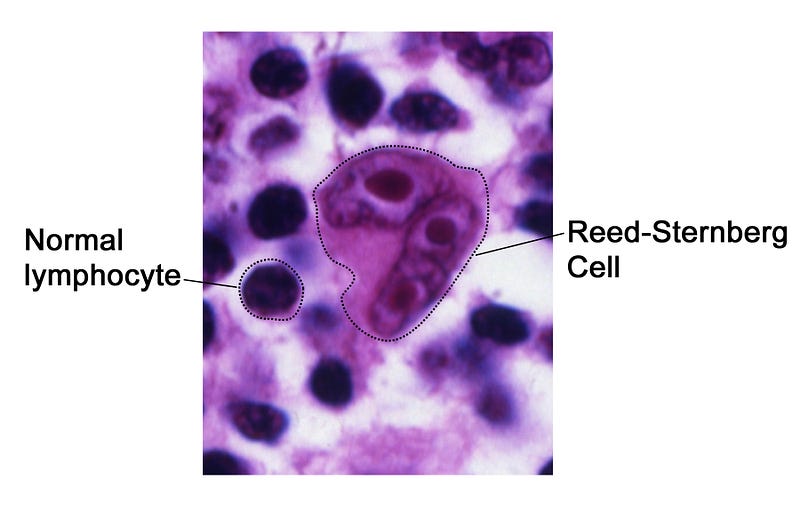
These monstrous Reed-Sternberg cells arise from B cells or B lymphocytes. B cells are a type of white blood cell which secretes antibodies, and have gained some media attention as the cells central to our hopeful immunity to the COVID-19 pandemic.
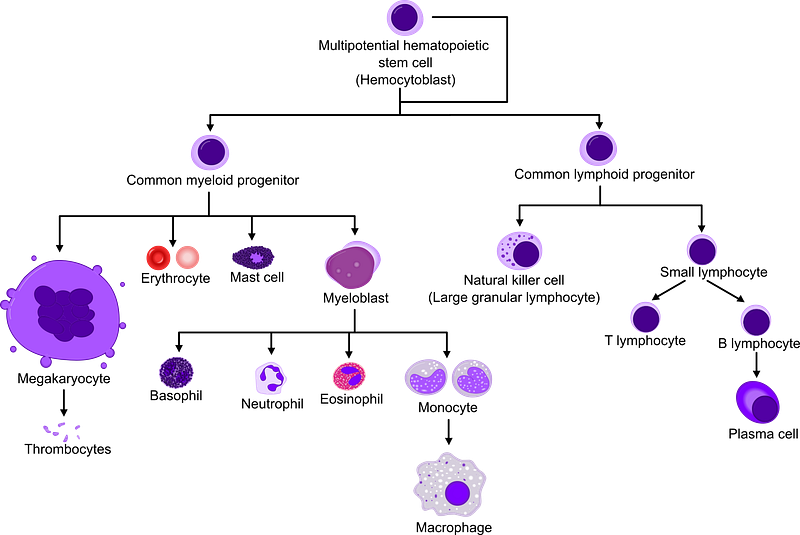
B cells are so-called because they mature in the bone marrow, found at the core of most bones. Within bone marrow resides a powerful master cell, a type of stem cell called a hematopoietic stem cell (HSC). This HSC gives rise to a complex lineage of lesser stem cells (more restricted in the types of cells they generate), and ultimately to a broad range of blood cells that perform a diversity of functions.
But the genetic characteristics, the causes of HL, of Reed-Sternberg cells, is still unknown, and work continues to tease out the mechanics of the disease.
NHL is far more complex because it covers many more types of cells, locations, etc. NHL can occur in either B cells or T cells.
T cells are also known as T lymphocytes because they mature in the thymus (rather than the bone for B cells). One of the many functions T cells have is to destroy cells infected with viruses or cancer cells. This makes them a tremendously attractive target for various therapeutic strategies.
For example, BioNTech is the German company who partnered with Pfizer and was the first to get approval for their historically rapid development and approval of their totally new mRNA-based vaccine technology against COVID-19. But their technology was so advanced only because they had spent a decade developing mRNA-based drugs for cancer immunotherapy (activating the immune system to attack cancers). And one of the main targets of BioNTech’s mRNA-based drugs are T cells.
NHL is by far the most common group of lymphomas, and within NHL, B cell lymphomas are again most common. Let’s focus there.
B Cells — giveth and taketh away
One of the main functions of B cells, we already said, is to produce the antibodies we use to fight infections.
Antibodies are just part of one arm of a very complex two-part immune system that mammals and vertebrates have. The first is an ancient innate immune system which is the dominant system found in plants, fungi, insects, and other more primitive organisms. But we also have a second and more recent adaptive immune system, which is one of the crowning achievements of vertebrate evolution, along with the brain’s cortex, and other innovations.
The primary goal of the adaptive immune system is to create a memory of an infection by a pathogen, but especially new pathogens. This is important since infectious agents are always evolving, often very rapidly.
Antibodies are part of the adaptive immune system. And B cells genetically encode, produce and secrete antibodies, proteins also known as immunoglobulins.
The genetic key to our adaptive immune system’s ability to… adapt… comes from two genetic processes with typically cryptic scientific names:
- Somatic hypermutation
- V(D)J recombination
Let’s take each in turn to see how a part of our adaptive immune cells, the B cells, work.
Somatic hypermutation is a million-fold increase in mutations in a small portion of the antibody’s gene, the part which codes for the antibody’s ability to recognize and bind to a particular part of the invading organism.
Imagine we have a B cell which produces an antibody against the COVID-19 virus SARS-CoV-2. If that B cell recognizes another SARS-CoV-2 virus, the B cell begins to divide and make many more B cells. Each of those daughter B cells undergoes somatic hypermutation within the antibody gene making many small variations. The goal is to produce antibodies that more effectively bind to that antigen, the materials that make up the virus.
V(D)J recombination occurs in developing B and T cells and is another process for randomizing antibody genes. An antibody gene has multiple blocks of DNA called variable (V), diversity (D) and joining (J) regions, and these specific regions undergo an almost random series of combinations and deletions, producing a tremendous diversity of antibodies able to bind to any antigen produced by bacteria, viruses, parasites and worms.
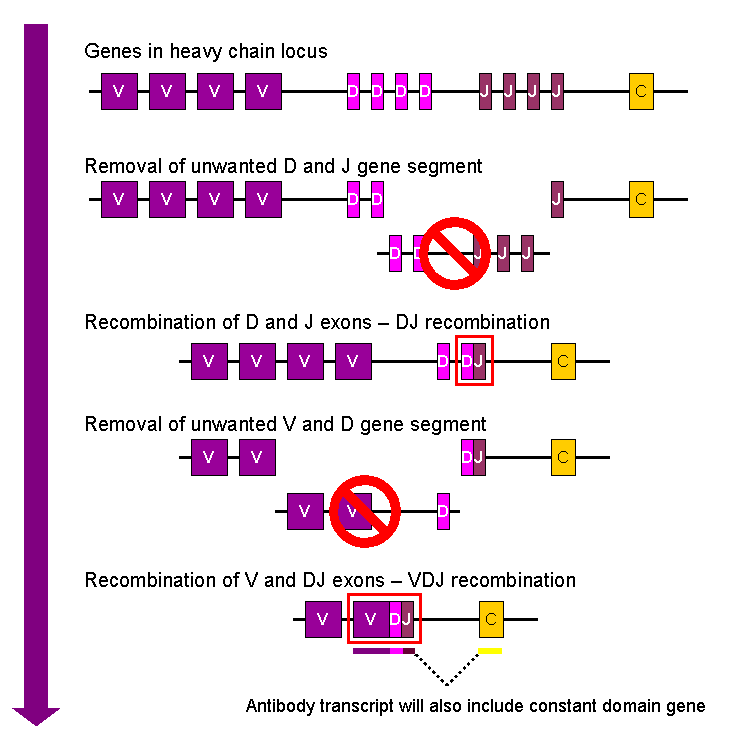
Both of these very novel genetic processes create huge diversity within a single organism, and is essential to build an adaptive immune system capable of recognizing almost any invasive and harmful pathogen.
These are very important exceptions to the popular trope that all our cells are genetically identical.
There are several ways in which that idea is not actually true. First, each cell is subject to all kinds of genetic damage, both internal and external. External factors include solar radiation, environmental chemicals, etc. Internal factors include the production of oxidizing free radicals from normal cellular processes such as respiration. Although we have numerous and effective DNA repair systems in place which address most of those genetic assaults, some damage and change persists in many of our cells. Most of those changes have no effect. Some do, and some of those lead to diseases.
The somatic hypermutation and V(D)J recombination are hyperactive mutations which our evolution has captured and harnessed for the purposes of immune adaptability.
This is a tremendous evolutionary gift, turning mutations into a feature and benefit.
However, there is no free lunch. The processes of hypermutation and recombination which gives us our adaptive immune system, can also occasionally go wrong. When that happens, the same processes are also implicated in sometimes creating lymphomas.
The Dude abides…
The treatment for lymphoma varies tremendously since this covers so many different specific diseases. Some lymphomas are slow-moving, and are called indolent, like The Dude (the character, not the actor). Some are more aggressive, like Walter, The Dude’s Vietnam Vet bowling buddy with self-control issues. Some are highly treatable despite their aggressiveness, and respond readily to chemotherapy or radiation. Some forms can even be accommodated for the patient’s life with little treatment necessary.
Since treatment of cancers is such a double-edged sword and carries many risks and side-effects, often with an indolent lymphoma a watch-and-wait approach is recommended.
So, for now, perhaps, The Dude abides.


