
REAL WORLD
My Patient Was a World-Famous HIV/AIDS Researcher Having a Massive Heart Attack
Under pressure in the emergency department
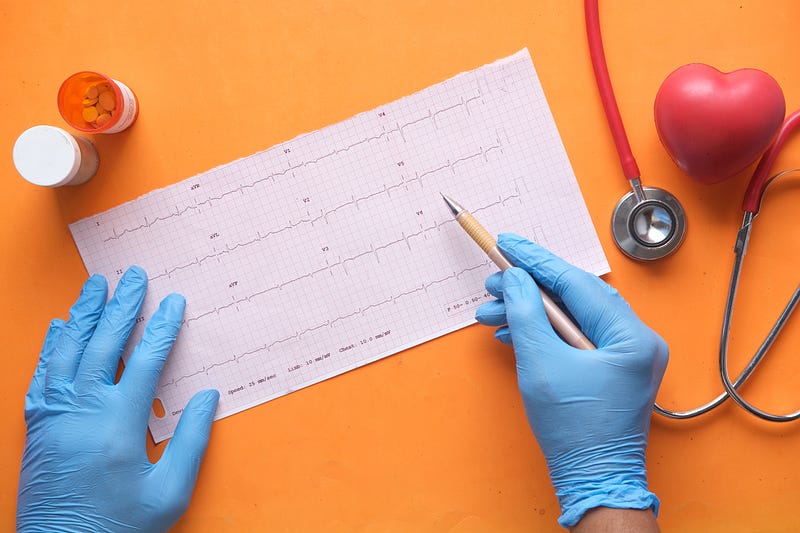
It’s the real deal. I know it as soon as I’m handed the electrocardiogram. The lines traced across the delicate pink squares on the page form an ominous, threatening pattern. Danger lurks.
I’m standing idly by Duke’s emergency department intake area, chatting up the nurses, waiting for the next patient to appear. It’s a quiet, cool, early-October day, a classic autumn moment on the vast beautiful campus, trees going yellow, orange and red with the temperature change, losing their deep summer green.
Suddenly the paramedic radio crackles to life. A nurse jumps for the receiver.
“This is paramedic Rogers. We’re bringing you a stat medical. Are you ready for report?”
“Yes” is always the answer, but they never fail to ask it seems, Southern civility.
“We’re on campus with a 42-year-old male. No past medical history. Experiencing severe chest pressure. He’s pale, cool and diaphoretic (sweat-soaked), with a normal mental status. Blood pressure is 160 over 95, pulse 102, respirations 24 and slightly labored, with rales (“crackles” indicating abnormal fluid) at both lung bases.”
The words race by me. The paramedic’s voice — normally a calm baritone — is high and tight. His staccato medico-speak, a departure from his usual gentlemanly Southern drawl.
I know Bobby Rogers. He’s one of the “paramagics” as the nurses say. Nothing electrifies him except bass fishing and NASCAR. Even then, the excitement about his two favorite subjects takes the form of long-winded, but never rapid-fire, discourses. He can go on forever about his twin passions, never in a hurry to finish his narratives.
That’s not the case now.
“We’ve established an IV. We’re giving oxygen at four liters per minute. He’s on the monitor, normal sinus rhythm with occasional ectopy (abnormal “skipped” heartbeats). We’re under a minute from your back door. Do you copy?”
The radio nurse recaps: “We copy a 42-year-old male, hypertensive with stable vital signs, with severe chest pain, en route to our facility. IV and O2 established.”
She continues, “Treat per protocol and transport code three. Recontact if there’s a change in condition.”
This is a classic scoop-and-run. The medics are so close to the emergency department — ED as most of us call it — that they take a minimalist approach to treatment and opt to drive like hell instead. They don’t want to waste time in the field with someone potentially “fixin’ to die” that they can do little to definitively help. It’s IV, oxygen, monitoring, load and GO! Medications can be given on the road if there’s time. If there’s a problem on the way, they’ll deal with it while driving.
Paramedic protocols are designed to maximize benefit and minimize risk. First the ABCs — airway, breathing and circulation — are assessed and treated if disordered in a life-threatening way. A victim with a steak chunk wedged in his throat doesn’t need an IV. He needs that food bolus removed and a tube to breathe through, either his native one, if it’s still functional, or a plastic surrogate.
The medics know this, and a whole host of other priorities. The don’t need to phone everything in. They just treat and move to the next item on their task list.
They’re smart, skilled and quick. Lives get saved with that approach.
No wonder the nurses, those in the know, call them the “paramagics” or sometimes just “the magics.”
I have my own theory about why some are referred to that way, but more about that later.
After the ABCs are stabilized, paramedics take the O-M-I tack with patients judged to be critically ill.
O-M-I is pronounced “oh my” as in, “oh my, they might be sick”.
It’s medical shorthand for Oxygen, Monitor and IV. If time allows, really sick patients get two IVs, just in case.
Oxygen is delivered via a nasal cannula, short narrow tubes that rest in the nostrils, or by face mask, generally used for those severely short of breath or actually hypoxemic (lacking adequate oxygen).
In the case of my chest pain patient, he probably has adequate oxygen stores. His hemoglobin molecules are doing a great job, picking up and delivering oxygen to most tissues needing it, except to his heart muscle.
A blocked coronary artery presents a different problem. More oxygen in the nose and lungs won’t solve that. But, every chest pain patient gets oxygen anyway, a part of the O-M-I approach. It’s like window dressing. Harmless, pretty to look at, and you think you’ve done something nice.
Monitoring translates to heart rate and blood pressure scrutiny at a minimum. Blood pressure that’s too high or low can be dangerous in and of itself and may signal the presence of other disorders.
It’s the same with pulse rate. Sixty to 100 is normal. Markedly faster or slower may be a bad thing, especially in a chest pain patient.
The “ectopy”, or skipped heart beats, referenced in the initial radio blast may mean nothing at all or may indicate that fecal material is about the contact the rotating cooling apparatus, or, the shit is about to hit the fan. Hard to tell without seeing the ectopy, and the patient.
The paramedics know all this and plenty more. For them, it’s as routine as rolling over in bed, most days.
It’s routine for me as well. I’ve considered all this in the instant between the initial paramedic report and the radio nurse’s response. It’s automatic, ingrained.
I consider all this and more while leaning against the radio alcove’s salmon-colored wall, listening to the “magics” work their call.
It is magical, the ability to save a life, or at least to intervene so the situation stabilizes and doesn’t slide further towards disaster.
Paramedics do that; and when they do it extraordinarily well, it seems like magic.
They deserve every accolade, every positive stroke, every “hey the magics saved another one” they get from all of us in the ED.
I always wonder though if the “magic” part of their pet name didn’t arise partially because of a different magical effect, the magical effect some of the — mostly male medics — have on the — mostly female — nurses.
There is all that rippling musculature and testosterone-dependent mustache growth to consider. Those royal blue coveralls fit “awe-fully” well, particularly on those over six feet tall, sporting broad shoulders and narrow hips. Most male medics have large, capable-looking, hands. All wear big black boots. You know what they say about men with large hands and large feet.
Who knows if any of this is true, but it’s definitely part of ED life.
And, it does little to stop the ED nurses from lusting after, or at least talking about, many of the “paramagic” men.
In a heartbeat the paramedic ambulance screams up to our back doors. They unload quickly and wheel toward Trauma 1, the room closest to the ambulance bay doors.
It’s a small room in a small department, its walls crammed with equipment and supplies. When it was built I’m sure it seemed huge, but medical technology has exploded in the last 20 years. Trauma 1 sees all the sickest patients, so all the life-saving gear goes there.
With the tubes, lines, medical procedure trays and other gadgets in Trauma 1, I can (among many other things): bore a hole in someone’s head, “crack” a chest and shock a quivering myocardium, and access arteries and veins of every size, description and location.
The surgeons can really have a field day in Trauma 1. They’ve got access to stuff even I can’t touch, especially here, where Southern surgery was born (or so they like to think).
Duke is sometimes called “The Harvard of the South.” But, people here, especially the high-IQ undergrads, usually refer to Harvard U. as “The Duke of the North.”
You know what they say about surgeons though. It’s in the lines of two old jokes. * Internists know everything, but do nothing. * Surgeons know nothing, but do everything. * Pathologists know everything and do everything, but it’s too late.
or
Surgeons … frequently wrong, but never in doubt.
We’re now all jammed into Trauma 1: me, two paramedics, several nurses, a tech or two, and the patient secured on the narrow paramedic gurney awaiting an offload to the slightly wider, cushier, ED gurney. Duke med studs, their young pure faces glowing and their short white coats starched and unsullied, hover bug-eyed at the door. They’re all way smarter than me, but far less wise. They do however, know it’s best to stay out of the way.
The patient looks like shit I think.
Let’s move him to our bed before he “codes.”
“Codes” being a medical euphemism we employ to protect ourselves from resorting to truth and saying “dies.”
After the patient is transferred, the paramedics give their report. It’s a reiteration of the radio run and whatever happened during the 45-second transport. Then my team swings into action.
I do what I do with patients able to communicate and introduce myself. Stationing myself to the patient’s right, near his chest, I shake his hand and say “Hello sir, my name is Michael Burg. I’m one of the emergency physicians. How do you feel right now?”
My purpose is to know his agenda right away and be in close enough to immediately intervene if his condition deteriorates precipitously. I can also tell immediately if my patient has an airway problem.
It always dazzles me when someone, in the throes of a major medical catastrophe, seemingly dismisses their immediate life threat and says something like, “I’m hungry.”
This man does not do that.
“I feel like I’m going to die” he states evenly, looking me dead in the eyes, pupils slightly wider than normal.
I’ve heard that statement about 20 times in my career. In the vast majority of cases, sudden death has occurred right after the word “die” leaves the patient’s lips.
I like what I do. Stress is not something I usually feel at work, except perhaps when I’m too busy to pee for an entire shift, but I sense my heart begin to thud more rapidly and forcefully.
With my right hand still grasping his and my eyes not leaving his face, I lift his arm and gently rest the pads of my index, middle, and ring fingers on his radial artery, just where it crosses from the wrist into the hand, overlying the radius. Thump, thump, thump is what I palpate there. Rapid, a bit too fast, but strong and regular.
Briefly casting my eyes around the room I observe that everything needing to be done is being performed in the proper order. I’m the team leader, but I don’t need to say a word.
A crash cart, full of meds and life-saving advanced airway equipment, is reassuringly close. A defibrillator sits atop the cart, crouched and ready.
As I continue my well-practiced routine I note that oxygen is flowing, a second IV is being established, and our monitor leads are being attached to my patient’s chest by a tech.
I don’t know this particular tech, but he’s doing what he’s supposed to. He’s new and a bit nervous, hands shaking slightly as he goes about his task. I hear him murmuring a mnemonic as he works.
“White on right. Smoke over fire.”
The white lead connects to the sticky pad on the patient’s right shoulder. The black affixes to the left shoulder. The red snakes its way down from the left lower abdomen.
The tech has to use tincture of benzoin, super sticky stuff, to keep the pads in place. My patient is so sweat drenched they’d peel off otherwise. I’m aware. Profuse sweating is a so-called skin sign, another reason I shake hands and check the pulse immediately while saying hello. Maybe shock lurks, maybe adrenergic hyperactivity, maybe more.
I’ll synthesize all the data points momentarily as I diagnose and treat my patient.
But for now I know, my patient is wet and slippery like a seal. I store this fact away. As ED cynics say “you can’t fake diaphoresis.”
My patient is nervous. I can smell it. Although it’s early in the day, his armpits are sour. He showered this morning. I smell soap and see caked deodorant in his axilla. But, fear has overpowered both, generating a dank musk. His breath too is no longer toothpaste sweet and minty fresh. That primeval fight-or-flight response, so useful for evading saber-toothed tigers, has parched his lips and evaporated his saliva. White dots of secretions lie speckled on his lower lip. His breath is rank, as though a lake has receded and only decomposing shoreline debris remains. Fear darts in his eyes.
I choke back mine. Stillness and focus under stress rule, something I learned long ago.
“What is your name?” I ask, readying my stethoscope.
“Doctor Robert Spaulding” he responds.
Doctor Spaulding’s dry tongue makes a sound, a soft thack, as it separates from his palate.
I hear “Spaulding” through the stethoscope’s bell I’ve applied to his chest.
When someone is this ill, history and physical examination intermingle. It’s the ABCs at work. Ensure basic life functions are present and functional. Anticipate that bad things can, and often do, happen in an instant. Then, back off, really meet your patient, and get a full medical history. Social niceties can wait. They get prioritized down, sometimes behind even labs, x-rays, EKGs and the like.
But “Doctor Robert Spaulding” catches my attention. I finish my “primary survey” — cardiovascular, pulmonary, abdominal and neurological and ask Dr. Spaulding what happened this morning that landed him before me.
As he starts to answer, I file away that his lungs are “wet”, crackly at both bases, the “rales” Rogers reported on over the radio. Thankfully, everything else checks out OK.
My patient may feel like he’s going to die, but it seems unlikely in the next minute. His damp lungs need my attention, and soon, but he’s sufficiently “O-M-I’d” that we can deal with any change in his status. Besides, nurses have their protocols too.
I’m working with one of Duke’s ED greats. She’s already reaching for the right medications. Aspirin and nitroglycerine are being administered, diuretics and others will follow. She could write the med orders. I just have to sign them.
The EKG and radiology techs were stat paged as the patient hit our bed. Labs were drawn as the second IV went in.
“I can tell you what happened this morning” a voice booms from the corner. “Why don’t you let him rest?”
It’s framed as a query, but it’s not a question; it’s a command.
“Is that OK with you Bob?”
After Bob’s nod of assent, the voice’s owner strides from his position in the corner to my patient’s left side and extends his hand.
“I’m Sterling W. Harcourt.”
The “Sterling W.” passes in a blur and disappears, but the name “Harcourt” leaps out and lodges in my brain.
I won’t be using the term “Sterling” anyway to address this individual. He’s Dr. Harcourt to all but his inner circle, MD, PhD, and probably many honorary degrees beyond that. Twice the doctor I am, as are many at Duke, dual-degreed to my one miserably ordinary MD.
Endowed Professor Harcourt is 6 foot 5, with sharply chiseled features capped by a mane of white hair swept back from his high, supremely intelligent, forehead. The large right hand he offers in greeting is strong, the skin buttery soft like fine leather. He no longer labors seeing patients, washing his mitts 50 times a day like the rest of us, roughening his epidermis. He long ago ascended to the laboratory and the boardroom, Chairman of Internal Medicine. Doctor Harcourt’s suite of offices sit atop a gleaming new tower complex at Duke University Medical Center.
My cubbyhole is sub-grade, buried, befitting the status Duke accords the newest medical specialty, emergency medicine.
Harcourt’s name adorns the spines of countless texts and graces many first-authored journal articles. Depending who you ask, he Chairs either the first or second most powerful and august department at Duke.
Surgery is right up there as well. Together, Internal Medicine and Surgery are the twin pillars that built, and now sustain, DUMC.
Professor Harcourt is impeccably outfitted in a beautifully tailored gray wool suit, similar to the one worn by his friend Doctor Spaulding until moments ago.
Now however, my patient, the Doctor, has been stripped of his coat. His sweat-soaked light blue shirt is open down the center, and his rep tie wilts, crazily askew. Both his sleeves have been hastily rolled up past his elbows to permit IV access. His thin tank-top style tee-shirt is pulled up, wet and crumpled under his chin so that monitoring leads can gain entree to his torso.
He’ll be made more comfortable later. For now though, he looks exposed and vulnerable. His pudgy, pale, pink belly mounds over his belt.
Dr. Harcourt is the farthest thing from vulnerable as he begins his recitation of this morning’s events.
“Bob was here,” gesturing vaguely in a broad semicircle to the magnificent campus surrounding us “giving a talk about HIV/AIDS.”
And, like lightning, it hits me.
“Bob,” friend to Professor Harcourt, endowed Chair of the Department of Internal Medicine at Duke University Medical Center, is THE Doctor Spaulding, developer of several reverse transcriptase inhibitors, savior of numerous lives worldwide, because of his early and brilliant work on HIV/AIDS. The only reason he didn’t win the Nobel Prize for Medicine is that someone else with a bigger, faster, group of post-doctoral Fellows outfoxed him and discovered The Virus first. He was left to do the second-tier work, but he missed winning the world’s most famous honor by the thinnest of whiskers.
This is my patient, the one who looks like shit still and is bubbling along in congestive heart failure after almost certainly suffering a massive myocardial infarction.
I picture the scene as Professor Harcourt continues his soliloquy.
Doctor Spaulding is on the dais, addressing his scholarly peers. He’s done this many times, but always gets a bit keyed up regardless. His heart, acting under the influence of adrenaline and his morning caffeine, pumps forcefully as he speaks. An atherosclerotic plaque in one of his coronary arteries creates just the slightest turbulence in the normally laminar blood flow.
Then it happens.
The plaque, years in the making, perhaps contributed to by burgers and fries or pizza grabbed on the fly, ruptures and separates from the arterial wall. Blood dissects beneath the plaque, elevating it into the artery’s lumen, partially occluding it. Platelets, and other elements so important in clot formation, rush in, aggregating to repair the damage. Almost instantaneously a tough plug forms, blockage is complete, and the horrible chest pressure begins.
Imagine the horrendous ache that occurs when a string is wound tight around your finger and it purples, starved for life-giving blood flow and oxygen. This same thing happens to the heart muscle suddenly deprived of its essential nutrients.
Ischemia produces agony.
Unstable, suddenly dysfunctional, myocardial tendrils can, and frequently do, fibrillate, resulting in sudden death. That’s the immediate danger.
Other perils exist as well, but tend to occur later in the “natural history” of a heart attack.
While we’ve been talking, and my patient is being treated, an EKG tech has produced an electrocardiogram, a “heart wave tracing” designed to look at the heart’s electrical activity. She hands it to me and retreats, eyebrows slightly raised and eyes wide. She’s seen it.”ACUTE ANTEROSEPTAL MI” is streaked across the top of the page, like “JAPS ATTACK PEARL HARBOR” in a December, 1941 newspaper.
In case the MD requesting an EKG needs help interpreting it, the EKG’s computer gives an analysis. It’s not perfect, but the computer program is great at two readings: normal and heart attack.
The friendly narrow waves indicating the heart’s anterior wall is healthy have been decimated, replaced by angry arcs, reacting like a cornered lynx, arched and stiff with rage. The muscular intraventricular septum is affected too. Dependent on the same artery as the anterior wall, it is ischemic, moribund but not yet lifeless, unstable as hell and capable of fibrillating at any moment.
Essentially, the heart’s main pumping chamber has been blown out.
“Reciprocal changes” are present as well. No one truly knows what causes these weird EKG undulations, but they cinch the diagnosis.
Nothing else looks like this. It’s a heart attack, a big one.
Doctor Sterling W. Harcourt hasn’t seen a patient or an EKG for decades, but he hasn’t forgotten much medical knowledge either. He leans in and whispers to me, “he’s got tombstoning,” medical slang for the EKG abnormalities we’re seeing, curved and elevated like tombstone tops. Then again, sotto voce, “Shouldn’t we have a cardiologist here.”
“Yes, we should and we will” I think. But, while waiting for a senior cath jockey to free himself from the procedure that generates so much precious Duke dough, I’ve got work to do. Professor Harcourt can try to pull some of his mighty strings, but at this time of day, I know that all his cardiac catheter-wielding colleagues are deep in the middle of someone’s chest. They can’t halt mid-procedure to care for his friend, no matter how famous or connected he is.
I do understand the meaning behind Harcourt’s question, but I also know something else that neither he nor Dr, Spaulding knows. In October, at a residency-training hospital like Duke, a request for a cardiology consultation will bring a first-year trainee to the beside. They will be less experienced, and no better equipped than I, to treat this patient. S/he can call for help from superiors, and wait, but all the stuff s/he can do, I can do better, especially if my patient suddenly dies and needs resuscitation.
The real decision — as precious minutes tick by — is whether Doctor Spaulding will be best served by receiving thrombolytics in the ED, those clot-busting silver bullets so much in the news, or by waiting to go upstairs to the cath lab where a narrow catheter can be snaked into his blocked artery to pop it open.
As is said, “time is (heart) muscle”.
Meanwhile, everything else we can do in the ED is already being done.
Aspirin, an anti-platelet agent, has been administered. Cheap as dirt but extremely effective, aspirin has saved more lives than most other “heart attack” medications combined.
Nitroglycerine too is part of the heart attack cocktail. It dilates coronary arteries — or so the medical witchcraft goes — and reduces blood pressure by relaxing capacitance vessels — veins — in the legs. This is probably its greatest benefit, because loosening those veins causes blood to pool, giving the heart less work to do. It’s good treatment, actually the best, for congestive heart failure as well, that bubbling in the lungs produced when a stunned dysfunctional heart fails as a pump and allows fluid backup into the lungs.
Morphine has been given to dull pain. It doesn’t do much physiologically, but pain relief (think of that strangled, purple, exquisitely painful, finger of yours) is always a good thing. Besides, pain causes catecholamine release. That drives heart rate up, producing more myocardial stress. Dull the pain and heart rate will fall, as will blood pressure, not to dangerous levels, but enough so that the oxygen supply:demand equation is more favorable.
Finally, I’ve directed that a diuretic be given. Urinating will allow fluid trapped in the lungs to be mobilized back into the circulatory system and then excreted by the kidneys. Wet lungs are heavy lungs and heavy lungs increase the work of breathing. Gas exchange and overall physiological function will be improved if fluid is sopped up and wrung out.
All this and more is happening apace as the Chair of Medicine, my patient — the world-famous researcher, and I, talk. We are reviewing the remainder of Dr. Spaulding’s medical history, his medications, allergies, habits and more.
A chest x-ray is done, blood is analyzed and so forth.
We’ve done a lot to help Doctor Spaulding. But, nothing changes the fact that oxygen-rich, life-giving, blood remains dammed at the wellspring of a critical stream, prevented from reaching and nourishing a major portion of his left ventricle, the main pumping chamber of his heart.
He still needs a “cath” or he needs clot busters.
It’s strange, but a coagulum smaller than a pencil eraser in a tube narrower than a McDonald’s milkshake straw could end the life of one of the world’s most valuable citizens or at least severely impact the quality of his life if he survives. Doctor Spaulding may not realize it, but unless we do something to relieve his obstruction he’ll be left with about 50 percent or less of normal cardiac function. He’ll be short of breath just walking across his living room and on medications for the rest of his, probably shorter than normal, life. He doesn’t look like much of a randy sexual beast, pale, pink and over-weight middle-aged man that he is, but even gentle love making will be too much for him. His wife (I saw the polished gold band glistening on his ring finger) will be too afraid to tax him; and he’ll be too scared to divert and sequester even a few precious ounces of live-giving blood from his wrecked myocardium for the transitory pleasures of tumescence.
Playing with his kids will be out of the question too, chess maybe, but no baseball, not even slow pitch.
His work will suffer as well. Time at doctor visits, all those medications and their side effects, and the demolition done by the heart attack itself will conspire to impair his overall functioning.
The quality of his life will be poor, extremely poor.
My musings about the downstream consequences of a massive MI are cut short by the appearance of the green-as-grass (as I correctly predicted) cardiology fellow. Thankfully, he quickly puts two and two together, and under Professor Sterling W. Harcourt, MD, PhD’s steely gaze, whisks my patient away for coronary artery catheterization.
I press Doctor Spaulding’s shoulder as his gurney rolls toward the elevator and get a one-pump handshake and a quiet “thanks” from Harcourt.
As the elevator doors slide shut behind my patient I exhale fully for the first time in 15 minutes and allow my tensed shoulders to descend a notch. Who knew they’d ridden up that high during this encounter? I feel the need for a back rub, but doubt I’ll be receiving one anytime soon.
Heading back to triage, I ready myself for the next emergency.
All is cool, quiet and calm on campus as I look out a window at the riot of color in the trees.
NB: Because of incredible teamwork, all the events in this story transpired in approximately 15 minutes. That’s from radio call to cath lab.
I do know that my patient had a successful, timely cath, and survived the procedure. As is the nature of emergency medicine, I lost track of him after that and have no idea of his longer-term clinical outcome. I hope for the best and have reason to suspect that may have been the case.
This story’s events occurred in the late 1990s. I wrote this piece in 2004. It has never been published.
Details have been changed to preserve patient confidentiality.