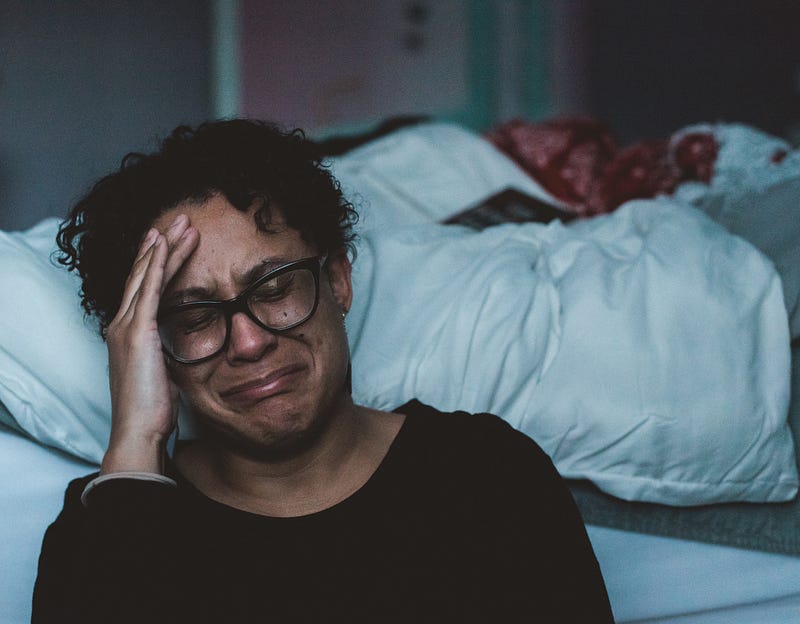
My Pain Isn’t My Problem: How to Understand the Angry “Friend”
Your discomfort with my pain is the problem. YOUR problem.
A few days ago I wrote a piece on gaslighting friends, which clearly resonated with more than a few folks. I might first refer you to the the work of Rev. Sheri Heller, LCSW, who inspired my piece.
What struck me powerfully were some of the personal stories you shared. I had a title that I’ve held in abeyance, as I’ll bet many of you do as well. Long lists of story ideas in need of fleshing out. I got my pound of flesh, if you will, when fellow Medium writer Kris Cochran shared an important story that absolutely makes the point I wanted to make (my thanks to her):
...I have a close friend who has been harshly judging my grieving process since my husband died in March. Apparently I am never in the stage I should be. WTF. Like it’s a process essay. She also acts like she does me a huge favor to take time out of her very busy life to set me straight. Today is garbage day. I’m throwing out my “kick me” sign and backing away. Hugs to you! Weight of the world lifted.Kris perfectly describes those around us who punish us for OUR pain, pain that they do not feel at all, but take it upon themselves to beat us up for experiencing.
You and I could go back and forth on this, and we could explore the deep and complex psychological dance of projection. However, it’s simpler to just call it out. When you get this kind of behavior, it’s time to shine a flashlight in its face.
Who on earth has the right to dictate to you when it’s time to stop grieving for the loss of your spouse? A dead child? A pet? For a job that got killed off for Covid-19? Your career, your college scholarship, your Olympic hopes? Does it even fucking matter? Because what is causing you great pain is unique to you. Comparing that to how bad their life is in that sick-stupid game of one-downmanship of YOU THINK YOU HAVE IT BAD? WELL LET ME TELL YOU HOW BAD I HAVE IT is insulting.
One way to have some empathy about this is to recognize that a friend or loved one may be deeply affected by your grief, and they don’t have adequate personal boundaries. As something of an empath, I know what that’s like, feeling someone else’s hurts. As a child I felt responsible for my parents’ pain, and as an adult it’s been an important habit to break. I’ve had to learn that giving those we love a sacred space to be angry, to grieve is part of what true friendship, true caring looks like.
People who are emotionally mature are fearless in the face of your pain for several reasons:
- Unless they are the cause (if so, please see this by Medium buddy Rosennab), they understand your right to your emotions. YOUR work. YOUR process. They will protect the space you need to scream, cry, yell, battle your demons. They know they are not the demon. Most importantly, they respect that this is critical to your recovery process. They do not, would never rob you of your pain, for that is yours to bear, and yours alone. You and I don’t need a savior. What we need is a hand to grasp in our greatest need, reminding us that yes, we can.
- They have done enough of their own work to understand the absolute need for grief, sadness, anger, whatever it is you and I need to feel, without judgment or censure.
- They don’t attack and damn you for doing what our culture ignores, avoids, dances around, denies and will do damned near ANYTHING to put off: the grieving and loss process. It’s precious, priceless work. Without learning to deal with loss, we cannot learn to truly live.
- Finally, unless we are trying to manipulate them with our feelings (which our best friends will indeed call us on), they will walk the path with us. And they will step away when they need to for a break, to breathe, recharge, and return as needed. Ultimately, however they know that this is a solo process. Our solo process. That takes courage.
However, as Kris points out, sometimes people who advertise themselves as our friends are indeed among the demons. Impatient with our process of grief because it doesn’t align with theirs, doesn’t live up to their expectation of what we “should” be doing, they effectively become part of the problem while also doing their best to cause us guilt for imposing on them.
To me, anyway, this speaks far more to their abject inability to deal with their own pain. There is no moral authority or superiority in being emotionally constipated.
Kindly.
Deep work leads us to be far more aware of the shit we carry. Especially that which we are so very eager to dump on others, in order to lighten our own load. Frankly, this is a lot deeper than simply projecting our pain onto others, which is basic Psych 101 (and nobody ever knows in the moment they’re doing it, including this writer).
Elisabeth Kübler-Ross is widely quoted on the five stages of grief. I have quoted them too, but with this caveat: Our grief is as individual as a fingerprint. There are so many “it depends” that making the mindless and incredibly unfair assumption that you just march forward through those stages and get your Good Housekeeping Seal of Approval Stamp in no time is again, insulting.
Grief doesn’t have a timeline. There are stages, and we backslide, and we move out, and then fall back and feel as though the event just happened all over again. This article, published in the middle of Covid-enforced mass grieving over billions of broken lives, stories and careers, points out what’s flawed:
From the article:
But George Bonanno says they (the Five Stages) can do more harm than good. “People who don’t go through these stages — and as far as I can tell that’s most people — can be led to believe that they are grieving incorrectly,” he argues.
He says he’s seen many examples over the years of people “who were assuming they should feel a certain way, or their friends and relatives were assuming they should feel a certain way, and they weren’t, and people were suggesting maybe they should see a therapist”.
Some doctor decides, or we interpret their work, that we only have to go through five stages. Or, that the process is linear, and we will never backslide. I could go on. You see what I mean. Then some mean friend decides for us that if we’re not moving along at the appropriate clip according to their interpretation of the Five Stages, then clearly there is something wrong with us.
If I may.
Kindly, you lose your gram to Covid-19. Then your gramps. Then your job. Your kids have to stay home and now you can’t feed them because you live in Florida where the unemployment checks are fucked up and the entire state government is criminally stupid. So now you can’t pay rent either, and oh, the bank is going to foreclose your car, and and and and. Oh, and with each of those, kindly, a grieving process beings. EACH of them. They overlap and merge the way great rivers conjoin in the Amazon, some clean, some muddy, some blue, some green, some brown, until you can no longer tell what you’re grieving.
Brave people make space for others’ pain. They don’t impose more pain on them for not ascribing to some ridiculous timeline or process which always was nothing more than a very loose understanding of how we can, might, may, sometimes deal with grief.
I am still grieving a vicious breakup that damned near did me in. That was in January 2019.
Think I should be over it already?
All due respect, but FUCK YOU. You aren’t me. You aren’t living this life.
Any more than, say, I have the right to say to a Black sister to “get over it already, George Floyd is dead and buried.”
Really?
The same goes to anyone who imposes their version of how to handle deep, complex, painful and devastating emotions on someone else. Not yours to do. It’s our pain. We will deal with it, thankyouverymuch.
We do not understand someone else’s pain or process. We don’t know their triggers. Hell, we hardly understand our own, for that matter, we are so under-trained on how to process legitimate pain.
We’d love you to love us enough to offer a shoulder, not a tut-tut or a there-there or a get-off-your-ass-and-move-it-soldier.
Love us enough to let us do the work our way, in our time, and on our terms. If you’re supremely fortunate, we will do the same for you.