
My Mother’s Struggle to See Herself as Feminine Became Mine, Too
I felt like a failure as a woman — and so did she.
“Oh, look, it’s your dad,” my friend Jenny said one day, when our school bus drove by my house, slowing down for the nearby bus stop.
I looked through the window at the figure bent over in my front yard, which soon after straightened, revealing a long, brown ponytail. It was my mom.
“Oh shoot,” Jenny said. “Sorry.”
I knew why she apologized. We were hyper-aware of gender expectations and knew, even at 15, that implying that a man was feminine or that a woman was masculine were the worst insults one could inflict.
It was unavoidable for my mother. She was almost 6 feet tall, just an inch shorter than my dad. And after four kids, she was the average size of the American woman, making her a bit larger than my skinny father.
This was a constant source of pain for her. She’d often confided in me that while she loved being tall, she had been teased mercilessly for it. The only thing that had made her feel feminine and beautiful was being skinny, once upon a time ago.
We were hyper-aware of gender expectations and knew, even at 15, that implying that a man was feminine or that a woman was masculine were the worst insults one could inflict.
I always appreciated that my mom was very honest with me about her decades-long struggle with eating disorders and body image. She never shied away from telling me that she used uppers throughout high school to keep from eating, and engaged in all kinds of other dangerous methods of weight control.
It helped me understand that I was not alone in my own struggles with my weight and body image issues.
Unfortunately, however, it didn’t stop me from experiencing a similar fate.
When I think of my mother, I always see her as a large person. It’s odd to me that that is the picture I have of her in my head because for all of my childhood, she was extremely thin. And yet somehow, I don’t remember that. When I look at the pictures of her in cutoff denim shorts with those skinny legs and her strikingly pronounced cheekbones on her chiseled face, I’m always shocked. I don’t recall that woman, at all.
My mother was always awkward in her body. That is what I remember. Awkward to the point that she seemed to lumber instead of walk. As she developed joint problems in her forties, that clumsy, heavy motion of her body became even more pronounced.
When I look at the pictures of her in cutoff denim shorts with those skinny legs and her strikingly pronounced cheekbones on her chiseled face, I’m always shocked. I don’t recall that woman, at all.
As she approached 50, she gained weight, almost all of it in her hips, thighs, and rear end — in fact, most of it in her rear end. It seemed like her clothing and the way she moved emphasized this to the point of absurdity.
I feel so horrible to say this, but as a teenager, I was ashamed of her because of the way she carried herself, and yes, because she had such a huge ass. Most of my friends’ moms were super tiny and skinny (at what cost, I now wonder) and those who were overweight were overweight all over and didn’t seem to be self-conscious or to carry themselves any differently than the skinnier moms.
I felt like my mother had failed at femininity. When Jenny misidentified her as my father that day on the bus, I felt so embarrassed.
The understanding that my mom wasn’t an “acceptable” female made me more uncomfortable than I could handle. Not just because of what that said about her — but because of what it said about me.
I was only 13 by the time I knew I had my mother’s body. She, in turn, inherited her stature, her heavy thighs and ass, from her father.
It seemed unbelievably cruel to me that one towering, heavy man and a dainty, petite woman had three towering, heavy children. That body type worked out quite well for my two uncles. Not so much for my mother.
My sister also ended up incredibly tall (5'11"), but bone-thin, like both our grandmothers. My half-sister inherited her mother’s swan-like body, completely the opposite of mine. And my three female cousins all inherited their mother’s genes: strikingly tall and skinny as Victoria’s Secret models.
And there I was, “short” at 5'7", with fleshy hips and thighs, stretch marks that tore across my abdomen by the age of 12, cellulite that blossomed everywhere by 14, and my mother’s (and grandfather’s) big, droopy, square-shaped ass.
I didn’t start gaining weight or struggling with eating disorders until I was 12, after suffering through daily bullying, harassment, and assault that slowed, but never ended until I graduated from high school.
I wonder what would have happened to me if I hadn’t experienced that. Would I have gained so much weight? Would I have developed eating disorders or body dysmorphic disorder?
I don’t know. But I do know that my struggles were extra tortuous because I both wanted to be fat and ugly (so my male classmates would leave me alone), but I also longed to be beautiful and thin, the way a woman was “supposed” to be.
There was no way out. In order to protect myself from the bullying and assault, I had to keep eating. I had to keep pushing away any chance that I could meet our culture’s standards of beauty (which is impossible, anyways).
And in that, I felt like a failure as a woman.
My mother was always hilariously self-deprecating. She loved to make jokes about how “fat” she was, how ugly, how clumsy, how unattractive. She’d tease about how much she wanted to wander through Middle Earth with Viggo Mortensen, then say, “I can only imagine how much he wants a piece of this,” while motioning to her body.
It was part of our family’s story: Mom was ugly and fat. Not attractive to men. Not desirable like a “pretty” woman might be. Not as valuable.
No one actually said that and I doubt any of us fully understood what she was trying to communicate. But that was the story and it didn’t seem so bad because she worked so hard to make it funny.
It was part of our family’s story: Mom was ugly and fat.
There was such a vulnerability to it, though, that I didn’t recognize at the time — how hard she tried to be beautiful, to be skinny. How much she longed to be “pretty” and “feminine.”
I remember the few times I talked to her when she was in the shower, seeing glimpses of her naked body when she got out and wrapped a towel around herself. I was scared by her body — especially her belly, hips, thighs, and rear end. Everything seemed so sloppy — droopy skin, scars, stretchmarks, dimples, cellulite, and varicose veins… There was no containing the imperfection.
I knew that it wasn’t acceptable by our culture’s standards. I understood why she made fun of herself. A man would look at that say, “Fuck, no.” It wasn’t sexy or desirable or beautiful. It was a failure.
And what was even scarier was that I saw the same thing in the mirror. I looked just like her.
What does it mean to be a woman? What does it mean to be feminine? All these years later, I still don’t know.
Nothing much has changed for me. Because you know what? Stretch marks don’t go away. Cellulite cannot be removed. And it turns out, dealing with sexual trauma and the associated coping behaviors that were born from it are lifelong journeys.
In other words: I’m still chubby, I still struggle with body dysmorphic disorder, and I still have not fully overcome my eating disorders.
And my mom still tells the story that she’s fat and ugly. She still makes sarcastic jokes about how unattractive she is to men.
She lost a ton of weight after her divorce and is actually quite a cute little 68-year-old. Except that she is still convinced that she’s a horrifying creature from a fairy tale. She still carries herself with that clumsy, lumbering gait. She still jokes about her tall frame and her varicose veins.
The vulnerability in her is palpable — just like, I suspect, it is within me.
…she is still convinced that she’s a horrifying creature from a fairy tale.
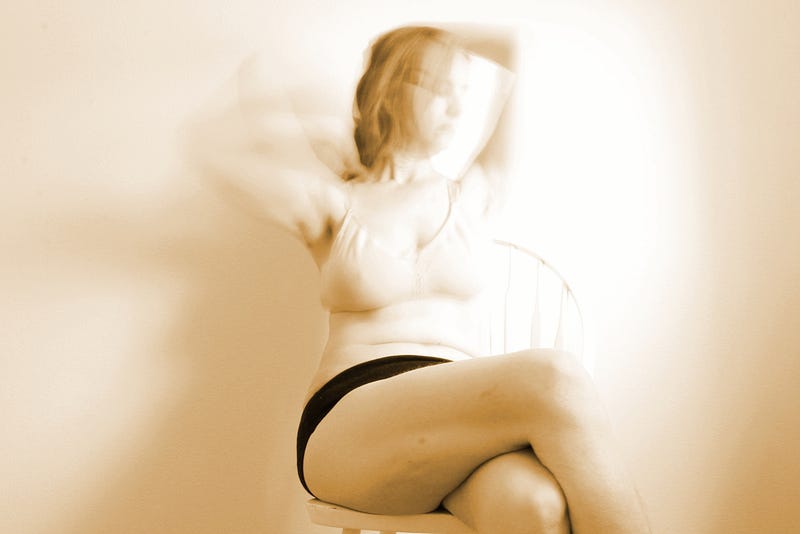
I’m still afraid when I see myself in the mirror and look at my hips and thighs and belly. Taking self-portraits in which my ass shows is deeply challenging and overwhelmingly humbling.
It’s all right there, in the place where the deepest part of my womanhood resides: my worth, or lack thereof.
Can this part of me, so messy and comprised of nothing but imperfection, be loved by someone else? Not tolerated, but adored?
Can this part of me, so wild and unmanageable, be desired? Not just fucked, but wanted?
Can this part of me, so unfeminine according to our culture, be recognized as the undiluted power of the feminine principle that it is? Not just accepted, but revered?
This is a journey my mother began — and probably many women before her. I don’t know if she will find her way.
But for her and all my sisters in this world, I must. I will.
© Yael Wolfe 2020
More on womanhood:


