
My Mother’s House
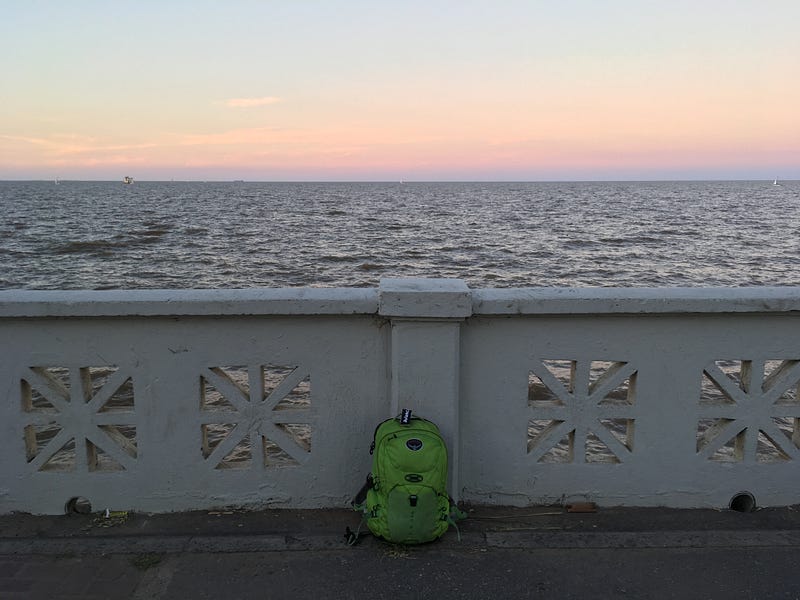
I zipped up my backpack after throwing my bundle of clothes inside. And just like that, I left my mother’s house.
It was the end of that leg of the “let’s visit family tour”. I’ve been living in New Mexico for over fifteen years now. My mother lives in Uruguay, right across the river from my sister who is in Argentina. The river is the Rio de la Plata, a wide body of water that serves as a border between the two countries. It takes half an hour to get across it on a fast ferry, or three hours on a regular one. My father lives now in Spain.
Being overly dramatic, I would say I don’t know if I will ever see my mother again since the trip is not an easy or cheap one to undertake. Being realistic, I will note that this can be said about just anyone. In my defense, distance, cost, and histrionics predispose me to the first line of thought, in which this is the final time I’ll see her. It is often once every one or two years I am able to afford this let’s visit family tour. My folks don’t even dream about it. My mother is now seventy-four years of age.
I had been apprehensive about this leg of the tour. My parents had recently divorced and sold the family house, leaving them in a not enviable place. You can imagine disassembling your home of twenty years and hastily move your stuff to a smaller place. The clothes us kids once wore, that they were keeping as souvenirs, as keepsakes of something that once was small. Now they were attempting to find a worthy new owner for them clothes, but who wants a forty-year-old V-neck sweater? The countless pictures on the furniture and fridge, who would take custody of them?
Financially, one mid-size house doesn’t always buy two small ones. It may buy a studio apartment in Buenos Aires that my sister ended up inheriting after my father re-acquainted himself with an old flame in Spain and a beach cabin in Uruguay that would be cozy if you were a mysterious and secretive struggling artist, but maybe not at age seventy-four. I had long stopped trying to make them consider the implications of their decisions, they were consenting adults after all.
Seeing my mother for the first time in two years, I was shocked. She had lost maybe thirty, possibly forty pounds. She was not a thin woman prior, but she wasn’t a heavy-weight either. The nursing school lectures about the elderly not eating due to having no companions flashed back to my mind. Depression in the elderly. Lack of resources. Loneliness. This was the prodigal case study:
Elderly woman whose closest child lives thirteen countries away… the writer here is struggling not to become melodramatic. Her closest child lives in the country next door, she has some relatives in the country where she now lives, but they are about a hundred and fifty miles away and they all depend on public transportation, for any practical purposes they are a good three hours away. What sort of community resources are appropriate for her?
Growing up, my parents seemed to be in a constant state of fight. There was no flight, there was only fight. My father was a left-wing revolutionary who had been good enough of an activist as to warrant running away from their home country of Uruguay since the authorities at the time had attached a price tag to his head. My mother was a professional nurse whom I believe, just wanted to be the respectable housewife of a respectable man. My father was a veterinarian, and her desire was to contribute to their advancement in society. However, support and appreciation for two professional Negroes were limited and conditional in their homeland.
I am highly embedded in race. Growing up in Argentina, I had always felt like an alien in my home town. It was easy to lie about my nationality. People were ready to believe I was from somewhere else.
In Uruguay things were different. Even now, Uruguay has a small provincial feel to it contrasting with Buenos Aire's cosmopolitanism. It is a peaceful country. Conservative. There is a newly build Trump Tower on Uruguay’s most popular beach town now.
When they ran away escaping the military coup, my mother left the dream of advancement behind. The dream to prove to her white friends she was an equal stayed in Uruguay. She had traded those dreams for the dream to survive.
Now, some half a century later, she had returned to her hometown, her paisito- little country-, wounded and with no husband. Old friends had moved on or died, this meant no one to brag about the children and grandchildren abroad you cannot afford to visit on most weekends, like most families would in family first South America where any weekend is a Thanksgiving style gathering, with barbecue in lieu of turkey and ham. This was my first trip to Uruguay in over two years, the first one after she bought her new house.
I was afraid of going. Our phone calls over the last couple of years had grown tense once I became more vocal about the decisions she was making. Divorce is fine if you don’t love your husband anymore, but moving so far away from the people who can lend you a hand when in need in the name of a paradise-like sleepy beach town seemed impractical to me.
Our relationship was tense growing up once I reached puberty. It is not easy to be a parent, as is not easy to be a child. Maybe I reminded her of the man that pulled her away from her newly furnished apartment in the wake of a military coup. I wonder if she had the same left-wing ideals my father had. She was fighting to be an equal with her nursing degree, I think she wondered why couldn’t everyone else do the same instead of starting a revolution.
To build a home and raise children is not an easy task. You need to navigate the intricacies of growth and change. Cuddle-craving children turn into hormone-rage-filled adolescents that desire their independence. Children that yesterday look up to you for the meaning of every little thing in life, now they avoid you like the plague. When yesterday they wanted your love, now they only crave their peers’ acceptance.
My mother lacked some of the ingredients that create the glue most people call home. Exiled from her country, she had no access to extended family. No parents nearby, nor aunts or nephews to use as a compass to follow. No lighthouse that would indicate her position at high sea at night. Looking different from most people in Buenos Aires, she had few chances to feel like she belonged.
Trying to fit in, she probably looked for validation instead of connection. She tried to make friends with achievers, mentioning that this friend was the one who managed this world-class dancer, or this was the spouse of a famous radio personality. It is ultimately not good for the ego to befriend authoritative people for the reason of the validation their authority confers. Additionally, people usually don’t want to be someone else’s crutches.
My mother was, therefore, a woman with a husband who spent the best part of his six-day workweek in a salaried job, with few real friends, and except for her sister who lived in a town nearby, no extended family. Feeling her dreams crushed, with no chance to shine in the Uruguayan society, and not quite making it as an expat in Argentina. And then probably without even noticing, she took the train of sadness. The train of prolonged sadness leads to depression, and depression to despair, passing by the town of anger, finishing in hopelessness.
I never felt it was my responsibility to make my mother happy, as I wanted to be my own persona. I like to think that harsh words were not my style, but I was confrontational and argumentative, and kind words were scarce if not absent from me. It may be argued that the lack of a kind word, is equivalent to an unkind one. And it may be said that even as we are not responsible for another person’s thoughts, it is also true that a kind word can displace an unpleasant thought the person may have, the same as a kind and honest word can reinforce a thought of self-love and appreciation.
Walking into her house, being surprised by her weight loss, neither I nor she knew exactly how to behave, fearing her hour-long monologues, it was easy to place myself into the future, two days later, when I would be flying back to Argentina. I was afraid to build trust. I was afraid to give myself to the mother that gave birth to me.
I could sense her fear, but also her desire to build. Her wanting to be the mother who was not afraid, who had no guilt over having made so many mistakes in the past. The mother who would forgive herself for not having always been there, who did not explain what to be a person of color was about, who somehow could not transmit to me in a language I understood, how beautiful I was when growing up.
It may be argued that the first ingredient to be forgiven is to initially forgive ourselves. It may be said that to forgive you must be first grateful.
I am usually a man of few words. But a few months back, living my dream of riding my bicycle in Italy, along Lake Garda, I got this sudden orgasmic realization of how great it was to be alive, and how thankful I was for the woman I used as a conduit into this world. That day, I called her and thanked her for bringing me to the world. However, I am not too sure she understood what I was trying to say. Who knows what was going through her mind that day. But my joy couldn’t light up her voice on the phone.
The morning before the afternoon in which I would zip up my backpack to depart, I told her so again. We were the pieces of something broken, some with sharp edges, some a pulverized powder of something unrecognizable that may be as well used for something new. For some, the sharp edges were beginning to soften, after having been used for so long.
That morning I thanked her for being my mother, for taking the pains of bringing me to the world. We hugged and I felt her softness and warmth, some internal wall falling in both her and I. There were no speeches, just the natural approximation of two elements that attract each other to form a bigger molecule. As we held on each other’s arms, not knowing who was holding who, she kissed me the way she used to when I was a child.
Later on that day, I zipped up my backpack after throwing my bundle of clothes inside. And just like that, I left my mother’s house.


