
My Mother was a Holocaust Refugee
One of the millions of stories you never heard.
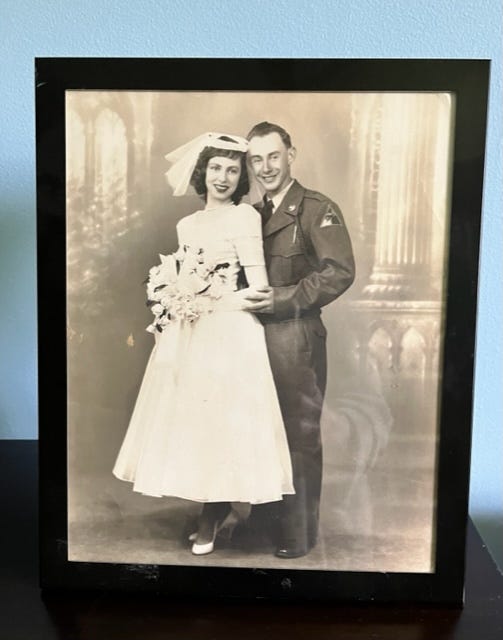
And there are millions. As the population of children directly affected by the Holocaust begins to pass away, it’s more important than ever to get these stories out into the public record.
The more we know, the more we can do to prevent similar events in the future. I hope.
Stories have trickled in about people who fled the Nazis with small children to far flung places like China, Australia, Uruguay, South Africa and Turkey. I have to wonder what their lives were like, because there isn’t much information out in InternetLand about some of these.
This is why I want to share with you my mother’s story. I will, at a later date, share my father’s too.
Beginnings
In 1937, my grandparents had a decision to make. It’s the kind of decision that nothing in life can prepare you for. Everyone they knew thought they were crazy to even consider leaving Berlin. They had a thriving business, an envious life of luxury, and a newborn baby.
But things were beginning to get ugly and scary. At that point, the SS had taken over the police force; “Gypsies” were rounded up and disappeared, anti-Jewish signs and propaganda became commonplace, the Nuremberg Race Laws stripped Jews who had been in Germany for generations of their citizenship, the first concentration camp had opened, and the Nazis were “encouraging” Jews to give up their property and emigrate.
My grandmother began to make plans to leave. Her brother and she argued about it to the point where they stopped speaking. It would be the last time they saw each other. By the time her brother realized she was right, it was too late. He and his wife were sent to Auschwitz and died there.
I don’t know why or how but am very grateful that my grandfather, his brother, and both sets of great grandparents agreed to go. I do know from later stories that my grandmother was a force of nature, and woe to anyone who stood up to her.
They went to the port of Bremerhaven with what they could carry. From here, the story becomes murky but there are hints that my grandmother smuggled out some valuable silver to pay their way onto a ship. When they arrived at the port, there was one freighter that agreed to take them and a small group of others. It was bound for Colombia, South America.
I heard the story of my grandmother’s reaction to this news many times from my mother. It must have been an oft-repeated family story since my mother was only nine months old at the time it happened. Apparently, my grandmother was horrified at the thought of going to a county where it was thought people lived in trees like monkeys. To me, her reaction is horrifying, but again, 1937.
They had no choice.
Zero. Again, the situation is impossible to imagine. So, they got on board.
They arrived in Colombia and were greeted by a man who worked with an international Jewish group. Everyone on the freighter was sent by horse and cart over the mountains and across to the farmland on the western side of the country.
My family had never seen a cow or goat in their lives. They had been a part of gentrified society for generations. Had none of this happened, my mother would have been a debutante that was introduced to society at a ball, like something out of a movie.
They stayed one year on the farm. That’s how long it took my grandmother to find a city to move to where they could start over.
Cali, Colombia at the time had a small population of Sephardic Jews who had come years before. She approached their Rabbi and demanded help. I understand he didn’t want these German Jews to come and destroy the fragile peace that he had helped establish for his small group. But again, you didn’t mess with my grandmother; and she got what she needed.
They moved to Cali, opened a small store called El Barato and bought a house at the base of a hill called La Loma de las Tres Cruces where they all lived together. My mother grew up surrounded by loving grandparents and was her father’s pet. She tells stories of being the only Jewish girl at a private Catholic school, her mother’s fame for her talent at singing at the store to entertain customers, and the birth of her brother and one cousin.
But things were not to go smoothly for her. My grandmother had designs for her that became obvious when she was a very young teenager.
My grandmother began searching for a rich Jewish man to marry my mother. They needed someone wealthy enough that he would not want a large dowry, which they did not have. She wanted her daughter to be established as the princess she was meant to be. The age of the man did not matter, his looks did not matter, nothing but his station in life was important.
But she didn’t count on the fact that her daughter had inherited some of the same characteristics she herself had relied on to get them to this point.
My mother went on so many arranged dates in Cali, sabotaging any match, that my grandmother had to start looking outside the country. The two of them traveled to Ecuador to meet the son of a wealthy business owner who had many other Jews working for him that came after the war was over.
That’s where she met my father.
He was an employee of the business; a working-class young man who had survived years in a prison camp and was now a fun-loving and funny teenager. They became friends, but my grandmother stifled my mother’s interest in him and continued to scour for the right one.
Finally, a letter arrived from the United States. A son of a doctor in Toledo, Ohio would marry my mother. It was all arranged and my mother, at nineteen, was put on an airplane and sent to Idlewild Airport in New York, to be cared for in Brooklyn by a family friend until things were ready in Ohio for her.
What my grandmother did not know was that my parents had maintained a secret correspondence for years. And that my father had moved to Brooklyn.
A year after she arrived, my parents married. My grandmother did not, however, give up. She invited them to Cali for a family celebration, but as my mother tells it, she knew that this meant my grandmother had a plan to annul the marriage and continue the search.
They stayed in New York.
Things were not easy for them. My father suffered from what we now call PTSD and could not hold a job. He ruled our house with an iron fist and would not allow my mother to go to college or get a job. After twenty years, she found her strength again and divorced my father.
She went to work, developed a social life, and got a bachelor’s degree at fifty years old. She began her lifelong dream of teaching, completed her master’s at fifty-five and taught for twenty years before retiring. Along the way, she fell in love with her grandchildren and spent every moment she could with them; and to this day, that love is mutual.
There’s a lot to admire about my mother. It wasn’t always easy being raised in this situation; and I’ve reconciled with that. As a woman, she is an example of pluck and drive and self-improvement.
And I’m telling this story as homage to her life as she begins to approach ninety years old, because her story is just one of the millions that needs to be heard.
I grew up hearing my parents’ stories. They made a deep impression on me and I always knew they should be shared. But I didn’t have enough details to write a nonfiction book about them, so I fictionalized their stories into a historical fiction novel. See the link below if you are interested.
Don’t worry, Dad. Your story is next.