
My Mini Boss
How listening to my mini moth orchid made me a better gardener.
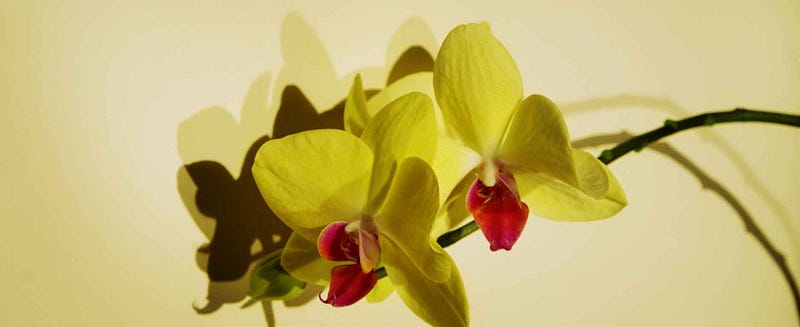
In June of last year, I accomplished something momentous. I got an orchid to re-bloom. For the first time ever —
A year and a half ago, a friend gifted me a moth orchid (Phalaenopsis Blume)—a mini, with gleaming leaves and creamy yellow-and-pink blooms.
I placed my orchid on the kitchen counter, where I could drink in its pint-sized beauty, while I ground spices for curry or rolled out chapatis.
The flowers continued to delight for over two months before falling off. Now, this should have signaled the end of the plant’s flowering career. I had never been good about taking care of orchids. So, it was hardly surprising that none had re-bloomed.
But this time, I looked at the little orchid and said: I’m going to pamper you silly. And then maybe you’ll bloom for me.
Assiduously —
Google told me the orchid’s next blooming cycle was four months away.
For the next three months, I watered my plant assiduously (a word I’ve always wanted to use). Starting month four, I added a phosphorus-rich fertilizer to “encourage profuse blooming” — as the label on the box promised.
And then—I waited. Every time a little green nub sprouted on a stem, I rejoiced and said: This is it!
And each time, the nub stubbornly branched out into leaves instead of flowers.
Doc Google —
I grew desperate and ran the following Google query: Why does my moth orchid refuse to bloom?
The diagnosis—and suggested remedy—across several gardening blogs and websites was this: Maybe your plant isn’t getting enough light. Try moving it closer to a window.
I mulled over the suggestion. I could move the plant to a ledge in my bathroom. The ledge is right by a window. My plant could bathe all day in “bright-but-indirect sunlight.”
The location was perfect, except for one thing: I didn’t want to move my plant from where I spent a good chunk of my time. I wanted it where I could look, touch, and talk to it—in between slicing okra and loading the dishwasher.
And so, the orchid stayed on in the kitchen. Its leaves grew quite large, what with all the watering and feeding. But it was resolute in its refusal to bloom. It seemed to have undertaken floral satyagraha¹.
Finally, a month into this battle of wills, I admitted defeat and moved my orchid to the bathroom ledge.
Two weeks passed. The little plant put out a shiny, new leaf and a tender aerial root. Figuratively, at least, it was blooming in its new home. I stopped caring whether it did so literally.
Another week went by. And then, one day, a tiny appendage appeared just below the tip of a stem.
Could this be the start of the elusive Bloom?
Please-let-it-be-a-bloom —
Over the next week, the please-let-it-be-a-bloom swelled and took on the unmistakable ovoid shape of a bud. At the start of week two, its tightly-pursed lips opened, and yellow-green sepals began peeling away from each other.
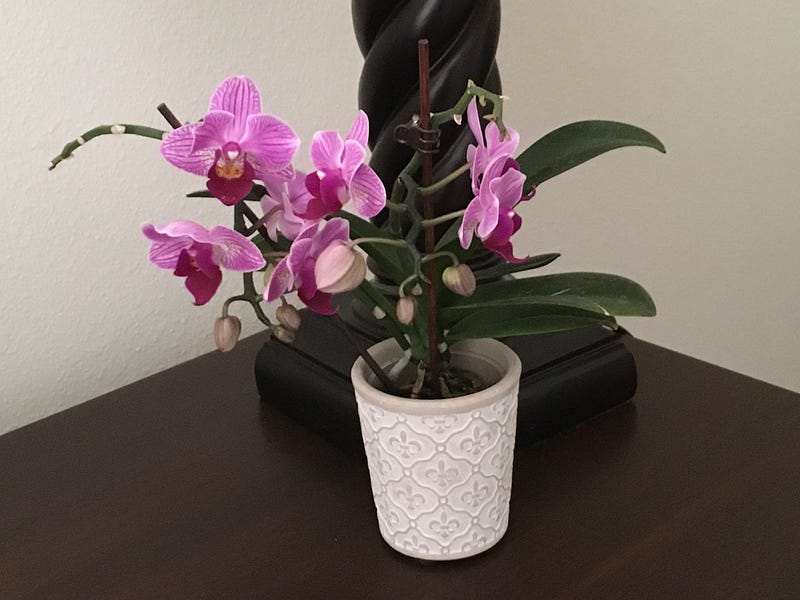
Finally, on day thirteen, the Bloom stood before me—proud and perfect —its creamy, dusted-with-pink petals cradling a wine-pink heart.
So, of course, I had to take a picture and post it online.
The boss of you —
Now, maybe this bloom is a one-time thing. Or perhaps it’s the start of my grand and glorious vocation as a re-bloomer of mini moth orchids.
Either way, I learned a lesson I believe most gardeners know already. And the lesson is simply this: Your plant is the boss of you.
I have six orchids. Currently, three are in a state of bloom.
And I am in a state of thankfulness to the Gardening Gods. And to my Mini Boss.
Citation: 1. Satyagraha refers to non-violent or civil resistance.
Thanks for reading!
A couple of my nature poems: