
“My own mind is my own church”
How Voltaire, Thomas Paine and the French Revolution changed modern religion

Today many of us seek to establish our beliefs for ourselves, based on our own experiences and enquiries. We also acknowledge others have the right to do the same, accepting or rejecting religious tenets as they see fit, free from condemnation or coercion. However, this freedom of choice was hard won.
At the start of the modern era — that is, from the early 1600s — the masses of nation’s citizens were not free intellectually, economically, socially or religiously. The shackles of feudalism still hung on the lower classes, with aristocrats and clergy operating in tandem to maintain power and control.
In this essay I examine three key contributions to breaking down these limitations, and the Christian doctrines used to support it. The three consist of a poem written by Voltaire, the ideals that drove the French Revolution, and the pioneering social concepts of Thomas Paine.
Each laid the foundations for the ideals of social, intellectual and religious freedom that today we assume as our right. I begin with a catastrophic act of nature.
The Lisbon disaster
In 1755 a massive earthquake devastated Lisbon. It sank innumerable ships moored in the harbour, and killed up to 100,000 people. F.M.A. Voltaire (1694–1778), one of the most celebrated philosophers and satirists of his age, responded by writing Poem on the Lisbon Disaster, which was published in 1756 to widespread acclaim. It began:
Unhappy mortals! Dark and mourning earth! … Behold these shreds and cinders of your race, This child and mother heaped in common wreck, These scattered limbs beneath the marble shafts … In racking torment end their stricken lives. [From Selected Works of Voltaire, edited and translated by Joseph McCabe]
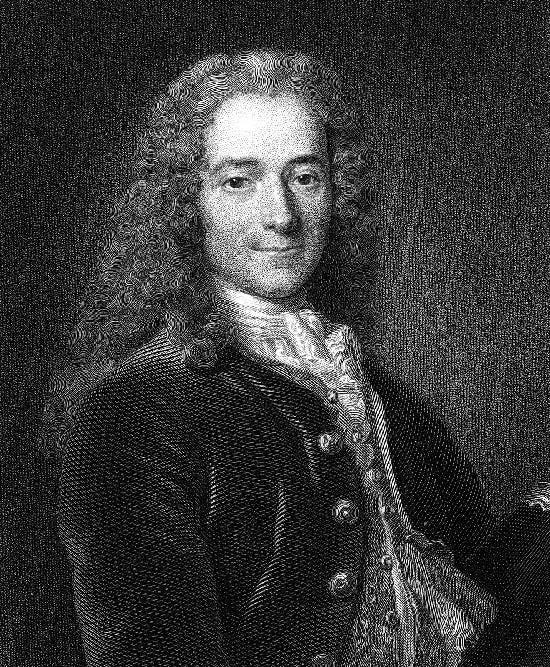
Lisbon’s earthquake set in motion a tidal wave of religious doubt. The earthquake had occurred on a religious holiday, to a Catholic population, and destroyed the most important churches in Lisbon. As news of the disaster washed across Europe numerous believers wondered why so many good Christians had died. If God was all-loving and all-knowing, how could He have allowed this to have occurred to His own?
Influential Christian apologists explained that evil happens to people because they’ve been bad. God, being all-good, all-knowing, and all-powerful, couldn’t allow anything bad to happen to His loyal believers. So those killed in Lisbon must, unknown to all, have really been bad people.
Voltaire struck back by asking what crimes the innocent infants who died in their mother’s arms had committed:
Say you, over that yet quivering mass of flesh “God is avenged: the wage of sin is death”? What crime, what sin, had those young hearts conceived That lie, bleeding and torn, on mother’s breast?
Voltaire went on to ask if the church-going people of Lisbon were really more evil than those God had left untouched to dance and carouse in London, Paris, or Madrid? Voltaire ended by observing that Christ, the Son God sent down to release believing humanity from sin, ultimately hadn’t proved effective:
A God came down to lift our stricken race: He visited the earth, and changed it not!
This wasn’t a single instance of Voltaire questioning Christian doctrines. Voltaire turned his questioning, often savage, wit onto everything that he viewed as foolishness, humbug or ignorant — and he considered Christian beliefs embodied all three.
The significance of Voltaire for us today is that he wasn’t alone in this line of thought. The questions he asked were the same questions many of his fellow Europeans were also asking.
Those questions reached a terrifying climax just two decades after Voltaire’s poem was published, when the French Revolution dealt to Christianity with great violence.
Dismantling Christianity
In the 1780s, France had fallen into deep trouble. France was a feudal state, ruled by a big-spending king supported by an aristocracy closely intertwined with the Catholic clergy. Throne, aristocracy and clergy together formed the ancien régime, a traditional power structure that financially exploited, and politically oppressed, the rest of the population.
This resulted in the hard-working middle-classes being heavily taxed to finance the lavish lifestyle of the king and his fellow aristocrats, while the serfs were taxed exorbitantly by the Catholic Church, which had a right to do so granted by the French throne.
When harvests failed in 1787, economic and political turmoil followed. The masses of French citizens were already chafing under their exploitation. So when the king decided the answer to the country’s economic woes was to go to war with his wife’s brother, the King of Austria, with the aim of stimulating the economy and raising his own declining profile (on the premise that there’s nothing like a good war to glossy up a ruler’s tarnished reputation), the middle and working classes went to war themselves. They began by storming the Bastille on 14 July 1789. The French Revolution had begun.
Initially, the Revolution was seen as an opportunity to get rid of the king and the ancien régime, and to create a new state built on egalitarian principles. French political thinkers formalised that aim in Declaration of the Rights of Man and of the Citizen (inspired by the American Declaration of Rights of 1776). This declaration, which became the founding document of the new republic, recognised that all citizens were born free and had equal rights. The separation of the powers of executive, parliament, and judiciary, and new social contracts between citizens and the state, were all established. The clergy was disbanded, and the Catholic Church forced to sell many of its lands, with the resulting income going towards paying off the national debt. Powers taken from the Catholic Church were vested in the French Republic.
In the years leading up to the French Revolution, Denis Diderot, writer and philosopher, famously proclaimed that France would never be free until the last king had been strangled with the entrails of the last priest. He got his wish — and more. Revolution was followed by the Reign of Terror, in which between 18,000 and 40,000 perished by the guillotine or were killed by marauding mobs.
In response to the historical abuses of the Catholic Church, those behind the Revolution initially sought to de-Christianize French culture. Jacques Hébert, a journalist and newspaper publisher who rose to prominence during the subsequent power struggles, advocated the rule of reason. This included declaring a young woman the Goddess of Reason and organizing public ceremonies in Paris during which churches were defaced. Alternative to Hébert, Maximilien Robespierre sought to establish a state religion that acknowledged a Supreme Being who watched over France, but without drawing on Christian doctrines to describe that Being.
It could be argued that both Hébert and Robespierre were cynical in proposing a Goddess of Reason or a Supreme Being. Each really wanted a secular state, but they realized that so many French citizens believed in God that a divine replacement needed to be conjured up to satisfy their desire to worship a higher power.
In an emphatic resolution to the argument between Hébert and Robespierre over what form this should take, both men died under the guillotine. In due course, Catholic worship was reinstated.
The violence of the Revolution shook Europe and the Americas. Initially, the French revolution had been seen as a unique opportunity for the ancien régime to be overturned, for social injustices to be righted, and for a new social and cultural order to be instituted. So there was wide dismay when the Revolution guillotined itself into excess.
Yet the anti-religious ideas the French Revolution politicised, which rose from a genuine desire to promote humane ideals, had a profound social and intellectual impact on Christianity. This was because humanist ideals and ethics — of egalitarianism, social freedom, and ending the exploitation of one class by another — were now offered as alternatives to traditional religious morality.
The idea that Christianity was part of an old order that controlled, exploited, and oppressed the wider populace, and therefore that it had to go, resonated with numerous other thinkers. Few, however, agreed with the extreme measures adopted during the Revolution and its following Terror.
One of the most measured alternatives was offered by Thomas Paine.
A champion of freedom
Thomas Paine (1737–1809) is best known today as one of the fathers of the American Revolution. In his booklet Common Sense (1776) he argued for the independence of the American colonies from Great Britain, and proposed the basis for a constitution. His book attracted huge interest when it first appeared, selling tens of thousands of copies. Among his contributions, Paine came up with the new nation’s name, the United States of America, and presciently foresaw that the USA could become the world’s greatest advocate for freedom. (However, he didn’t foresee the political and economic complexities that later accompanied this advocacy).
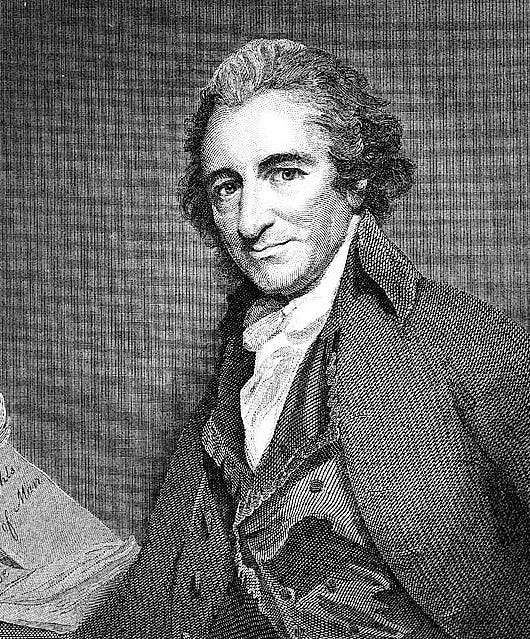
Paine was born in England. He had a Quaker father and Church of England mother. The Quaker independence of outlook, taking its cue from founder George Fox’s free-thinking and dissenter attitude, stayed with Paine throughout his life. Essentially a humanist, possessing a natural affinity with the poor, and always opposed to the exploitation of the masses by the wealthy, in his twenties Paine became involved in labour disputes, advocating for the workers. But by his late thirties Paine’s career supporting workers had died, principally because he had so riled the British ruling (and controlling) classes that most of his social and political writings were banned by Parliament. At the suggestion of Benjamin Franklin, in 1774 Paine moved to the American colonies where he re-established himself as a journalist.
Paine’s American articles and pamphlets immediately created a stir. He argued for the abolition of slavery, proposed a basic wage for all along with a pension for the elderly, sought social justice for women, advocated for an end to cruelty towards animals, and, most significantly, asserted that the American colonies needed independence from Britain in order to grow. Paine’s articulation of these issues not only made a fundamental contribution to what subsequently developed into the American Revolution, but also inspired those who initiated the French Revolution.
This inspiration was so great that Paine was offered French citizenship and a seat in the French Convention of 1792. Recognizing the momentousness of what the French sought to achieve, Paine took up both offers. But his French sojourn did not play out as he expected.
After voting for the establishment of the French Republic, Paine found himself caught up in the subsequent Terror. He was imprisoned, and nearly guillotined at Robespierre’s command, only avoiding death because his cell door was incorrectly marked. Paine was freed several days later, after Robespierre himself had fallen under the guillotine’s blade.
It was during the brief period between hearing he would be arrested and being taken to prison that Paine began writing his most influential book, The Age of Reason.
“The Age of Reason”
Paine had intended to write The Age of Reason in his final years, as a summation of his religious, political and social outlook. However, because of the carnage occurring in France, and having been warned he would himself likely soon be arrested, he felt compelled to start the book immediately — while he was still alive to do so.
Ironically for a religious sceptic, one of Paine’s central concerns was that with the abolition of the Catholic Church by the new French government there was a danger that “in the general wreck of superstition, of false systems of government, and false theology, we lose sight of morality, of humanity, and of the theology that is true.” [The Age of Reason, Part One]
What Paine considered to be true he articulated in the Profession of Faith that opens his book:
I believe in one God, and no more; and I hope for happiness beyond this life. I believe in the equality of man, and I believe that religious duties consist in doing justice, loving mercy, and endeavouring to make our fellow-creatures happy.
He was equally clear about what he did not accept:
I do not believe in the creed professed by the Jewish church, by the Roman church, by the Greek church, by the Turkish church, by the Protestant church, nor by any church that I know of. My own mind is my own church. All national institutions of churches, whether Jewish, Christian, or Turkish, appear to me no other than human inventions set up to terrify and enslave mankind, and monopolise power and profit. [The Age of Reason, Part One]
However, despite rejecting churches, Paine was clear that everyone was free to believe whatever they wished:
I do not mean by this declaration to condemn those who believe otherwise; they have the same right to their belief as I have to mine. But it is necessary to the happiness of man, that he be mentally faithful to himself. Infidelity does not consist in believing, or in disbelieving; it consists in professing to believe what he does not believe.
What Paine couldn’t abide were those who professed a belief, but acted contrary to that belief — he would have found plenty of targets had he been alive to witness world politics today!
As could be expected, accusations of atheism were thrown at Paine when the first part of The Age of Reason was published in 1795. Religious authorities and the politically powerful worked together to add his new book to the list of Paine’s pamphlets and books already banned by the British Government on the grounds they were seditious and blasphemous.
Yet it is clear from Paine’s Declaration of Faith that he was not an atheist. On the contrary, he held a very strong belief in God. It was just that, along with many others of his era, he wasn’t satisfied with traditional Christian formulations of belief in God, much of which, like Voltaire, he dismissed as superstitious and absurd.
Our religious freedoms today
The religious and spiritual freedoms we take for granted today — to think of Jesus as a man and not a God, to practise meditation and yoga, to read all world’s spiritual texts — have their roots in the efforts of many individuals. Voltaire, Paine and those who instigated the French Revolution were far from the only ones involved. Nonetheless, these three represent the significant steps that needed to be made in order to establish the freedoms we enjoy today.
Specifically: Voltaire challenged prevailing Christian doctrines that (inadequately, he thought) explained what happened in the world; the French Revolution dismantled feudalism and its ties to the clergy, replacing them with egalitarian and secular social contracts; and Paine articulated the intellectual ideals behind those contracts, in the process envisioning possibilities that have significantly shaped our modern outlook.
When Thomas Paine wrote, “my own mind is my own church,” he hoped, but could not foresee, what a profound contribution he made to our privileged modern religious and spiritual expression.
Keith Hill is the author of the award-winning book, The God Revolution, which examines how the concept of God evolved during the modern era.


