
My Migraines Led To A Near-Fatal Overdose On Prescription Medicine
Please do not ever make my mistake — a shared lesson
Dear Readers,
Happy Thanksgiving! When I think of this holiday and the true spirit, one word comes to mind — gratitude. And today, I feel complete and total gratitude because I’m breathing, still here, and not permanently harmed.
I began to write this, hours after being released from the hospital from a near-fatal accidental overdose from one pill of medicine I take to prevent migraines. I am finally well enough to finish writing four days later.
Please don’t make the same mistake I did. And please, do not ever think that “just one extra pill by mistake” is nothing. It’s holy sh*t not.
Since I was about six years old, I have suffered from migraines. That’s five decades of migraines. When I was young, my parents didn’t think kids could have headaches and dismissed me as dramatic. I used to roll pillows around my head and imagine I was in another place until I fell asleep from the pain. Or, more likely, I passed out.
As I got older, I learned various ways of managing the headaches. Still, I always knew I would be robbed of a considerable time when they would hit. I became aware of my triggers and minimized them at all costs. Everyone’s are different — although many migraine sufferers share common elements.
I was moving along for many years managing my chronic migraines — or more, they were controlling me. When migraines would strike, I would lose entire days to recovery if I didn’t have my medication in time.
One of my mother’s best friends was a neurologist. She noticed me rubbing my temples and neck (classic physical behaviors of someone with a severe headache) at a family get together. She asked me about my headaches and asked if I’d allow her to help me. And help me, she did. After the necessary MRIs and tests to rule out other neurologic issues, we began trying medications to mitigate the headaches. She tried prescribing Sumatriptan, which was new on the market. I would lose my depth perception. Then we tried Inderal, a beta-blocker, to reduce the headaches. That didn’t work.
I kept a headache diary to monitor what I ate, what worked, and what did not. Ultimately, I wound up having a prescription for Fioricet with Codeine as a rescue medication. That was my silver bullet. If I felt a headache coming, I would pop two of those capsules, and the headache would be gone. I never felt high from the medication — just out of pain. Or so I thought.
Interestingly, I never had a migraine whenever I was pregnant, which was a blessing since my rescue medicine was not safe for use during pregnancy.
Migraine treatments started to evolve. Neurologists were learning more about what caused migraines and how to stop them in their tracks. Some medications were accidentally discovered — for example, Botox for migraines. Women who were getting Botox for cosmetic reasons reported significant decreases in migraine headaches. This development led to the drug’s eventual approval as an approved therapy for the often life-altering headaches.
As time went on, my doctor prescribed Topamax to prevent migraines that I took daily — but I felt that it made me “stupid.” The drug has nicknames such as “dopamax” and “stupemax” because it causes the patient not to think clearly. Some patients, including me, reported difficulty recalling complex words. I was also receiving Botox injections every ninety days, and I had my prescription for the Fioricet with Codeine.
I was delighted until the opioid crisis hit, and doctors received scrutiny for the drugs they prescribed. Because my migraine medicine contained codeine, it was suddenly some big deal — regardless of how much it helped. And I only needed it when I had a headache. Because of the opioid crisis, suddenly, the drug was getting harder and harder to get. And because I received 100 capsules every three weeks, it triggered my prescription to be flagged.
It turns out I was having a lot of headaches. I was waking up every morning at 5 am with a headache and taking two capsules. Then at about 4 pm, I needed another two pills because the headache was returning. Many of these headaches were likely rebound headaches. However, I still had the same headache — even switching to other analgesics to avoid that. So I was refilling my medicine regularly, and I was setting off alarms.
Making matters worse — or in my case for the better, my neurologist was retiring, and I needed a new neurologist.
Enter a new neurologist. A brilliant, caring — and very blunt doctor who specializes in headaches. Just headaches. I have found my mothership.
I walk into my first appointment telling her — “I need a refill for…”
Oh no. My new doctor stopped me dead in my tracks. I was no longer running the show on the medication. She let me know in no uncertain terms that my rescue medication was “old school” and that she does not prescribe it. She talked about links between trauma survivors, migraine sufferers, and opioid painkillers as silver bullets. There is one. I was no longer going to be able to go to “Escapeville.”
My work began. The new neurologist slowly weaned me off the Fioricet. She created what I refer to as my “migraine prevention cocktail.” We continued my Botox injections. She added a monthly injection I gave myself called Aimovig, and I continued taking Topamax. She also prescribed an antihistamine called Vistaril and a drug for anxiety called Buspirone. She also prescribed a muscle relaxer called Zanaflex. And she started me on an antidepressant (not for depression, but part of the migraine prevention cocktail) called Aplenzin.
At first, I was pretty frustrated and freaked out. What the hell was I going to do when one of my hideous migraines struck? She gave me three different types of “Triptan class” drugs (Rizatriptan, Eletriptan, and Naratriptan) designed to be effective migraine rescue drugs. Two out of the three worked for me — Rizatriptan and Eletriptan. Plus, I had my choice of Compazine or Zofran for the nausea aspect of the migraine. Again, I had a specific “cocktail” of instructions to self-administer when I felt a migraine beginning to strike.
I learned to trust this process, and my migraines were under control for the most part. There were a few times when my migraines went out of control. Again, the doctor had other interventions, which I won’t discuss here as they are not relevant to this article.
Since that time, I have been working on myself. I have been meditating and learning to visualize migraines leaving my body without my rescue medication. We have been slowly cutting back my preventative medicines. I am on the path of healing my body from the inside out. I am also learning to manage and choose how I am affected by stress.
Nonetheless, last Saturday morning at about 7 am, while taking my medicine, I accidentally took my Aplenzin twice. I am on the highest dose of this medicine — 522 mg. By taking two pills, I had taken 1044 mg. When I made the mistake, I was not aware that I had done it. But something in the back of my mind, set off a little alarm that I disregarded.
Later in the day — at about 1 pm, while sitting with my daughter in our living room, just talking and having fun, I noticed something was very wrong. I felt my heart beating very fast, and I felt lightheaded — like everything was about to go white. I was all sweaty and feeling hyper. Then I realized — did I take two Aplenzin? Could that be why I’m feeling like this? I started to look up information on the drug and the side effects.
The symptoms I had that were causing me concern are:
- Feeling agitated and restless
- Panicky
- Irritable
- Manic
- Dry Mouth
- Like I was about to faint and light-headed
- Fast pulse — 120 BPM
I’m having trouble finding information about how much Aplenzin is too much specifically. Here’s what I see in large letters at the top of my Google search:
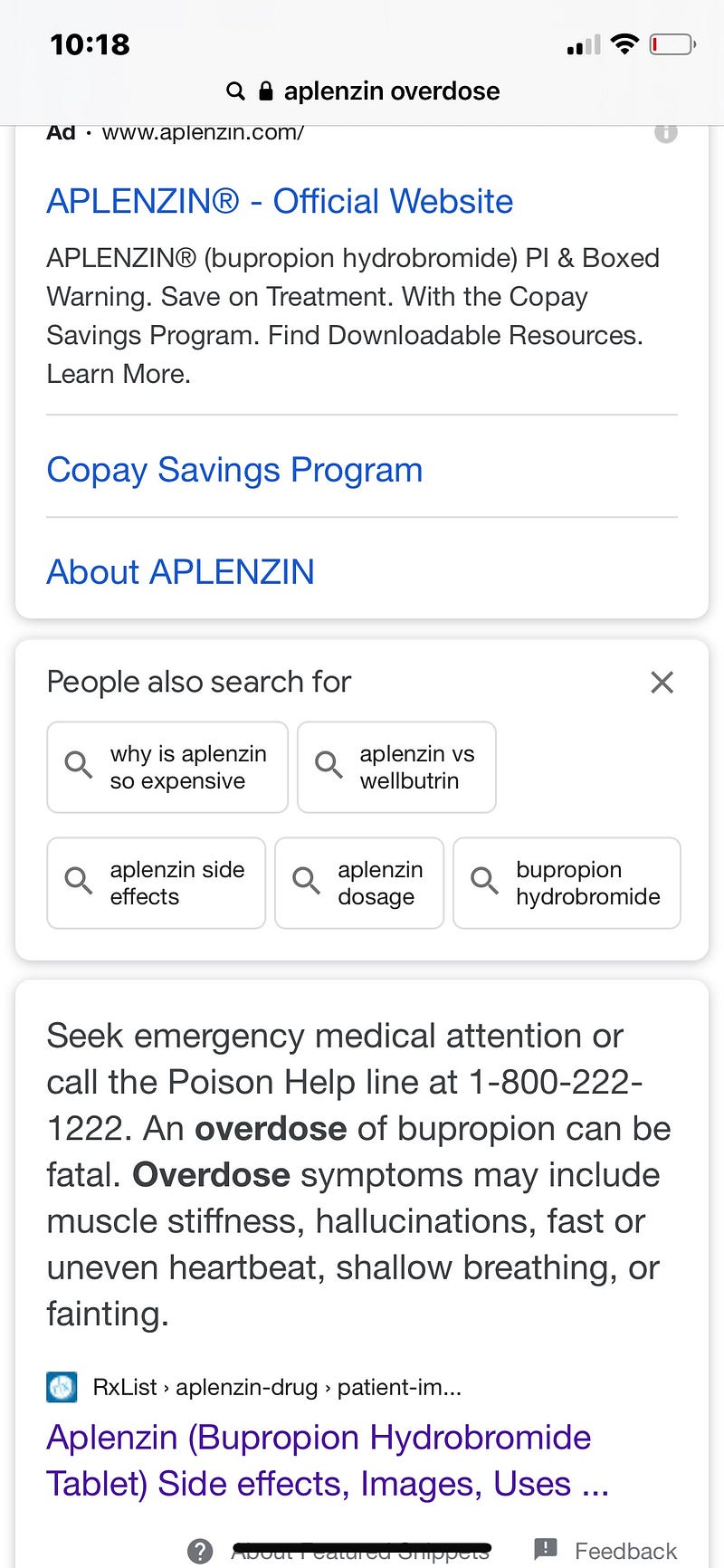
So, I call Poison Control — because I don’t know about you — but that screen is SCARY. Especially if you realized you’ve just done what I did — because I started to feel the effects, and they were not pretty.
Poison Control, first of all — is fantastic. These people deserve a medal. This woman had to convince me that something serious was going on and that I needed to go to the hospital. I did not want to go. I was fighting hard to rationalize with her why I did not have to go.
Finally, she explained that the threshold for sending someone to the emergency room for an overdose on the generic equivalent of bupropion is 450 mg/day. At 522 mg for one pill, my usual daily dose, I was already over the threshold. The fact that I had inadvertently taken a second pill adding another 522 mg put me into the “potentially life-threatening” toxic category.
She told me not to drive and to call an ambulance if there was no one to take me to the hospital. She asked me which hospital I was going to so that she could call ahead to tell them I was coming. I started to freak out because it was feeling scary and real. She was imploring on me the urgency of my getting treatment.
We hung up the phone. I grabbed my iPad, iPhone, and charger — just in case I got stuck waiting, I could make the most of it. If I ever get sent to the ER again, I’ll also remember to grab headphones.
Then my daughter called an Uber, and off we went.
I had overdosed on an antidepressant, and it was starting to kick in. My daughter told me to behave in the Uber so I wouldn’t hurt her rating. I could barely control my laughter while I was so freaking nervous.
We arrived at the emergency room. The ER personnel told my daughter she couldn’t come in because of Covid and everything. I told her that I’d just be a few minutes. That they need to make sure “nothing bad is happening, and then we can go back home.” She decides to wait outside.
I walked up to the triage nurse. She asked me why I was there. I explained that I took an extra pill by accident. She noticed that I was very agitated. Then she sent me to the next nurse, who was sorting patients further. I was immediately moved inside to a nurse who checks my vital signs; then, two more nurses speak with me. They again ask me what happened. I tell them. By this time — I’m in rare form. I’m starting to sing my words practically. I can barely sit still. My legs are dangling from the exam table, and I’m swinging them like a child with ADHD.
I hear over the PA system “57-year-old accidental overdose” — and I’m like, “who is that?” And then I realize — “Oh shit, that’s me.” I don’t know what was worse — the 57 years old part or the accidental overdose. I do not feel like I’m 57. And I still can’t believe I did something so stupid. But that’s the thing. It was so easy to make that mistake. Too easy.
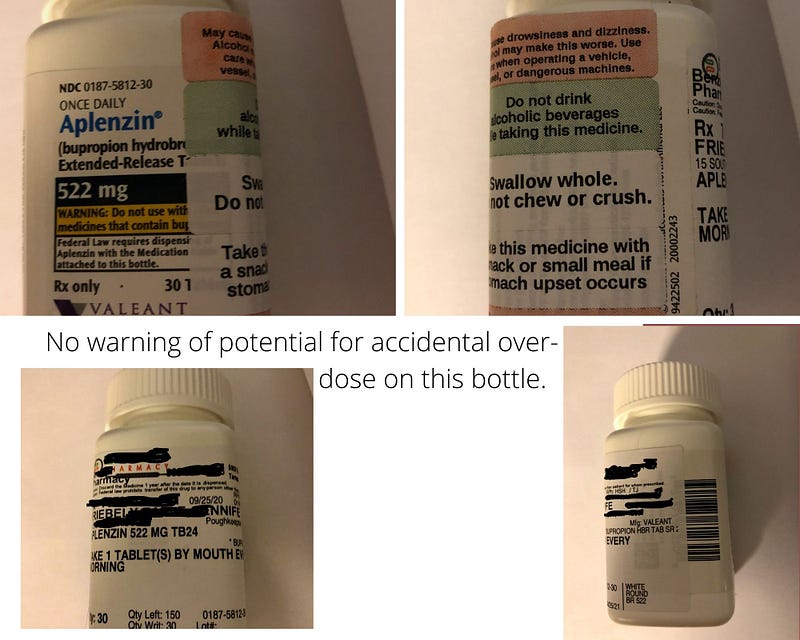
If you look at the photos of my medicine bottle (below), there’s no warning about taking more than one pill. That if you do take two pills it could be fatal. If I had not gone to the emergency room, I could have gone into renal failure, had a heart attack, and died.
The doctor introduced herself. She explained that they’d got my vitals and all of the information they need and are now going to call Poison Control, who is calling the shots on my case. She said that this is standard protocol in incidents such as mine. The doctor asked me to wait in a lounge area until we find out what Poison Control wants to do.
At this point, it’s starting to get cold out, and my daughter is still waiting. The lounge area is adjacent to the doors where the patient triage area is — and my daughter can see me through the glass. I quickly get up, run, and give her my coat to tolerate waiting outside as it gets dark.
Finally — the doctor came back with an update. It felt like hours, but it was only about fifteen minutes. Poison Control said that they needed to admit me. I was floored. The doctor explained that the drug could cause a great deal of damage. They needed to monitor me for 22 to 24 hours and that I needed treatment to mitigate the excess drug in my system.
I sent my daughter home.
At that point, they took me to an emergency room bay and hooked me up to an IV. Fluids were started. I had to drink charcoal — it was cherry flavored. I had no idea that black ember dust could have flavor.
I was put on a monitor. My numbers were scary and not my usual healthy ones, which was terrifying. My blood pressure and heart rate were high. My pulse ox was on the low side, and I felt like my chest was exploding. Amplifying matters, the medicine heightened all of my senses. I felt like I could hear every single thing going on in every single bay. Individual conversations. Television shows. One man was cursing to himself loudly — he was the most entertaining. A couple was arguing. Another guy was complaining that he was hungry. Someone had a violent movie on, and it made me jump.
Once they completed all of the “admitting-type of ER functions,” I was moved to an ER hold area while waiting to be moved to a hospital room. Due to Covid, the hospital was short on beds and rooms.
They placed me on a monitor and left me alone. I had a nurse call bell. There had to be about 5 or 6 patients in the ER hold area, all being taken care of by one nurse. She had her work cut out for her.
In the middle of the night, I woke up and noticed that my entire right side had become swollen. My hand was so swollen I couldn’t bend my fingers, and I had a ring on my finger that was squeezing it so hard that the pain was unbearable. I started screaming for the nurse. She got me ice packs to try to get the swelling down to remove the ring.
I had no idea that the swelling was a symptom of what was happening to my body resulting from the drug overdose. It’s probably a good thing. I remember lying there in bed, with the ice pack on my hand — crying in pain, trying to wiggle my ring off my finger. It is an opal ring that my late husband had given me. The ring means a lot to me.
I was feeling very alone at that moment, and that there was something very wrong with my body. Through all of the chaos and noise of the ER, I could hear a song, the only song I could recognize the entire time I was there — my wedding song with my late husband. I thought to myself, “Ed, are you there? Am I dying?” I didn’t want to die. I knew that, and I stood firm in that feeling. I wonder if I was given a choice at that moment. I do believe that I had his spirit with me to comfort me.
I got the ring off my finger and put it safely in my bag. I don’t know how it came off because my hand was incredibly swollen. Not only that, but the ring had been on backward when I noticed my swollen hand — which I have no idea when or how I would have reversed it in the first place. It was the fact that it was backward that alerted me to how swollen I was.
After the ring incident, I fell asleep and was awakened by a doctor who wanted to know what happened with the swelling. I had also taken off all of the monitoring leads in my sleep because everything had made me uncomfortable. There were huge marks on my arm from the blood pressure cuff, and the pulse ox hurt my finger.
The doctor gave me a break from the monitoring for a little while. Now it was early morning. My nurse came in — and she needed to prepare me for the move up to my regular hospital room. She had to replace all of the monitor leads. She chastised me a little.
When I got to my hospital room, they laid out more of my treatment plans for me. Poison Control wanted more blood test results and another EKG. They also wanted a cardiologist to weigh in on the EKG findings.
Complicating matters was that I had a terrible migraine that made me feel too ill to function. They treated me for that and let me sleep for an hour before asking me any more questions.
So, finally, the doctor told me that Poison Control advised that I could go home. My levels were going back to normal. My blood pressure was normal again. My heart rate was still a little high but within normal limits. I was not talking a mile a minute any longer. I continued to feel energetic, but my doctor told me it would take a while for the drug’s stimulant aspect to subside. The doctor said to me that she hoped to release me around 6 pm.
The nurse gave me my discharge papers. The diagnosis is as follows:
- Accidental overdose
- Acute kidney injury
- Elevated Troponin I Levels
One pill did all of that damage. What I understand, though, is that because we caught the error quickly, the damage was reversible.
I have learned my lesson to be much more careful with my medications and not take anything for granted. Even though something is not a narcotic — it doesn’t make it any less dangerous. Sometimes it can be even more dangerous.
I am grateful for a lot of people— from the person on the other end of the Poison Control Line to every nurse, doctor, and technician that took care of me. And I hope this story helps you — dear reader, to be more careful about your medicine as well. I can’t be the only one with this risk factor out there.
Have a very Happy Thanksgiving!
Love, Jenny
P.S. The phone number for the National Poison Control Hotline is: 800–222–1222. They are awesome. Don’t ever think twice about calling them.
Jennifer Friebely is a New York-based content writer, marketer, and speaker covering stories from personal development, bully bosses, the Law of Attraction, marketing, and productivity to politics and music to whatever idea strikes. She has a 30+ year background in marketing and advertising and holds a BA in Political Science. Email her at [email protected] or visit www.successpicture.com.