
Healthcare Costs
My Medical Insurance Company Found Another Way to Cheat You
How OptumRx plotted to collect 2 extra co-pays per year by changing the 90-day supply computations
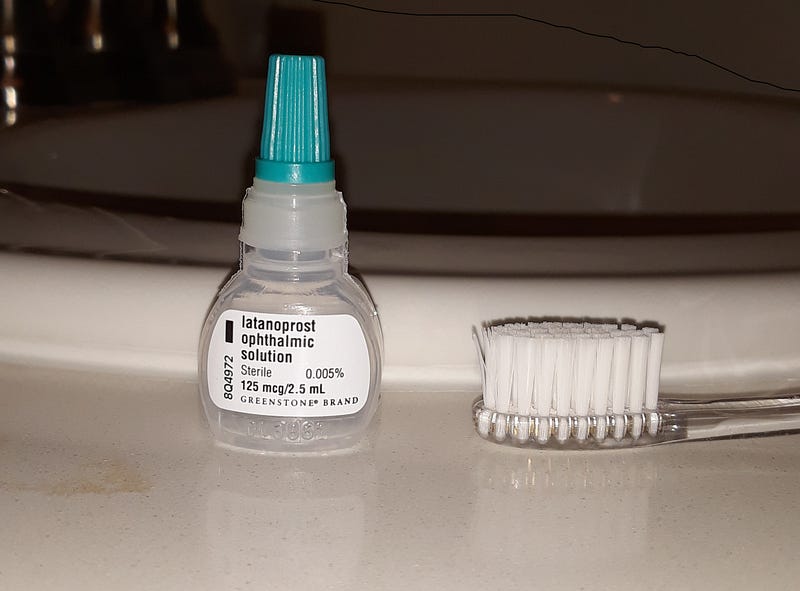
I went to the local pharmacy to pick up my latanoprost eyedrop drug that prevents glaucoma. For more than 10 years, it’s been 3 bottles for 3 months. This time they only gave me 2 bottles. The pharmacist said, “Your insurance company, OptumRx, limited it, claiming the bottle contains a 35-day supply and 3 bottles would be more than 90 days.”
As I walked away, this vision popped into my mind:
The mad scientist shuffles into his lab with the bottle of latanoprost, hands it to the robot, and tells it to measure one drop. The robot puts it into a stainless steel syringe, squeezes out one drop, and measures it to 1 millionth of a milliliter. The scientist sends the results to his Dilbert manager. Using a computer for the difficult math, the manager divides the 2.5 ml in the bottle by the drop size — 70 drops. Realizing most people have two eyes, the bottle contains 35 daily doses. Three bottles contain 105 doses, more than 90 in a 3-month supply. He orders prescriptions to be limited to 2 bottles.
No real scientist works that way. The drops come from a plastic bottle, squeezed by fingers, dispensing variable-sized drops. Then the patient may occasionally miss the eye and need to dispense another drop. Nobody is as precise as a robot with a stainless steel syringe. It appears that if the bottle contains 35 doses, the manufacturer allowed for such variations.
I wondered how accurate the 35 days per bottle was, so I counted the days per bottle for 3 bottles, the old 90-day standard.
Results were far worse than expected.
If the company uses the same logic with other medications, they could actually endanger patients. A statistically poor distribution could cause me to go for weeks without my medication!
How Prescriptions work in the U.S.
Most drugs and other treatments require written orders from a doctor, i.e., a prescription. A few, like Fexofenadine, an anti-allergy medication, are now available without a prescription, but those are rare.
Most are partially covered by insurance, if the patient has insurance through their job or for retired people, Medicare. The patient pays a “co-pay,” like for me, $20 for one bottle of latanoprost. My local pharmacy charges $69 per bottle without insurance or coupons. If someone has no insurance, drug costs can be devastating!
Insurance companies encourage patients to buy a 90-day supply of medications by having the patient make two monthly co-pays at once instead of three. The company saves money by processing only one claim instead of three and one shipment if sent by mail. The company also occasionally saves by using one larger container instead of three smaller ones.
That method generally works well and everybody benefits. That is, if you are taking pills that are easy to count. Ointments, liquids and eyedrops are different. No two people will apply the same amount of ointment to an area. Some will use household silverware instead of a precise medicine cup for liquids. Then there is my experience with eyedrops.
Using the new logic, I would pay 50% more for my eyedrops per year.
The co-pay did not change
Two bottles per prescription allows them to collect 6 co-pays per year instead of four.
90-day results
Here are the results when I counted the days per bottle for 3 bottles, the old 90-day standard.
Required: 90-day supply New claim: 35 days per bottle instead of 30, thus 3 bottles 105 days, > 90 days. Fill prescription with 2 bottles instead. Actual: 21 days, 31 days, 29 days for a total of 81 days. Combinations of any 2 bottles: 60, 50, 52.
No pair reached the 70 days claimed by the insurance company. No pair even came close. In fact, there was no guarantee that three bottles would always equal 90 days. Still, they would be close enough not to worry about the variance, assuming the 21 days was a fluke. You may occasionally get more, like my 4th-month bottle lasted 35 days.
What should the insurance company do?
First, recognize that they made an error and revert back to the original prescription of 3 bottles for 90 days like their website says they do. Second, review all similar decisions in the past year to see if they made any other dumb mistakes.
I’m being generous here Attributing the decision to a mistake Instead of greed or stupidity
They seem to be doing something! I got 3 bottles with my last refill, but the pharmacist said it was for 105 days. Maybe the Dilbert managers made their computer programs much more complex by trying to fill in the gaps. Hopefully, they didn’t add any bugs to the software.
I don’t know if I will get three or two bottles with my next refill.
System-wide problem?
My wife had a similar problem with her insurance company and diabetic sensors, each lasting 14 days. Six sensors cover only 84 days. The doctor sent the drug company a prescription, the company tried to fill it with a different count, and confusion reigned! It took one week and 6 attempts to get it right.
Conclusion
The system allows no way to fill the gap if the prescription, when filled, does not cover the entire 90 days. The patient is out of medication and no way to get a refill until time has expired, which may endanger the patient!
The system is too complex. The whole system needs to change.
Dilbert manager or Pointy-haired Boss (PHB) from Wikipedia: “hopelessly incompetent at management and does not understand technical issues…”
OptumRx, along with United Health Care, is owned by UnitedHealth Group. UnitedHealth Group — Wikipedia


