
My MacBook Pro Has the Best Screen I’ve Ever Used. And I’m Annoyed.
Seriously, this shouldn’t frustrate me so much.
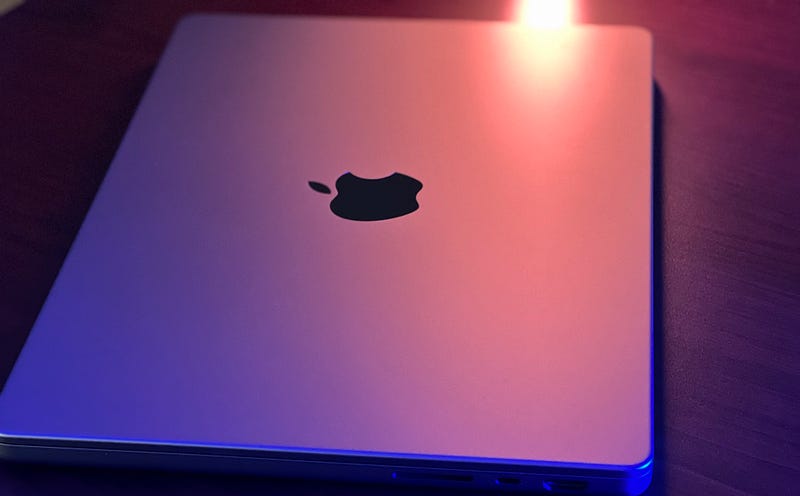
A few weeks ago, I bought a 14-inch MacBook Pro with the M1 Pro chip, 1TB of SSD storage and 16GB of RAM. While it’s not perfect, it has easily the best laptop screen I have ever used.
To understand why that frustrates me, you need to understand what led me to this point — the point at which I chose to buy a machine with soldered storage and RAM.
The quest for a laptop that doesn’t suck
For a while, I had been searching for the perfect portable laptop. I wanted a laptop I could write on and maybe even play some games and do a bit of design work without worrying too much about battery life. I wanted to be able to take it on the road or even to the couch without having to lug around my charger or stay plugged in to use it for more than a couple of hours. So my list of must-haves was more like a laundry list. I wanted:
- A high resolution screen. None of that 1080p nonsense. I know higher resolution screens mean reduced battery life, but they also look way better.
- Good color accuracy. I wasn’t exactly looking for the P3 color gamut, but something with at least 100% sRGB coverage would have been nice. One thing I can’t stand is a screen with washed out, inaccurate colors — especially as I’m working in Illustrator or editing a video.
- Good screen quality. I actually consider this a separate category from screen resolution and color accuracy. When I say screen quality, I’m talking about color uniformity, backlight bleed, IPS glow, etc. Screen defects are dealbreakers for me.
- Excellent battery life. My Dell XPS is a great laptop, but it doesn’t last for more than a couple of hours away from the wall, and that’s a problem for me. I’d like at least a good 6 hours of battery without needing to plug in.
- Something that I can use on a lap or bed. I work from home a lot, and I don’t want to have to use a laptop cooling pad to protect my laptop if I decide to work from the couch or bed. My Dell XPS heats up and gets angry with me if I don’t set it on a flat surface, so using it in bed is out of the question without a cooling pad or lap desk.
- Decent performance at least. I wasn’t looking for high-end, crazy workstation performance, but I was looking for something that could run the apps I want to run.
But as I would soon come to find out, I’m very picky. Every machine I bought failed in one or more of these categories. Every one.
A series of failures. Maddening, stupid failures.
As time went on, I would research various laptops, find one that was interesting that might fit my needs, go buy it — only to find something wrong with it and return it.
Am I just picky? Am I wrong to insist that a machine that’s not exactly cheap should perform well and have a decent screen?
Several machines had terrible backlight bleed. Another had a screen that was literally not put in straight. One had dead pixels. And my last Windows laptop that I bought and subsequently returned failed to reliably turn on.
Yeah. That’s pretty important. The laptop needs to be able to turn on. What a concept! After leaving the machine on its charger for an hour or so, I couldn’t get it to power on without disconnecting the power cord and pressing and holding the power button. Then, maybe, it would give some sign of life. To me that sounds like either a bad BIOS or a bad motherboard.
Either way, I refused to play that game. Back it went.
“Do all laptops just suck right now?”
I eventually got so discouraged with my laptop search that I was tempted to just give up on it and try again in a year or so. Surely not all laptops are terrible, right?
Is there something wrong with me? Am I just too picky? I mean, I don’t think so? Maybe other people are just too willing to live with defects on their expensive laptops? Do I just have bad luck? I don’t know. And I don’t know what the answer is. But I do know that, for me, no brand and no model seemed like a good buy.
But surely they can’t all suck. Right?
Right?
I didn’t want a Mac, really.
Years ago, I was almost exclusively a Mac guy. At the time, Windows laptops were just so disappointing that, if you could afford one, a Mac was the machine to buy. But then, my 2008 MacBook Pro failed me (due to the Nvidia 8600m GT failure). Over time, I got back into Windows, and I didn’t look back. For years, I was a PC guy. As I started in my IT career, I made the conscious decision to stick with Windows laptops.
Windows is what I’ve known, and it’s what I’ve been comfortable with for the past decade. A little more than a decade, really.
But after so many strikeouts with PC laptops, I decided to give a Mac another try— despite my reservations about Apple’s soldered RAM and soldered storage drives (which I’d really like to see Apple change but doubt they will.)
So, off to Best Buy I went to pick up a 14-inch MacBook Pro. Yeah yeah. The same guy who wrote this…
…was on his way to buy a Mac. Go figure. Laugh it up.
Wow. That screen.
One of the first things I notice about any laptop is its screen. I’m extremely picky when it comes to screen quality. Backlight bleeding, dead pixels, and colors that seem “off” are all major deal breakers for me. To some extent, backlight bleeding and “IPS glow” are normal for most displays, so I’ve learned to live with it a bit on my Dell XPS, but I’m not exactly happy about it.
But on the Mac? One of the first things I noticed when I booted up my MacBook Pro for the first time was the complete absence of backlight bleed. No, it wasn’t just so minimal that it looked good enough. It was absent.
No… backlight… bleed??
The 14-inch MacBook Pro has a Mini-LED display which operates a bit differently from the vast majority of laptop displays. Instead of being lit in such a way that light can bleed from the edges, it’s lit with an array of thousands of tiny LEDs so that only the areas that need to be lit actually are.
This results in much richer black levels and better overall uniformity.
Take a look at this comparison between the MacBook Pro (left) and my Dell XPS 17 (right).
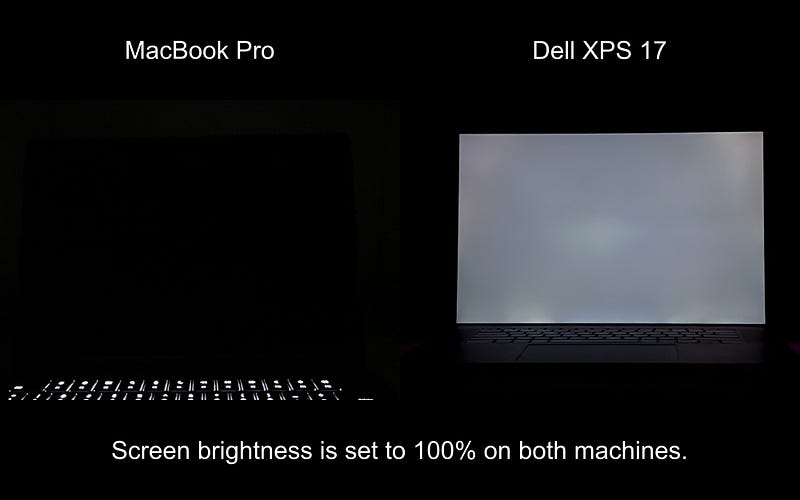
On both machines, the screen brightness is set to 100% with the same black image on the screen. I have the keyboard backlight on for the Mac just so you can see that it’s actually on. Otherwise, you couldn’t even tell. Impressive.
The Dell, on the other hand, has a pretty obvious IPS glow with some significant backlight bleeding in the lower left and top corners especially. Sadly, this is on the “excellent” side for most IPS displays, which most Windows laptops have.
With another camera and angle, the IPS glow of the Dell becomes quite evident. (It’s not quite this bad in person as the camera does exaggerate it, but I want you see the effect and difference.)

The Mac’s display quality should be standard for all laptops. But it’s not.
And now to the source of my frustration. Why is it that Apple can get this right, but most Windows laptops — even those that cost multiple thousands of dollars — can’t? Why are they still using technology that’s rife with problems?
I recognize that most people aren’t professional graphic artists, and perhaps most don’t care as much as I do about display imperfections.
But why do many (most? all?) PC manufacturers think it’s okay to sell laptops that cost multiple thousands of dollars and include displays that are prone to backlight bleeding and IPS glow? Why do most Windows laptops on the market still feature relatively low resolution, poor quality screens?
It’s ridiculous.
Even the cheapest Mac notebook has a great screen.
My Dell XPS laptop has a decent screen for a Windows machine. No, it’s not perfect, and as you can see in the pictures above, it does have some backlight bleeding and fairly typical IPS glow. I can’t fault it for that since that’s really just the nature of the technology.
But I paid good money for this laptop. I needed something with a good screen resolution and a good color gamut. This model can hit 100% of sRGB, 100% of Adobe RGB, and up to 99% of the DCI-P3 color gamut. It wasn’t cheap to get a machine that could hit all of those.
The cheapest Mac notebook, the M1 MacBook Air, which is roughly a third of the price I paid for my Dell, has a 2560 by 1600 display that goes up to 400 nits of brightness and supports the wide color (P3) color gamut. Again, it costs a third of what my Dell did.
The M2 MacBook Air ups the ante a bit by adding a few more pixels and going to up to 500 nits of brightness.
Those machines start at only $999 and $1199 respectively, which is far less than I paid for my Dell. You can walk into any electronics store you choose and pick up a Windows laptop for more money that doesn’t have a screen nearly as good as what you can get in one of these two relatively inexpensive Macs.
Why? No, really. I want to know why.
Dell? Lenovo? HP? Are you guys listening? Why is it that Apple’s cheapest laptops have screens that ought to embarrass the screens you slap on many of your mid to high tier laptops?
I’d really like an answer to that.
And to be clear, I expect a cheap $500 Windows laptop to have a disappointing screen, so that’s not what I’m talking about. I’m talking machines at a comparable price point. Can anyone show me a $1000 — or even $1200 — Windows laptop that can display at least 99% of the DCI-P3 color gamut and a resolution above 1080p? I’d love to know about it.
If it exists, I’d be willing to bet it’s an outlier. I’ve looked.
Will displays ever improve for PC laptops?
Some manufacturers are starting to get the picture and are now offering OLED displays on some models. But while OLED displays can produce beautiful images with deep blacks and great contrast, they’re not without their problems — not the least of which is burn-in.
A few now have a model here and there with Mini-LED displays. Remember, Mini-LED is the display technology that’s behind the screens of the 14-inch and 16-inch MacBook Pros. So I’m very excited to see the adoption of Mini-LED in Windows land.
But in this writer’s opinion, that adoption isn’t happening fast enough. I think right now, far too many manufacturers are just fine selling expensive machines with displays that really ought to be better.
While none of us can know for sure what sorts of machines we’ll see in 6 months, a year, 5 years or more, I firmly believe we ought to demand — with our wallets — that PC manufacturers start taking display quality seriously and stop insulting us with 1366 by 768 or 1920 by 1080 IPS screens with weak color gamut support. We shouldn’t have to pay over $1000 — and often more — just to get screens that are suitable for professional work. Not when even Apple, which has never really been the bastion of affordable technology, offers far superior displays for less.
If Apple can put better-than-1080p displays that support P3 color into its cheapest laptops, there is no excuse for Dell, HP, Lenovo, Acer, Asus, and all the rest to keep selling terrible screens in their machines that cost just as much or more.
Just another rant, right?
I don’t know. Maybe you’re reading this and thinking, “Whatever. Just another rant. Meh.” But I hope you don’t misunderstand me here. I’m not some Apple fanboy. I have and like both macOS and Windows machines. I like a lot about my Dell XPS. (It’s battery life is not one of those things.)
Ultimately, I want the best quality for the most people in the widest range of devices possible. Because here’s the thing: the kind of laptop that suits me best might not be right for you. Maybe you need something that’s ultraportable and don’t care about things like screen resolution and color gamut. Or maybe you need a desktop replacement laptop with a big screen and as many pixels as you can get and don’t really care about battery life.
Whatever your use case happens to be and whatever your needs are, my hope is that the standard for PC laptops of the future will be screens that don’t suck. My hope is that more manufacturers will adopt Mini-LED for more of their machines so that a wider market will be able to enjoy systems with no backlight bleed and no burn in. Apple has already done it, and while Apple has done much that I don’t like, this is one thing that I would love to see the rest of the industry copy en masse.
Will that ever happen? Who knows. But, again, I can dream.


