
My Low-Vision Life
Things you’d never know by looking at me.
Three months after I was born my young parents became worried. I was a happy baby when they were nearby, but when they moved a couple of feet away I would cry relentlessly.
They took me to the doctor. He assessed me and reported the devastating news: I was legally blind. In those days that meant I’d likely have to be institutionalized.
Thankfully as I grew, so did the deformed optic nerve in my left eye. My vision improved up until I was 20. Now on the flip-side of 40 my eye is experiencing the natural degeneration that comes with aging.
I was one of the first kids who had a disability to attend a “regular” elementary school in Pittsburg. In first grade they took me out of class to go swimming and have lunch in the teacher’s cafeteria at the high school. I’m still not sure how this related to my visual impairment, but it was fun.
In 3rd grade we moved to Connecticut and I was assigned a teacher for the visually impaired. She was much more useful. She took me out and tutored me on crossing streets. She also taught me to type.
She wasn’t perfect, despite her big heart. For example, I wasn’t a big fan of the “Large Print Pocket Dictionary” which was bigger than my head. My peers got a laugh out of that. I met with her an hour a week through high school.
I declined any special services in college and beyond since I didn’t feel I needed them.
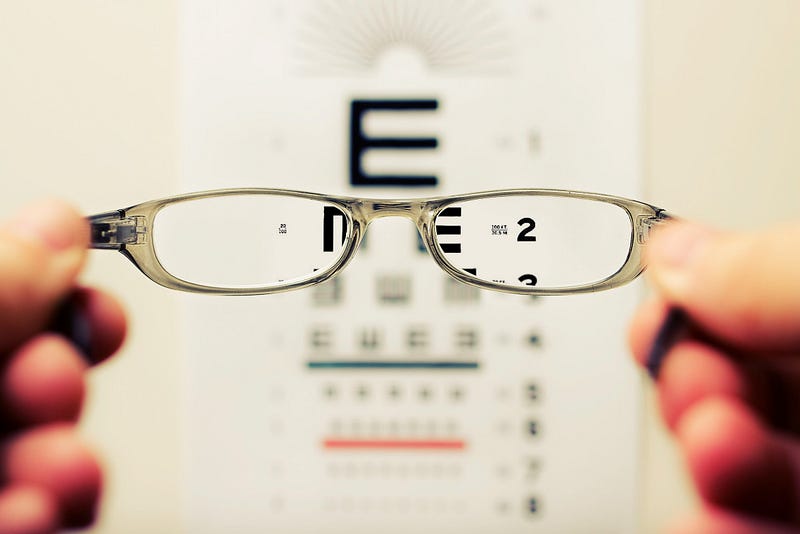
Most people are surprised when I tell them I’m visually impaired and blind in my right eye. Besides wearing glasses there’s really nothing blatant to tip a person off.
Of course, there are some challenges with having bad eyesight.
I’m a klutz. My lack of depth perception and peripheral vision means that I trip and fall a lot. What’s a bruised knee here and there? (I probably won’t have that attitude when I’m 80 and falling means broken hips.)
I also can’t drive. I rely on public transportation or the kindness of friends. The benefit? I’ve saved thousands upon thousands of dollars on car payments, insurance, gas and mechanics.
Wall menus used to be a real bitch. Now I can just snap a photo with my iPhone and zoom in. It's nice to be able to have a selection rather than being relegated to obvious menu choices dependent on the type of restaurant I’m in.
Its hard for me to see a person’s facial features or expressions from any distance. I’m not a snob, I’m actually very friendly person close-up!
3-D movies are the worst. My one working eye sees blurry, super-imposed images on the screen. Recipe for a headache.
I miss my library of paper books. I’ve always been a voracious reader. I’m grateful for my virtual large-print library on my Kindle.
Every single ophthalmologist I’ve gone to still feels the need to test whether I have vision in my right eye.
“Cover your left eye, now what do you see?” Nothing!
I’ve discovered along the way that the majority of people assume that blind people see black. Black is actually a color. Trying to see out of my right eye is like trying to see out of a cheek — just nothing to see.
When I discovered that novelist Alice Walker and poet Audrey Lorde were blind in their right eyes I was overjoyed to be in the company of such talented writers.