
My Love For Black Women School Teachers
How can I ever repay them?
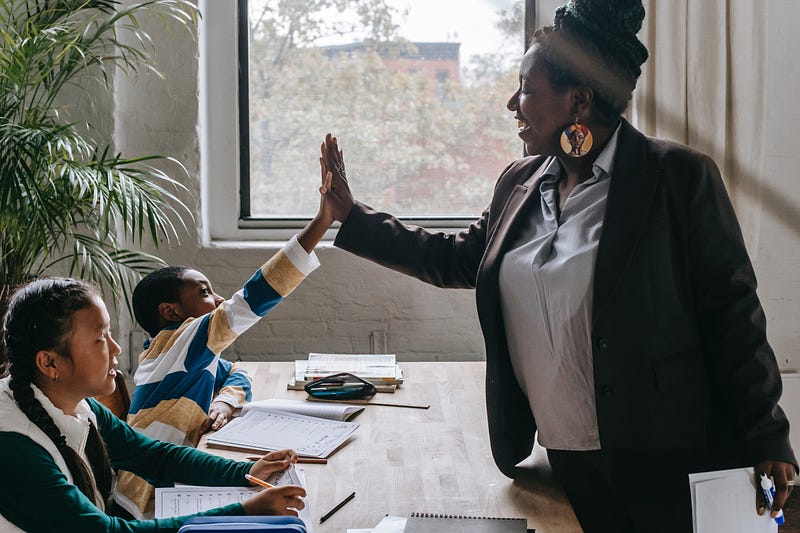
In elementary school, most of my teachers were Black women. It is an experience that continues to empower me to this day.
In kindergarten, at LaSalle Elementary School in Washington D.C., my teacher was the beautiful and dignified Mrs. West, and in third grade, it was Mrs. Lewis, the Black woman who let me read a poem by Paul Laurence Dunbar before the class. That was also the moment I fell in love with poetry.
There was also Mrs. Smith who I still have a crush on today she was so pretty and sharp, but the one who I remember above all of those early teachers was Mrs. Dorothy Preston. Mrs. Preston was my first-grade teacher. She was tall, regal, beautiful, intelligent, but most of all she was my protector.
First grade was the first year where I attended school for a full day and it was my first chance to use my brain and interact with the world. First grade was pretty serious and Mrs. Preston insisted upon hard work and excellence. She was the human embodiment of tough love.
I remember her always pushing me and being on top of me and some of the time as this tall, wonderful but domineering Black woman stood over my desk, I thought she didn’t like me. I was almost afraid of her. But it was all about protecting me on my journey — myself and the other children.
There was a reason she pushed me too. She thought I could do big things, important things. She thought I was intelligent and had potential and she did not want me to fumble it.
But there was also something bigger I know now. I was in first grade at a time when the school system was experimenting with something called “Non-graded primaries.” This is when if you tested at a higher level than your age grade you might be moved to the grade level that your work reflected.
It so happens after I finished first grade, I was moved to the third grade (skipping the second) because of the work I had been doing in Mrs. Preston’s class. The school had considered moving me to the fourth grade but thought that might be a little disruptive.
It was a tough adjustment moving one grade and I became a target of bullies for being a “smart kid.” Yet, from that point in my life, I never felt out of place in school or intellectual environments. Mrs. Preston and all of those wonderful Black women did that for me, way back in elementary school.
How important are Black women teachers or just Black teachers to Black children?
In 2016, the National Bureau of Economic Research completed a study that convincingly concluded that Black teachers overall were very important to the performance of Black children in life. The study found “causal evidence that Black students who have at least one Black teacher in elementary school are 9 percentage points (13%) more likely to graduate high school and 6 percentage points (19%) more likely to enroll in college than their peers who are not as- signed to a Black teacher.”
The study was conducted in multiple states. At the time, the number of African American teachers lagged behind the population averages. Only about 6–7 percent of teachers in the U.S. were Black. Public schools, as we all are aware, have high concentrations of African American students for socioeconomic reasons.
The study also concluded that Black boys benefited from Black male teachers and Black girls benefited from having a Black female teacher. Yet, the most important thing was for the students to have a Black teacher.
Malcolm Gladwell, the writer, also did a podcast episode on this issue. He studied the court decision, Brown v. Board of Education, the decision that declared “separate but equal” schools, unconstitutional.
But Gladwell also dug into what was taken from Black students when the segregated systems were shutdown — Black teachers. They were the first to be let go after the Brown decision began to take effect. Approximately, 38,000 Black teachers lost their jobs after the desegregation order went into motion. The white teachers kept their jobs; many Black teachers lost theirs.
Gladwell explained why that matters historically:
“…When a black student has a black teacher, a number of educational outcomes become more positive. More likely to be in a gifted or talented program, less likely to be suspended, more likely to graduate, higher GPA, etc.”
For me, in grade school through the 8th grade, all my teachers were Black (African American) and it continues to matter to me. When my sixth-grade teacher, John Sparrow died some years ago, it mattered to me. I took notice even though I was not living in Washington D.C. I am forever in his debt and in debt of all of the other teachers, including Mrs. Dorothy Preston, who was the one most of all who made me know I could achieve things when she recommended me to be moved to the third grade.
I always wonder if Mrs. Preston is still alive somewhere. If I find her, I will track her down and thank her for all that she did to help me become who I am today.


