
My Life With Birds
A Weeds and Wildflowers Prompt
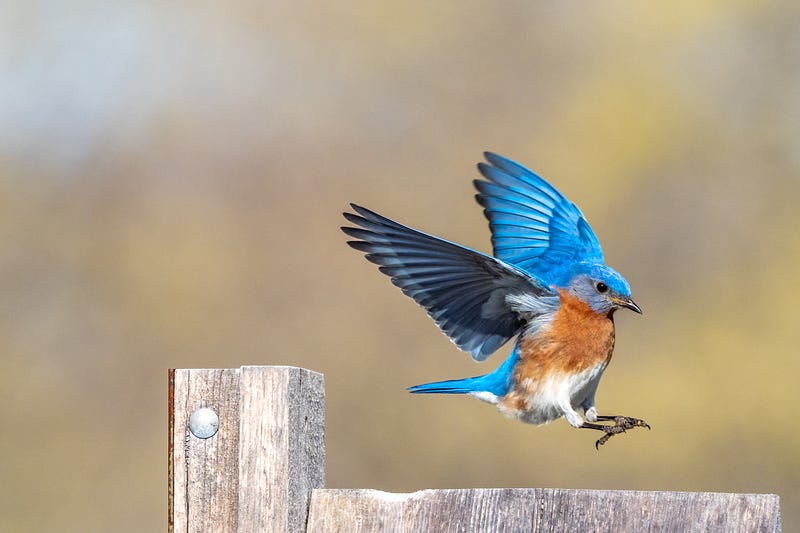
Birds are the thread that has laced my life together. From the time I was very small, birds were in my consciousness. Some people go their whole lives and never know the name of a single bird. Many never even really look at birds to notice their unique characteristics. But as a child, I spent many hours in the woods with my dad. We camped and hiked, and he would point out the birds and tell me their names.
One of the first gifts my dad gave me was Petersen’s Field Guide to the Birds. I had dog-eared his copy, and now I had my very own. I was thrilled. I studied it like a bible. I learned the names of birds I had never seen but hoped to someday. I studied their colorations, their beak shape, their eye ring, or lack thereof. I knew these birds like I knew my own face in the mirror.
When I got married and had my own house, the first thing I did was put out a birdfeeder. My dad made me a feeder from an old wooden wire reel and mounted it on a post right outside my kitchen window. The first winter I had that feeder, an entire flock of Evening Grosbeaks showed up and cleaned the feeder off. They returned every day for the entire winter. It was the most thrilling thing that had ever happened to me. These are large, gregarious, and magnificently colored birds. They were my winter entertainment when large icicles hung from the eaves, and I was in my warm steamy kitchen baking bread.
Evening Grosbeaks were not regular winter residents in my town of Columbus, Georgia. I learned from my natural history book that species would sometimes be pushed outside their normal territory by lack of food or abundance of food, extreme temperatures, or other natural phenomena. This rare visitation was called an irruption. Merriam-Webster defines irruption, as it pertains to ecology, like this: “a sudden sharp increase in the relative numbers of a natural population usually associated with favorable alteration of the environment.”
I guess my giant feeder filled with black oil sunflower seeds was the favorable alteration in the environment. But after that winter, I never had another Evening Grosbeak on my feeders. It was a special dispensation, and one of many that I would experience over my years as a bird lover, bird watcher, and amateur ornithologist.
I was never without a birdfeeder, no matter where I lived. It was one of the first things to go up after the truck was unloaded. It was not home until there were birds outside my windows. And I never failed to attract an array of local birds and the occasional migratory bird passing through on its way to somewhere else. I often pull out my now dog-eared field guide to check my ID of a migratory warbler or a strange, non-descript brown bird that usually ends up being the female of a brilliant rose-breasted or blue grosbeak.
I had the opportunity to work with adults living with dementia, and I often did bird programs for them. I taught them to identify some of our most common birds by their songs. I showed them the live feeder cams hosted by the Cornell School of Ornithology. I taught them about the phenomenon of the dawn chorus, and the nesting habits of our backyard birds. I showed them a video of a starling murmuration — hundreds of thousands of starlings flying in synchrony to form black tornadoes of writhing, twisting birds. You cannot watch this video without being moved.
There is no way you can learn even a little about birds without falling in love with them. Birds are amazing, resourceful, and beautiful creatures.
As for the special dispensations — I have had several close encounters with birds that defied the human/bird relationship.
Once, I had a bird fly toward me and hover in front of my face, then touch his beak to my mouth. I was so startled that I froze. Standing there watching, the little bird landed on a branch only an arm’s length away from me. He studied me closely, and I stared back at him. Then, he dove off the branch to hover before me again, and again he touched his beak to my lips. It was such a surreal moment. I wondered if I was being visited by my deceased father.
This little bird continued this behavior for several minutes. I went over to the bird feed can and got a handful of seed, thinking he may have been trained to take seed from someone’s mouth. But he wasn’t interested in the seed. He just kept hovering and looking into my eyes and kissing me on the mouth.
I sat on a bench beneath the tree, and the bird landed on my knee, then hopped down my leg to sit on my foot and look up at me expectantly. I didn’t know what he wanted from me, but by this time, I was fairly certain this was my daddy come to visit me from the other side. The bird stayed with me in the garden for another half hour as I went about my chores, and then he flew away. I never saw him again.
Another time, I was standing in the garden with a water hose, watering my flowers on a late summer afternoon. A bird came over and drank from the hose, then flew over and landed on my arm. I froze, for fear of scaring him away, but there was no need. He wasn’t the least bit concerned about what I was doing. He hopped up on my shoulder, then skittered down my other arm and poked around under the folds of my sleeve. He stayed with me for several minutes while I continued to water my plants, all the while thinking, “I have a bird on me. Nice!”, as though this happened every day.
My dad again? I think so.
One day when I was standing on my deck, a magnificent hawk came and landed on one of the rails. He stood looking at me, close enough for me to reach out and touch him. Suddenly I realized my hens were scratching in the grass below the deck, and I sprang into action, shooing him away. I regret that because if that was my dad, too, he would not have hauled off one of my chickens.
Another time a grand Pileated Woodpecker came and landed on the finial of the patio umbrella on the deck. Being unable to get purchase on the slippery, round plastic ball at the top of the umbrella, he dropped down and landed on the gate right next to me. These birds are close relatives of the (believed) extinct Ivory Bill Woodpecker. The Ivory Bill was nicknamed the Lord God bird because when people saw them for the first time, they would exclaim, “Lord God, what a bird!” Magnificent is not a descriptive enough word for the Pileated. This was my father’s favorite bird, so I am certain this one was him.
My everyday encounters with birds are just as special. When I hear the first sweet notes of the White Throated Sparrow, singing his plaintive song of love for Canada — “Oh, Sweet Canada, Canada, Canada!,” I know that I can begin to settle in for the coming winter. I anticipate his return like an old friend every October. He serenades me all winter, when most other birds go quiet.
The chickadees, the cardinals, the finches are all year-round residents. The summer migrants come like clockwork — the Rose Breasted Grosbeaks showing up every year the last week of April. They never fail to show. The timely arrival of these birds is reassuring and makes me feel that all is right with the world, even when things are scary and chaotic. The birds don’t care who is president, they just want me to fill the feeders.
That’s why if I don’t get the hummingbird feeder out in time, the hummingbirds come to my kitchen door and look in. They swoop to where the feeder should be hanging and then come back to look in and demand that I get out there immediately and hang their feeder up. How can something so tiny fly all the way across the ocean and come back to the exact spot where it spent the summer before? And know that the creature inside that house is the one responsible for the nectar in its feeder? I have no idea. Some mysteries don’t need to be solved. All I know is that they come to me like a benediction. Undeserved grace, but there all the same.
I have counted more than 45 species of birds in my yard. Having these lovely winged creatures as companions is one of the great joys of my life. When we let birds enter our consciousness, our lives are enriched in ways we could never have anticipated. We become more aware of the natural world around us. We become more curious and more convinced of our need to care for the earth so that we will always have these fabulous creatures to bring music, color, and joy to our lives.
Here’s a piece I wrote about identifying birds by their songs.


