
My Junior Year Abroad, I Behaved Like a Monk
My medieval university fueled my imaginary world
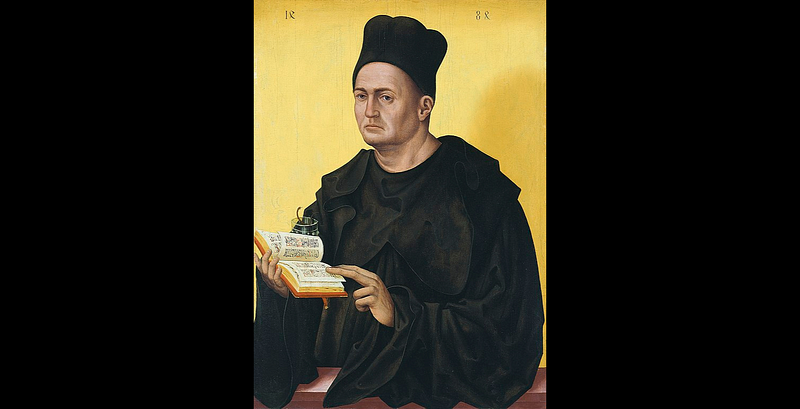

I write to help myself solve a riddle. Why, in the vaulted stone basement of a Renaissance library, in the prime of my atheist-minded youth, did I fall under the spell of St. Benedict?
I wasn’t a religious supplicant, you understand, but a curious Junior Year Abroad student yearning to create new ideas from the ones I was learning in books.
Finding St. Benedict’s Rule (written c. 530) down in an Oxford University basement was like a confirmation of my own way of living. Though I existed within the scholarly community, I had no real friends here and spoke little, and I was fine with that.
I traveled through England, alone. Delved into my psyche, alone. Journeyed into books, alone.
That was me: the scholar-monk.
“There are times when good words are to be left unsaid out of esteem for silence.” — St. Benedict’s Rule, Ch. VI
In my sophomore year back in the United States, I took a course called “The University and Society,” which ended up being my favorite class in college and the one that made me decide to become a history major.
Learning about medieval universities fascinated me and only increased my hunger to attend one.
The first universities in Europe — Oxford being the third-oldest, established around AD 1096 — were founded by monks. Like monasteries, they had quadrangles, cloisters (covered walkways in the quads), and a status hierarchy ranging down from professor to master to various levels of scholars, rich and poor.
Is it any wonder that studying at Oxford made me behave like a monk?
Rather than obedience to God, my loyalty was to holy Academe. While my peers partied and rowed on the Thames in the early morning fog, I stayed in my favorite libraries until closing time.
Breathless, I observed the university at night on my solitary walks home, winding through medieval lanes of crumbling black stone. I’d stare up at the stars, awed at Oxford’s great age, and honored that I placed my feet where centuries of great thinkers had gone before me.
“Almost at the same moment as the master gives the instruction, the disciple quickly puts it into practice.” — St. Benedict’s Rule, Ch. V
As I prepared my essay assignments, I never wrote anything but what was asked of me. I brilliantly summarized the arguments in other people’s books, but never once had an original thought myself.
Back in elementary, middle, and high school, I loved taking the two-day state achievement tests every year — the kind where you fill in the bubbles for the letters of your name and for your answers to the multiple-choice questions.
I excelled at those tests. And once I reached college, I chased the excitement of achieving A’s and a high GPA.
But Oxford didn’t give out grades, at least not until your performance was converted onto your American transcript.
Perhaps sitting bent over my books, being the scholar-monk, was my way of feeling that special tingle of pride that I’d always associated with academic success.
“There are the sarabaites, the most detestable kind of monks… Their law is what they like to do, whatever strikes their fancy.” — St. Benedict’s Rule, Ch. I
Oxford has three academic terms per year, and for each, Junior Year Abroad students choose two courses. Scrolling through the course catalog for my second term, I was tempted to explore the history of the Wars of the Roses, an intriguing topic I knew nothing about.
Instead, I chose two courses about the Anglo-Saxon era, just as I had my first term.
Back in the United States, I had first encountered the Anglo-Saxons in an archaeology class. I sat enthralled as the teaching assistant explained how the term referred to a group of Germanic tribes that had conquered England in the middle of the first millennium AD.
Being on an evolution-of-the-English-language kick, the Anglo-Saxons seemed right up my alley.
But poison entered me along with the passion. I had bipolar disorder, though I didn’t know it, and delusions of grandeur are part of that disease.
Somehow I got it into my head that I would become a great professor of the Anglo-Saxons — the best ever! I would change the entire field, be a revolutionary, become a household name.
With that kind of pressure, the fun can drain away from anything.
“Hate the urgings of self will.” — St. Benedict’s Rule, Ch. IV
On a cold winter’s night in Oxford, I sat in the St. Hilda’s College Library, lit only by solitary lamps at desks like mine. I was writing an essay about the Venerable Bede, an Anglo-Saxon saint.
Bede, who was given to his monastery at age seven and never left, once wrote:
“I have devoted my energies to the study of the scriptures, observing monastic discipline, and singing the daily services in church; study, teaching, and writing have always been my delight.” — Ecclesiastical History of the English People
If you removed the singing and changed “scriptures” to my academic texts, Bede was like me. A scholarly monk sitting up late in a library.
But I didn’t like studying Bede at all. His focus was entirely on Christianity, which didn’t interest me.
So much of Anglo-Saxon studies, in fact, involved reading stories of saints’ lives, investigating Christian artifacts, and perusing chronicles written by monks.
And when I strode through the city at night, imagining myself walking in the footsteps of those past greats, I bucked against the idea that so many of them had been medieval scholars of Christianity.
I wanted a real humanist hero, one who worshipped the stars and the achievements of man.
I was going to be a great professor of the Anglo-Saxons, though, so I must know these things. My delusions of grandeur had sunk their claws deep; I had to study the Anglo-Saxons.
A monkish obstinance had taken hold of me, and my future seemed mapped out.
All the while my real interests lay latent, not yet discovered.
“Stay awake.” — St. Benedict’s Rule, Ch. VII
Back before my monkish life grew old, before I got sick of the Anglo-Saxons, my tutor Nicholas took me to Oxford’s legendary Duke Humfrey’s Library to look at a medieval copy of a book by the Venerable Bede.
So rare and precious was the book, the librarian brought it to us wearing a pair of latex gloves and placed it upon a V-shaped piece of foam, its sides tilted up so that the book wouldn’t open up flat and damage its binding.
Nicholas and I sat side by side in a cubicle, shoulders touching, as we paged through the Bede, Nicholas pointing out different features in the Latin script. I wished so much that I could read it.
Above hovered the most magnificent ceiling I’d ever seen. Between gorgeous wood beams gleamed panels painted brilliant gold, each shining with the blue and white of the Oxford University crest.
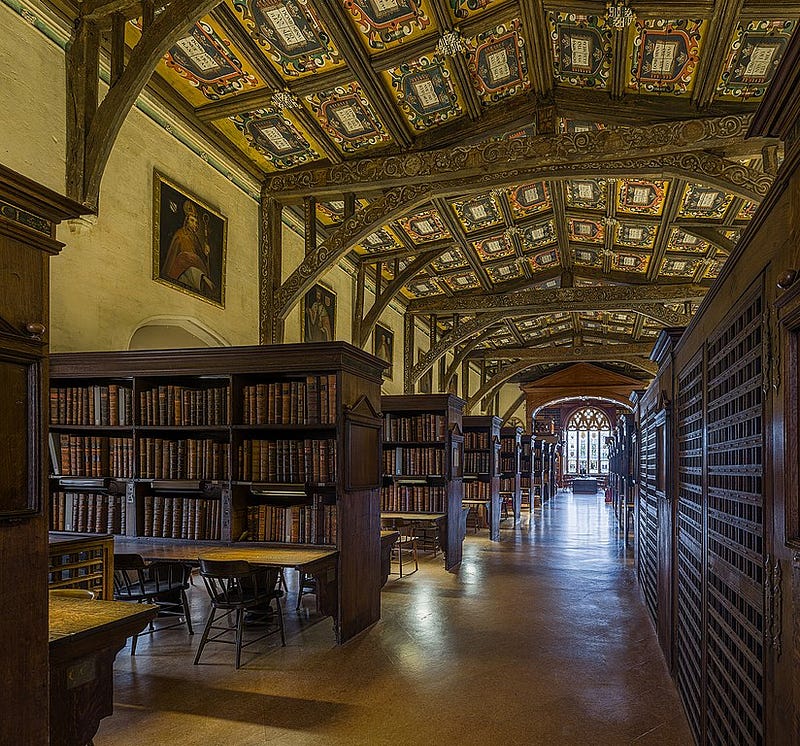

Before us loomed a shelf of ancient books. They were so old, I pretended, that some of them would have been chained to their desks back in medieval times when books were too valuable to risk students stealing them away.
The books were not quite that old, but that was the imaginary world I wanted to live in.
And so, I’ve solved my riddle.
Being the scholar-monk was really about sensuality. I longed to see, touch, and taste this place, to build my own fantastical version of Oxford that would quicken my pulse far more than my ambitions of becoming an Anglo-Saxon professor ever did.
A Junior Year Abroad is about change and self-discovery. By forming temporary new ideas about myself, like I did when I found St. Benedict’s Rule, I was breaking my chains.
In the third and final term at Oxford, I abandoned the Anglo-Saxons at last and chose courses about the Renaissance and ancient Rome. The new subjects warmed my blood, getting me excited about school again.
And as I breathed the intoxicating spring air, my heart cracked open like a robin’s egg. I metamorphosed from the scholar-monk into the scholar-gypsy — but that’s a story for another time.
Thanks for reading! Here’s another essay I wrote for The Narrative Arc that you might enjoy:
— Erie Astin