
My Journey to Overcoming My Fear of Public Speaking
I’ve given hundreds of media interviews and delivered remarks on live TV and to large audiences as an advocate and spokesperson. But allow me to let you in on a secret.
I struggled with a fear of public speaking for a large part of my life.
In high school I recall giving a terrible speech in English class on Greek mythology. I sweated. I stammered. I clutched my colorful index cards with notes. I thought I might throw up. It was utterly horrible. It was probably the worst grade I received in my time at the Bronx High School of Science. Throughout my school years I was often painfully shy, so speaking in front of a class was scary for me.
In college I became a bit of an activist and did a lot of volunteer work with Habitat for Humanity. A large church invited our nonprofit organization to send a speaker for a service, because they wanted to give us a check and someone had to go accept it. I thought how hard could this be? They were giving us money for our work to help people. This should be a cake walk, I thought.
Oh, was I wrong. When I got up on stage to the podium I made it through my talking points but looking at the sea of hundreds of people in front of me was terrifying. My leg actually started to vibrate I was so scared. This had never happened before when I gave a talk and I was so grateful the podium was huge and hid my leg from the audience’s view. I clutched the podium for dear life and it was not attached to the stage I discovered. It actually moved. I wondered if I might vomit right there. I was terrified.
Thankfully it did not fall off the stage and my sweaty palms did not spoil the sizable donation check. I made it through my carefully written talking points about the number of families we helped and our work, but left the event feeling a bit shaken and overly relieved to have such an ordeal behind me.
I recognized that to do the things I wanted to do in life, I would have to overcome my fear of public speaking. I visited Toastmasters (an excellent organization) but could not fit the regular meetings into my hectic schedule.
So I began to practice before any event where I had to give a presentation or do an interview — in order to improve my skills and address my fear. I read books on public speaking and rehearsed in front of my college roommates and family members. By being successful in small moments, I was able to build confidence for bigger events.
While still in graduate school, I had one disastrous job interview where I truly struggled and I didn’t get the job. At the time, I wanted a better job and felt like I just wanted my life to start so I could exit grad school and get on with my life. I had a lot going on in my personal life and that impacted my confidence. I didn’t have the maturity to realize that this job just wasn’t the right fit for me, or that something much better might come along. My lack of confidence and my own doubts showed in how I spoke.
By this time, I had already done well speaking at a lot of smaller (and larger) events due to my activism and volunteer roles. So I walked out of the interview feeling defeated. It felt like I had taken a big step backwards, instead of the leap forward I was so longing to make.
I redoubled my focus on improving my skills and building up my confidence. And the next time I got invited to interview for a job, I undertook preparation with diligence. I practiced in advance, thought of questions I could be asked, and worked my tail off.
Excitedly, I exited the interview knowing I had done my best and with confidence in spades. It was a total reversal from my previous interview experience. Ironically, I didn’t get that second job either. The hiring committee felt my skills far eclipsed the role and that I wouldn’t stay at the organization. And they were right.
But then a third job opportunity came along that was the right fit and included a huge panel interview at an enormous conference table. I just marched in and did my thing. I got that job. I went on to work at Florida 4-H. I ran events large and small, worked with media, and it was smooth sailing for many years after that for me with public speaking.
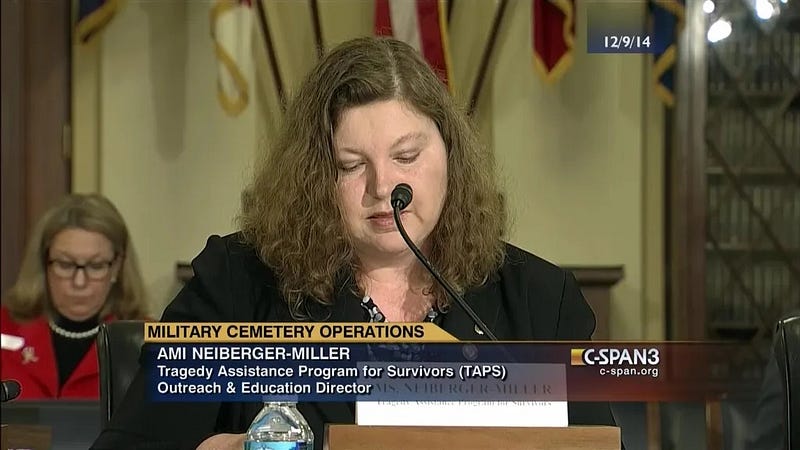
Years later I was asked to testify for Congress on issues impacting gold star families. These were topics I worked on every day at the time. Speaking for Congress is a nerve-wracking event that requires practice, careful sculpting of words, and rigorous attention to detail.
Even “friendly” testimony — the type I was giving (no scandal committed by me or the organization I represented, no giant press scrum, just a few reporters covering the daily humdrum of the Hill), meant being precise and delivering remarks on time.
I would sit at a table with a microphone in front of me, with a timer with red lights counting down how little time I had left, below the people I was addressing, while staring down a large camera used to stream testimony online. As a trainer I would call this a “hostile” environment just by design.
Knowing my past public speaking history, testifying for Congress felt a little daunting to me. I recognized this was the big leagues. I didn’t want to mess up on a stage so huge. I also didn’t want to embarrass the organization I worked for or myself. I wanted to clearly speak about the issues we observed and that I knew so well. I didn’t want to stand in the way of the information getting through to the legislators who needed to hear about it.
So I made a point of getting good advice. I practiced and rehearsed. I asked questions on how to be well-prepared from others who had testified for Congress before. And I tried to follow their advice. I planned what to wear and rehearsed. I went to the Hill to drop off our printed, submitted testimony and saw the hearing room in advance and where I would sit. I had been there before to watch hearings, but knowing I would be sitting at the front at the table for witnesses in one of the big chairs made it different.
For this type of testimony I always prefer to write out my remarks and to rehearse several times. It also was tough to shoehorn into our limited verbal remarks details desired for the topic at hand — so I would not exceed the time limit. It was hard to choose. Our organization was also allowed to submit written testimony (more than a dozen pages and formatted to very specific requirements), so the big details went into that document for the committee (and the media and the public) to read in advance, and my spoken testimony (capped at 5 minutes) was just for the highlights.
I also had to respond to questions from the committee. There was no way to know entirely what those would be, so I invested time in reviewing our much longer submitted written testimony to be sure I understood the details in and out. And I wrote down a few ideas for possible questions and rehearsed what my answers might be. Doing all of this was time-consuming and took hours. Preparing for Congress is not something you can wing or do the night before.
It was quite an adventure to go through that process a few times for various hearings, but I felt my testimony went well and that gave me confidence. Now every time I face a difficult public speaking assignment like making public remarks to a county board or a speech, I think well, gee, at least I am not having to prepare to do Congressional testimony again. This is easy by comparison.
I also know to watch for certain vulnerabilities. For me — speaking about my brother, U.S. Army Specialist Christopher Neiberger, who died in the Iraq war can be emotional — this is something I have to watch for every time I talk about it. I gave remarks at a county Board of Supervisors meeting a few months ago to support a friend and just a simple reference to him as I talked about why I care about this issue made me a bit emotional. The emotion in my voice also got the attention of all of the elected officials in the room. The old emotions made it harder for me to get through my remarks. And I’ve done this for a long time — I’ve been an advocate for gold star families for years. I’ve talked about my brother for a long time. Grief and loss are something I carry. And that’s ok. It’s far better to carry a twinge of emotion my entire life, than to forget his life and memory.
I say all this to point out — improving your public speaking can be a journey and it may not be linear. One coaching session may not be enough to totally “fix” your presentation style or address your fears, but you can work very hard to improve your skills and confidence over time. You can recognize where you may have vulnerabilities that you need to shore up or address. Some vulnerabilities may stay with you.
We all may need to re-visit our public speaking or presentation skills from time to time. Give yourself a tune-up periodically when you need one. If it doesn’t go as well as you had hoped, give yourself grace. Sometimes we all have an “off” day. Just get back up and try again.
You have much to share with the world and it wants to hear you.
I hope you enjoyed reading this. If you’d like to support me as a writer, consider signing up to become a Medium member. It’s just $5 a month and you get unlimited access to Medium.
Ami Neiberger is accredited in public relations and has worked as an independent public relations consultant and writer since 2002. She provides communications strategy, media relations, writing and other services to assist nonprofits, trade associations, government organizations and businesses. Contact her to discuss your project. Follow her on Twitter @AmazingPRMaven.