DILLON ON FILM
My Journey of Faith and The Exorcist
How the most frightening film I’d ever seen evolved into one of the most faith-affirming.
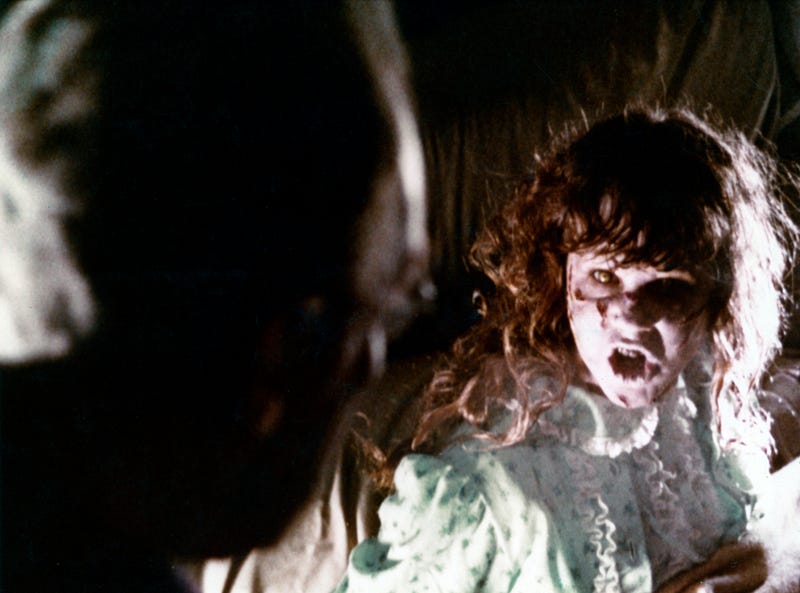
As an agnostic teenager from an evangelical Christian background, I found The Exorcist to be the most frightening film I had ever seen. I even watched it a second time, just to make sure I hadn’t dreamed how scary it was the first time. Since then, I haven’t had the nerve to watch it all the way through again, until last night, when I finally plucked up the courage to catch a re-release at the cinema.
In the intervening years, my belief systems changed. The short-lived experimental agnosticism of my teenage years evolved into a Christian faith that ultimately rejected much of the evangelical mindset I grew up around, but is nonetheless a strong faith. Having undergone this spiritual evolution, The Exorcist is no longer a film I cower from, but a work I find considered, compassionate, cathartic, and moving.
Don’t misunderstand me; the greatest horror film of all time is still emphatically a horror film. Certain scenes still twist my stomach in knots. However, what my experience last night demonstrates is how often a great horror film, or a great film, or indeed any great work of art, becomes whatever you bring to it. The viewer is the missing component that completes the work of art.
In this case, as an agnostic teenager, what I brought to The Exorcist was an open mind of sorts; an awareness of and belief in the supernatural, having already had some personal experiences I couldn’t conventionally explain. However, because I had at that point dismissed Christianity, I also brought to the film the potential to be immensely disturbed by the idea that evil could prevail against good. That writer William Peter Blatty based his source novel on a genuine possession case gave the film an urgent credibility. Furthermore, director William Friedkin helmed the film so brilliantly, carefully taking time to gradually build suspense in an almost documentary fashion, that I found disbelief not so much suspended as expelled. The most shocking moments weren’t that far removed from incidents I had witnessed in my own upbringing. It also didn’t help that the performances, and indeed every other element of the film — use of autumnal Georgetown locations, sound design, music, visual effects, make-up, and so forth — were all so outstanding.
The story of The Exorcist is surely familiar to everyone by now, but just in case it isn’t, here’s an official spoiler warning, as I’m going to discuss the plot in detail. This tale of an actress whose twelve-year-old daughter gets possessed always struck me as a film in denial of itself. No one wants to believe young Regan (Linda Blair) has a demon inside her. Her mother Chris (Ellen Burstyn) is an atheist, and naturally goes everywhere but the church for answers, including doctors, psychiatrists, and so forth. Even when Father Karras (Jason Miller) gets involved, he’s initially sceptical, no doubt in part because of his own crisis of faith, following the death of his mother. It is only in the finale, when Father Merrin (Max von Sydow) returns to the picture (following his appearance in that immensely unsettling Northern Iraq prologue), that the characters — and indeed the film — reluctantly accept the truth.
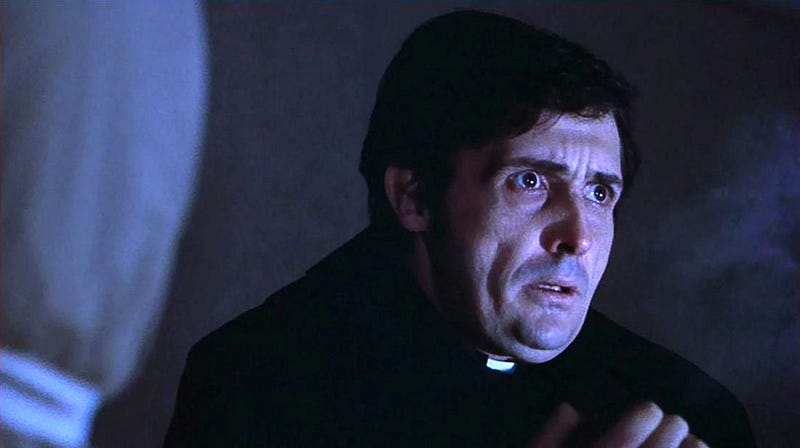
In this finale, after a plethora of fiery and dramatically exhilarating exorcism rites, Merrin is killed. Karras offers his own body in exchange for Regan, telling the demon to take him instead. When this happens, he smashes through the bedroom window and falls down the famous “Exorcist steps” in Georgetown, Washington DC, to his death. Seeing this as an agnostic teenager made me consider what I’d been taught growing up, that the name of Jesus drives away demons. In the film, it didn’t appear to be the name of Jesus that was triumphant, but the quick-thinking priest, who tricks the demon into taking him instead. Something about that idea greatly unsettled me, especially with my aforementioned teenage doubts about the ability of good to triumph over evil, until a few years later, when I began to develop my own Christian faith.
After that, I took a rather dim view of The Exorcist. In purely critical terms, I still considered it the greatest horror film ever made, but the theologically misleading finale became something of an unpardonable sin. However, as my faith gradually evolved, so did my knowledge as a storyteller. I began to realise that a story wasn’t a sermon. It didn’t need to be theologically sound (and to be clear, the theology of The Exorcist in terms of what it literally depicts, is nonsense, as once Karras was dead, the demon could have gone straight back into Regan). By dramatic necessity, the power of evil in a possession story needs to be exaggerated. The actions of Father Karras in the finale are intended as an allegory of Christ’s substitutional sacrifice for sin. That is what makes it so dramatically satisfying.
What I brought to The Exorcist last night was completely different to what I brought to it as a teenager. I now carry the scars of losing my father, and my father-in-law, and understand grief and loss in a much more profound way. I’m also a father myself, with one teenager and one adolescent, and understand the burden of parental fears. In addition, I carry the baggage of decades of my own journey of faith, with all the questions and doubts I have experienced along the way. I believe Christians have to wrestle with these doubts, in order for faith to be real, rather than suppress them. In my case, I haven’t experienced crises of faith so much as crises of understanding. As a result, I have embraced a theology of suffering that often differs from those of an evangelical mindset. The Bible says we share in the sufferings of Christ, that we might also share in his glory.
With all of that in mind, I now find The Exorcist contains many points of emotional identification. Father Karras’s faith struggles and grief over the death of his mother, and the anguish of Chris over what is happening to her daughter, give the film a profoundly sympathetic and humane undertone. The extended (and now my preferred) cut of the film also adds back in a wonderful exchange between Merrin and Karras, mid-exorcism, which I’ll transcribe below.
Karras: Why her? Why this girl?
Merrin: I think the point is to make us despair. To see ourselves as… animal and ugly. To make us reject the possibility that God could love us.
Billy Graham was a great preacher, but I believe he was wrong about The Exorcist. He apparently claimed evil was embedded in the very celluloid itself. Personally, I now see God in the film. I see chinks of kindness, compassion, mercy, and grace, like light breaking through darkness. That isn’t to say the film should be approached lightly, as it is still a hugely bracing experience. But I do not believe it is the embodiment of evil, as certain evangelicals have claimed. Instead, I think it is not only the greatest horror film ever made, but also a truly transcendent and deeply spiritual cinematic experience.
(This article is a revised version of a piece originally published at Simon Dillon Books.)
If you enjoyed this article, please consider supporting my writing on Patreon or Ko-fi. You can also offer a tip via Paypal (see tip button below). Alternatively, if you want unlimited access to my writing on Medium (and that of many other talented writers), click here to upgrade to full Medium membership. This is an affiliate link. I receive financial incentives for new referrals, so that’s another hugely helpful support to me. Thank you.
For more about me and my writing on Medium, please click here. For information on my writing outside Medium, please click here. For a list of my published novels and other works, please click here.