
My journey from being gender identified to gender neutral….
Over the last few years, my journey has been the process of letting go of many of my identifications. However, I will limit this article to gender identification with content that focuses on women (in the spirit of women’s day).
I will dive straight into clarifying gender-neutral and gender identification as the words could signify different things to each of us.
Identifications evoke a sense of who one is. We could harbour different identifications with our nationality, our religion, our race, our caste, our beliefs, and so on. I am employing the word identified to suggest the situations where-in our identifications become more important than the truth. For example, being identified as a Hindu I justify violent actions against non-Hindus. At this place, one can say the person is identified with his religion. It has become primary to his existence and in fact, is guiding his actions and not the knowledge of what is true and false. One can also say his humanity has taken the back seat, and identifications have taken the front seat of his life.
In this context, gender-neutral means gender is secondary to one’s existence and humanity is in the front seat. I am not implying here that gender is not important, it does not mean we don’t celebrate ourselves. But merely inquiring into the condition of strong identifications that hamper our ability to explore our true potential. My journey was rocky and bumpy, to say the least, but if one is to describe it in a sentence, there was this constant tension between “what I am” with “what I should be like” and between “what I want” with “what is expected of me.”
Most women would have experienced it and likely far more tensions like we are seeing even in the case of the Dubai Princess Latifa. In slightly more gender-balanced societies, the tensions could be relatively less. But for me, growing up in a country like India with clearly defined gender roles and identifications, this tension was extremely intense daily. It was never about being human or a person. Every lesson learned, what I could do or not do was towards the service of my gender. Every life experience, choice, was to accentuate gender even if it was at the cost of one’s well-being. Intuitively (like most of us) I knew something was not right.
The societal influence Every society or culture holds certain assumptions, rigidities that are never entertained in discussions. It is almost an unspoken or invisible requirement for everyone to subscribe to these assumptions, deny they are operated in the society, denial is also denied. This is a big one and while you are growing up you don’t realise these things. But in my late teens I started to notice even if the men and women did not subscribe to certain views there was this overall collusion among people to “play false” to protect these assumptions and carry on with the charade.
The assumptions or opinions could have been anything from the definition of an ideal woman, woman’s freedom of choice, what beauty means, what is the right thing to do if you are assaulted sexually or otherwise. Once I saw this tendency in society to play false, I could not unsee it. The force of society colluding against the truth can be utterly overwhelming. The times I had to stand up for myself or speak the truth it demanded massive courage. You are essentially an outcast if you are not playing by their rules (even if they are incorrect).
Why is it so? I wondered. Generally, people are caught in thinking that these assumptions are an absolute necessity (never to yield) for a healthy and stable society. But with a little investigation (if one is willing) you can see how these notions pollute and destabilise a society by masking the truth.
One can look at the billion-dollar industry established over the beauty obsession, reminding women every day what is considered beautiful. It is an example of society colluding to “play false” for self-serving interests. If women challenged what is wrong with the way they look naturally, there would be no power of these industries or societies, in general, to control the perceptions of beauty or drive a narrative for their benefit. Every human needs to care for his health and fitness irrespective of his or her gender. If we want to lead fulfilling life health and fitness of our bodies is extremely important to enrich ourselves with varied experiences. But what is going on here is far remote from educating the populace about self-care, self-love, acceptance but setting up a problem that does not exist in the first place.
As quoted by Bell Hooks in her work Appearance obsession: Is the price too high? The obsession with physical appearance often distorts reality, making individuals vulnerable to a host of psychological difficulties, including depression and anxiety, and even abuse.
Individual influence As individuals belonging to a society or culture we are invariably a private mixture of our societal assumptions and our own experiences. As we grow up, we are infused with these identifications as an important part of fitting into the society we live in. Suddenly we are wearing the glasses of identifications to then go about in the world. For example, we start seeing ourselves as a woman and not as a human being. We write our life stories accordingly. I am a woman so the story continues…
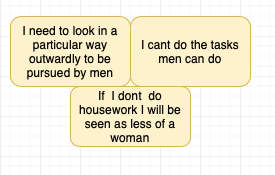
This played out in my earlier, adult life especially if I had to do some tasks within my house or choose a career, a little voice in my head going “women can’t do these things” and at times I would not even try them. I would also hear my friends (many male friends) saying yes women can’t carry out these things. I wondered I hadn’t even given it a shot, but they are already telling me I can’t do it. That’s when I started to observe how I was in subtle and obvious ways also corroborating, co-operating, and reaffirming these assumptions or identifications.
Once I started peeling this out of my system and started putting my humanity first the world was mine to explore. Growth mindset to acquiring new skills and if any resistance(little voice) would come up I would question it. This included all the things I was expected to be good at but only now it considered the right context and meaning. It was no longer about gender that I had to be a good cook but as a living thriving life, you would want to take care of yourself with healthy and nutritious food.There are numerous examples of how we as individuals co-operate with society to reaffirm rigid notions. Let’s take the example of commoditisation of women’s bodies.
It is well-documented that women tend to be more objectified than men as their bodies tend to be more looked at, evaluated, and sexualised. Research in the field shows how women react to societal objectification by adopting an observer’s perspective on their bodies, a process they call self-objectification which links their self-worth to their appearance.
Self-objectification occurs when a person privileges her or his physical attractiveness over non-observable bodily attributes such as subjective feelings of physical competence and health. The world around objectifies the female body (to a greater or lesser degree) which puts women in social situations that increase self-objectification, anxiety, vigilance concerning their physical appearance. Fredrickson and Roberts in objectification theory point out that the common thread amongst all forms of objectification is the “experience of being treated as a body (or collection of body parts) valued predominately for its use to (or consumption by) others.”
I think here we have great power as individuals to shift this rigidity in our cultures by becoming aware of how we are colluding and co-operating ourselves by allowing these notions to shape our lives.
I had to make the transition in a way to have the right relationship with my own body. Acknowledging deeply to myself that the body deserved no such scrutiny, nor it should be put through an ordeal to fulfill the requirements of the society or men in particular. It is an indispensable tool of our human existence and deserves respect, care, and love in its natural form and to never lose sight of this truth.
My journey continues but my experience so far of being gender-neutral helps me connect with every other person as a person, not a man or woman or third gender. It is a liberating experience because there is a real connection and communication, the beauty of it cannot be articulated in words. But now you can say that the society remains the same. Yes, it is not difficult to observe people’s responses based on your gender in gender-identified societies. The tone of cruelty, objectification cannot be missed. The important observation I had nevertheless was when I let go of my gender identifications my conversations and interactions with people changed for the better. Bringing that understanding in a way was shaping their responses towards me. I highly recommend trying it out for yourself!
Once we have our humanity at our forefront, it is not hard to see that everyone likes to be treated with the same kindness and respect we feel for ourselves. I hope our future generations make this shift to gender-neutral societies for all to thrive and succeed in the brief life we are all blessed with.
I will leave you with this beautiful quote by Leila Aboulela in her novel Minaret “All through life there were distinctions — toilets for men, toilets for women; clothes for men, clothes for women — then, at the end, the graves are identical.”


