avatarGirish Babu (Entrepreneur, Advisor, Exec, MBA)

Free AI web copilot to create summaries, insights and extended knowledge, download it at here

1594

Abstract

two)states: <b>0, 1</b></li></ul><figure id="5c20"><img src="https://cdn-images-1.readmedium.com/v2/resize:fit:800/0*G9LP3czrP2VvqTCo"><figcaption>Photo by <a href="https://unsplash.com/@markusspiske?utm_source=medium&amp;utm_medium=referral">Markus Spiske</a> on <a href="https://unsplash.com?utm_source=medium&amp;utm_medium=referral">Unsplash</a></figcaption></figure><p id="854e">That’s an easy way to understand — you have an <b>Off </b>or <b>On</b> State!</p><p id="db50">Imagine you had to represent the English alphabet in binary format; you need <b>26</b> variants to represent <b>a->z</b> (let’s ignore uppercase for now).</p><p id="7408">How many bits are required to store 26? Given there are two states, you need a minimum of 2⁵ (32 bits)!</p><p id="e538">Example: a = 00001, b = 00010, c = 00011, d = 00100, e = 00101, …</p><p id="a8cb">You get the idea.</p><p id="e23a"><b>Challenges</b>:</p><ul><li>The more types of data you need to store, the more you need many bits to represent them uniquely.</li><li>Classical computers (although they have evolved significantly over the past 50 years) run into issues doing complex calculations (like bitcoin hashing). This topic is for another day!!</li></ul><h1 id="6bb1">Quantum Computers</h1><ul><li>Information stored as Quantum bits (qubits): Each atom has a direction of spin (<b>clockwise</b>, <b>anti-clockwise</b>) and <b>360⁰</b> of motion. Hence <b>720</b> states are represented by a single atom!</li><li>I’ll break this down with an example: a <b>Circular clock </b>has <b>360⁰</b> — each position can represent a state. N

Options

ow assume the clock can move both forwards and backward — hence the additional <b>360⁰</b></li></ul><p id="d07e">If I have to expand this idea further, the particle can rotate across multiple axes in a 3-D space (considering depth).</p><p id="b235">Imagine a sphere like the earth: the clock can move along the North axis, South, or somewhere between.</p><p id="dcc9">So, many positions can be used to represent data.</p><figure id="5d34"><img src="https://cdn-images-1.readmedium.com/v2/resize:fit:800/1*vma7g-l86p9O8jteG__a0A.png"><figcaption>Source: <a href="https://upload.wikimedia.org/wikipedia/commons/thumb/6/6b/Bloch_sphere.svg/1280px-Bloch_sphere.svg.png">https://upload.wikimedia.org/wikipedia/commons/thumb/6/6b/Bloch_sphere.svg/1280px-Bloch_sphere.svg.png</a></figcaption></figure><h2 id="4712">Advantages (over classical computers)</h2><p id="9098">Imagine a computer so powerful that it can perform <b>complex calculations</b> at an unprecedented <b>speed</b>, tackling problems once thought impossible.</p><p id="f6ce">Quantum computing holds this promise by leveraging principles of quantum mechanics.</p><p id="8dc3">There are complex challenges to dealing with computing states. However, the promise of solving complex problems pushes heavy investment in research and development in this field.</p><p id="ceb1">It can solve challenges with cryptography, optimization problems, drug discovery, and more.</p><p id="5f8c">I hope this gives you a glimpse into the basics of quantum computing and encourages you to read about this exciting field of technology!</p></article></body>

My introduction to Quantum computing for beginners

Here’s my simple approach to understanding the emerging area of Quantum computing
Photo by ThisisEngineering RAEng on Unsplash

I have found some great tech articles on Medium, with many publications dedicated to Tech professionals!

I found that introductory material is quite sparse, so I want to help my readers understand the basics of new areas.

Let’s begin to understand what Quantum computing is all about without further ado.

“computing that makes use of the quantum states of subatomic particles to store information.” — from dictionary.com

Now, isn’t that quite complicated? What are quantum states and subatomic particles??

I’ll break this down into simple steps as follows:

Classical Computers

  • Information stored in Binary (two)states: 0, 1
Photo by Markus Spiske on Unsplash

That’s an easy way to understand — you have an Off or On State!

Imagine you had to represent the English alphabet in binary format; you need 26 variants to represent a->z (let’s ignore uppercase for now).

How many bits are required to store 26? Given there are two states, you need a minimum of 2⁵ (32 bits)!

Example: a = 00001, b = 00010, c = 00011, d = 00100, e = 00101, …

You get the idea.

Challenges:

  • The more types of data you need to store, the more you need many bits to represent them uniquely.
  • Classical computers (although they have evolved significantly over the past 50 years) run into issues doing complex calculations (like bitcoin hashing). This topic is for another day!!

Quantum Computers

  • Information stored as Quantum bits (qubits): Each atom has a direction of spin (clockwise, anti-clockwise) and 360⁰ of motion. Hence 720 states are represented by a single atom!
  • I’ll break this down with an example: a Circular clock has 360⁰ — each position can represent a state. Now assume the clock can move both forwards and backward — hence the additional 360⁰

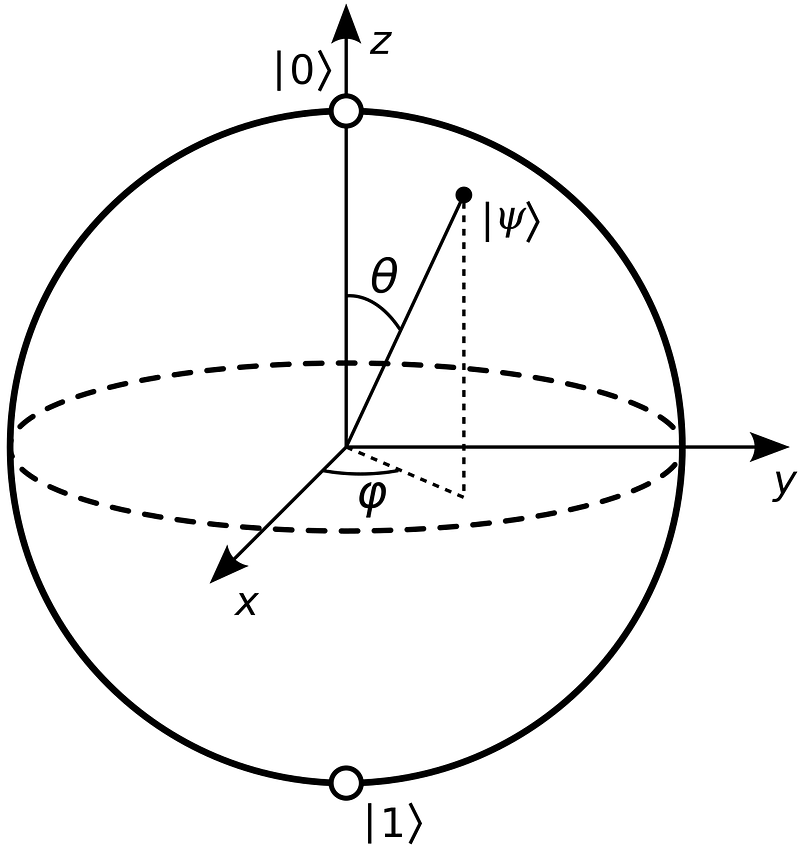
If I have to expand this idea further, the particle can rotate across multiple axes in a 3-D space (considering depth).

Imagine a sphere like the earth: the clock can move along the North axis, South, or somewhere between.

So, many positions can be used to represent data.
Source: https://upload.wikimedia.org/wikipedia/commons/thumb/6/6b/Bloch_sphere.svg/1280px-Bloch_sphere.svg.png

Advantages (over classical computers)

Imagine a computer so powerful that it can perform complex calculations at an unprecedented speed, tackling problems once thought impossible.

Quantum computing holds this promise by leveraging principles of quantum mechanics.

There are complex challenges to dealing with computing states. However, the promise of solving complex problems pushes heavy investment in research and development in this field.

It can solve challenges with cryptography, optimization problems, drug discovery, and more.

I hope this gives you a glimpse into the basics of quantum computing and encourages you to read about this exciting field of technology!

Quantum Computing
Computers
Basics
Technology
Learning
Recommended from ReadMedium