
My (Imaginary)Interview With Rachel Dolezal
Get ready for a bumpy ride, and hold onto your wig, because she’s coming for yours!
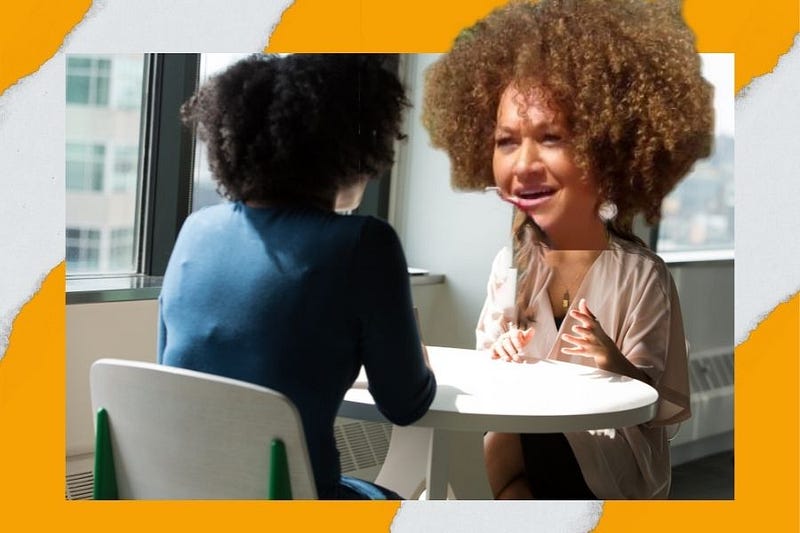
Last week I interviewed Rachel Dolezal. She happily accepted that I share it on Medium. All publicity is good publicity. Don’t lie on the couch, just sit on it, I said invitingly. After all, I don’t do therapy on Wednesdays.
On Blackness and the Black Community
MJ: Why do you think the black community is angry with you?
Dolezal: The black community? Such ungrateful curmudgeons. I did more for them than they ever could do for themselves. I mean, I made so much progress with the police commission, the NAACP… I even wrote an African American spiritual. I’ll be coming out with my single in 2022, “Michael Jackson, You Made It Look Easy.” And now because of some misunderstandings, they threw me to the curb like some Friday-night garbage. Is that justice to you? (crying).
MJ: You referred to the black community as hostile and angry…
Dolezal: Tomahto, tomato. What matters is that I escaped my parents. I can’t count on the black community to save me from them anymore because they won’t get over whatever-thing-that-perhaps-happened. I can’t even remember what we were arguing about. It was a little thing, really.
I mean, just because I’m white I can’t be forgiven? It’s so unfair. To be white in this world is such a double whammy. No one lets you do whatever you want anymore. Then people attack you for crying about it (starts to cry). Back in Christopher Columbus’ time, no one would have made a big deal of something like this. By the way, I just created a foundation make-up line. “Ra’Chelle: When the white keeps coming, suit up and re-apply. Never detect the lie.”
MJ: Can we please focus? When you were a student at Belhaven college, the Black Student Association elected you president (Aitkenhead, 2017). White Rachel. You won because you were passionate, and you cared about black history and politics. You couldn’t have done the same thing as a white person after college?
Dolezal: It’s other people’s fault. They made me do it. I would have told the truth, but then, whenever I didn’t lie, they took away something from me (starts to cry). So, you know, if you want something, you can just do whatever it takes to get it. I mean, they didn’t feel comfortable around me when I said I was white (Aitkenhead, 2017).
It’s like if someone asks if you stole the cookie from the jar, and you just shake your head no? Even if you did it? I mean, that’s on them if they couldn’t read between the li(n)es.
On White Tears and White Privilege
MJ: Some people said what you did is the “epitome of white privilege.” Many have critiqued “The Rachel Divide” (Brownson, 2018) as showing a lot of white tears.
Dolezal: Well, I’m the victim, darn it. Can’t a woman lie anymore? And now it’s a sin to lie and then cry (stops crying). I call it emotional intelligence. If I cry, people forget what they were mad at me for. They even buy my books. It’s a win-win. You get to read a bestseller, and I get to impersonate Cleopatra.
White privilege? I never benefitted from it. Being a teacher in Africana Studies gives me all the authority to say white privilege is a bunch of bull. I was poor as dirt (Aitkenhead, 2017). Just because I’m white, doesn’t mean you can hog all the black oppression for yourselves. That’s just greedy and frankly, unfair.
MJ: I’m glad you brought up your book. Kelley Williams-Bolar was imprisoned for using her father’s address to get her daughter into a good school. If you had been caught lying while black, you would have faced serious legal troubles. People say your whiteness protected you. In your case, you landed book deals.
Dolezal: I’ve seen the meanest messages on Facebook. Do you want my life right now? And when I post all my private pictures of my newborn son on Instagram, Facebook, YouTube, Twitter, anything but Tinder, people are so cruel. Can’t they just give me privacy? That’s what I plead for in my international talk-show interviews.
MJ: Many have said you could have achieved more being you, a white woman. Your affinity with white, conservative, religious people could have propelled anti-racism into territory inhospitable for most black people.
Dolezal: Don’t you get it? I want nothing to do with being white. I learned early on that I was cursed when I almost killed my mom in childbirth and she never forgave me (Brownson, 2018). So what’s the most cursed being on earth? Black people because they came from Ham. I wanted to express my rottenness externally, by becoming the incarnation of evil. That’s why I was so close to my adopted black siblings. I suddenly felt like I fit in. We were kindred.
On Parenting
MJ: Your eldest son Izaiah moved to Spain to let you “be on your journey alone,” and your middle son Franklin wanted this to “go away” (Brownson, 2018). How do you think your choices affected your children?
Dolezal: My kids got my back. Before bedtime, I share with them all my hate mail. I get their advice on how to respond to nasty comments people shout at me in the street. Franklin enjoys coming to my talk show interviews. Can you think of any other reason why he is always huddled up in bed refusing to eat (Brownson, 2018)? That’s how proud of me he is. Anyway, it’s a Dolezal thing, you wouldn’t get it.
On Sexual Abuse
MJ: When the truth came out that you were lying about your identity, your lack of credibility ruined your sister’s chances of pressing charges of sexual abuse against your biological brother. Now no one will take her case (Brownson, 2018). What do you think about that?
Dolezal: Geeesh, why can’t people live and let live? A kind person with a soft tone could have talked to me over tea, and simply said, “You know, Rachel, sweet Rachel, you got into Howard, you received teaching gigs, and you became president of an organization because you lied. No big deal. End of discussion, now let’s go shoot clay pigeons.” But no-o-o-. People had to get all up in my business. I would never do that to anyone, cut into other people’s lives, social identities, social movements. That’s too personal.
On Transgender Comparisons
MJ: You claimed that trans people have welcomed your, ahem, “transition” (Aitkenhead, 2017)? I hate to ask, but is this true?
Dolezal: This is a trap, right? I bet you’re going to say that gender is something assigned at birth, and race is something inherited. I’ve heard it all before. I’ll tell you what, missy, no one can tell me what to do. Not a black person. Not a white person. Not a trans person. Not a cis person.
I’m never going to be that little Montana girl again (Brownson, 2018). Never. My parents have no power over me (crying). I’m gonna be as black as I possibly can, and they can roll over in their hay bales if they care. You didn’t get the memo? Race is socially constructed. That means I can construct anything I want out of thin air.
I’m an artist, a creator. Didn’t God create man from his own imagination? If he could do it, why can’t I? Social construct means that history, social science, politics, and culture have no bearing on reality. You can do whatever you like as it suits you. One day you will see me up on that cross, and you will say, “I should have listened to Rachel.”
On Transracialism
MJ: I am the textbook definition of a transracial person. So are your adopted black siblings. You aren’t transracial, because you are the same race as your parents, and you weren’t adopted. Why do you call yourself a “transracial girl?”
Dolezal: I think I deserve a Peace Prize, a Nobel Peace Prize. No other theorist has contributed more to the critical analysis of race and identity as I have. Open your minds, people. Let Rachel in!
On Reality
MJ: On Langston’s birth certificate, you listed your race as black and white because it’s “truth for me” (Brownson, 2018). Is truth whatever we want it to be?
Dolezal: You all sound like a broken record. A James Brown record. (starts dancing on the table, crying).
MJ: “Don’t Tell a Lie About Me, and I Won’t Tell the Truth About You?” Is that the song you…?
Dolezal: …If I shout “fire” in a theater, that’s my business. The word “fire” is a social construct. Not everyone has the same idea about it. I am actually referring to popcorn. People are so literal these days.
Even after teaching in the Africana Studies department (Millner, 2017), I can say there’s only one group of people who get it. My hair clients (Brownson, 2018). They have stayed with me because they believe in me. Who would drive 50 miles for someone to do hair when they could just go down the block to my deft white hands with their black spirit tucked safely inside?
Thank you for reading,
MJ
References
Aitkenhead, D. (2017, February 25). Rachel Dolezal: ‘I’m not going to stoop, apologize and grovel.’ The Guardian. https://www.theguardian.com/us-news/2017/feb/25/rachel-dolezal-not-going-stoop-apologise-grovel
Brownson, L. (Director) (2018). The Rachel divide [Film]. Netflix.
Millner, D. (2017, March 3). Why Rachel Dolezal can never be black. NPR. https://www.npr.org/sections/codeswitch/2017/03/03/518184030/why-rachel-dolezal-can-never-be-black


