
Beauty | Health
My Hair or My Uterus?
What’s a girl to do
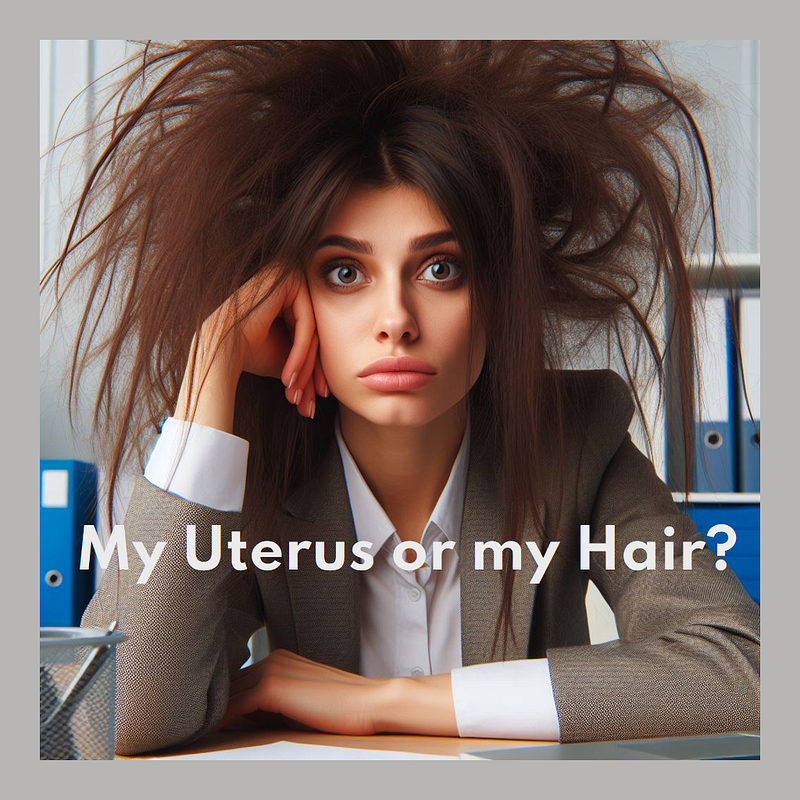
My hair is always a stringy, hot mess. It’s dry, frizzy, brittle, coarse, untamed, wild, broken — damaged. Think of the untamed and snakelike hair of Medusa. My daughters seem to like to point this out and give me advice whenever they see me. “Mom, you should try a new conditioner.” “Mom, you should use a flat iron and coconut oil.”
Even my friends have commented on my split and disheveled strands peeking out from under my baseball cap. Self-conscious I am.
I’ve heeded my daughters’ and friends’ advice and now only wash it once a week and damp olive oil on the ends in between. I’m on my third day, and it’s not a good look; plus, I smell like a bad day at Pia Nonna’s kitchen. It, my hair, has a mind of its own — rebelling against every attempt at control. It’s a defiant follicle insurrection. Yes, my hair and I are at odds — a battle of wills, mocking everything I do to reign it in.
My friend Anne used to have hair like mine. Her hair was a dishwater-brown worn-out mop atop her head, its tangled knots perfect for hiding rodents. Not that she had any to my knowledge, but it always reminded me of a high school janitor’s grungy mop saturated with sweaty testosterone left in the corner of the gymnasium after a basketball game,
Then, one day, her hair changed. It was smooth, sleek, and sun-streaked with golden rays. What happened? Who was this person? Where was Ol’ Raggedy Annie? Was she abducted by Chaz Dean Studio and doused with luscious chemical treatments? Was she wearing a wig like the kind Gayle King wears on the CBS morning show?
I was so enthralled staring at Anne’s new hairdo that I knocked myself in the chin with my pickleball paddle. I complimented her lock transformation and told her how “beautiful” she looked, and then I proceeded to interrogate her on the what, the how, and the who.
Desperate to fit in with my sleek-haired female friends, I made an appointment to get it done with the same hairdresser as Anne’s before even knowing what the make-my-hair-sixteen-year-old-again-product was. I didn’t care. I wanted to turn back the clock on my hair.
The Miracle Hair Cure — Keratin
The miracle product, Keratin, gave me hope for a healthy and youthful appearance. No more Grandma Hair! Bring it on! I looked at the advertisements guaranteeing its strength and structure, smoothness and shine, manageability, repair, restoration — overall hair integrity, and who doesn’t want that?
Too good to be true?
Yes? One cursory search immediately revealed that “Hair straightening chemicals were associated with higher uterine cancer risk.” According to the National Institutes of Health, women who use Keratin products more than four times a year are two times more prone to developing uterine cancer.
According to Dr. Alexandra White, head of the NIEHS environment and cancer epidemiology group:
“We estimated that 1.64 percent of women who never used hair straighteners would go on to develop uterine cancer by the age of 70; but for frequent users, that risk goes up to 4.05 percent.”
What? My Uterus or my hair? I have to choose.
If I didn’t already have endometriosis, a thickening of the uterine lining, which has to be checked and biopsied annually to make sure it doesn’t lead to cancer, I would most probably give it a go, get it done, do the do. However, since most Keratin-related cancers that start in the uterus are endometrial cancers, I had pause for concern.
Keratin and other carcinogenic products, including Permanent Hair Dyes, which have estrogen-like properties, are absorbed through the scalp and enter the bloodstream en route through other bodily organs to wreak havoc on the reproductive system.
While Keratin is a natural protein found in human nails, skin, and hair, manufactured keratin hair straightening products have carcinogenic ingredients, including a chemical called Formaldehyde. The American Cancer Society claims that formaldehyde is a known carcinogen that can cause cancerous cells to form and grow, as well as trigger other negative side effects.
Adding to the complexity, research provided by Breastcancer.org suggests a racial disparity in the impact of hair dye and chemical straighteners on cancer risk. Particularly, in the United States, “black women” statistically exhibit higher rates of cancer of the uterus, emphasizing the importance of understanding how these beauty products may disproportionately affect different ethnic groups.
Navigating Racial Disparities: Hair Products and Cancer Risk
The Resilient Sisterhood Project, a non-profit committed to promoting awareness of the reproductive health of black women, highlights significant disparities between black and white women concerning uterine cancer. Researchers suggest that the effects are disproportionately greater for Black women “because they’re more likely to use these products.”
According to their research, black women exhibit a higher likelihood of advanced stages of uterine cancer and “are more prone to aggressive tumor types, including clear cell, serous, high-grade endometrioid, and malignant mixed Mullerian tumors,” compared to their white counterparts.
Although the study did not identify a variation in the association between straightener use and uterine cancer risk based on race, the impact could potentially be more significant for Black women due to their higher likelihood of utilizing these products.
The American Journal of Obstetrics and Gynecology further explored this connection of mortality rates associated with endometrial cancer and revealed an elevated risk among black women for experiencing aggressive forms of uterine cancer. The research pinpointed two key factors contributing to this heightened risk:
- Black women have a higher prevalence of molecular and genetic markers for more aggressive forms of endometrial cancer.
- Black women are often less likely to receive proper care for the disease, and the disease is often diagnosed at later and more aggressive stages compared to white women.
My research journey has been an eye-opener. From Keratin to racial disparities in cancer rates, the complexity of the issue demands a closer look. More research is not just necessary — it’s essential.
I haven’t told my friend Anne about the dangers of Keratin. . . yet. For all I know, she’s probably already aware of the risks and went ahead anyway. Women are touchy about weighing the health risks and benefits of beauty interventions. So, I’m waiting for the opportune time when she asks me about my hair. I will tell her honestly about my uterine cancer concerns.
Through women talking to women, we can bridge the gaps in my/our understanding, question the safety of products marketed to women, and advocate for a more comprehensive approach to women’s reproductive health.
As for my bad-hair-everyday-hair, I’ve realized that my vanity should not come at the expense of my physical health. The decision is not just about my hair or my uterus; it’s about embracing a holistic approach to beauty — one that prioritizes women’s health, celebrates women’s diversity, and seeks answers to the hidden health risks in female beauty products.
Mary Louisa is a writer trying to figure life out one day at a time.