My Grief Ages With Me
Time heals all wounds. Except grief.
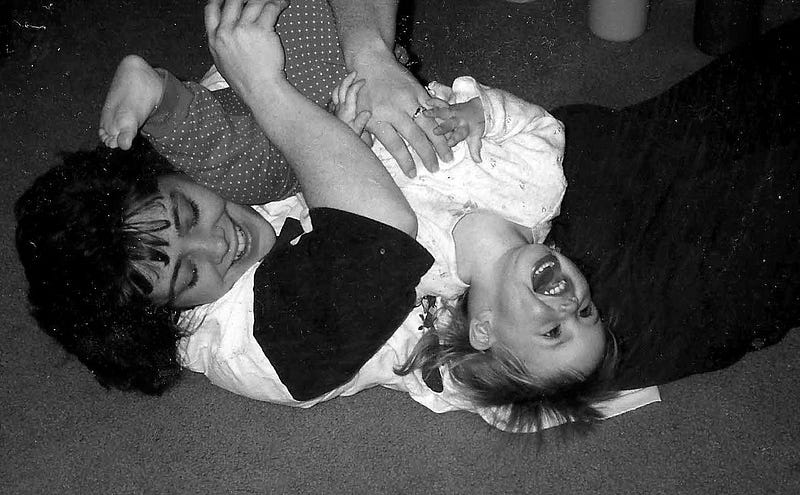
I’m in my childhood kitchen. It’s a mess, to Mom’s dismay. Rejected pieces of frozen pizza dry out on the stove, dishes overflow from the sink onto indigo tiles. Junk coagulates in the grouted crevices of our countertops and coffee circles dot the scene like the freckles on her skin. She doesn’t drink coffee in the morning, just Pepsi, but she cleans her boyfriend’s stains, anyway. This kitchen is a battle she can win. She scrubs at the tiles, packs the dishwasher with impossible precision, reorganizes the glass canisters against the wall, descending by height, tall to small. She is the Tazmanian Devil in reverse. Equally short in stature and temper, she whirls around the kitchen and leaves sparkles in her wake.
After her deep clean, she runs a Clorox wipe over the scene. Every night by bedtime, her kitchen gleams, even as her life crumbles into pieces inside of it. The next day brings another undoing, just one of the visible clues of ongoing destruction. Another is the graying and drooping of her skin. Abusive boyfriends — and cancer — will do that to you.
Mom makes salsa in a handheld vegetable dicer. Round and round her freckled arm goes. The harder you try, the better it tastes, apparently. She tires and hands it off to me, age thirteen. I don’t appreciate tomatoes and onions mingling in such proximity.
In fact, when she’s in Mom-mode, I don’t appreciate many things about her. We fight about anything and everything: no, you can’t stay over your boyfriend’s house, no, you can’t buy thongs with your allowance money, no, you can’t yell at your stepfather. Even though he yells first. Her salsa is just one of our many pain points as mother and daughter, co-survivors, friends. She makes me try it and my nose crunches up in disgust. Mom rolls her eyes. I don’t realize that, years down the line, I’ll wish I had this very recipe. I’ll recreate it in my memory a thousand times. Nondescript yet juicy; sweet and citrusy — and how do you get that consistency with a blender? Mexicans would call it a sad excuse for salsa…
How did I get from Mom’s kitchen to this kitchen, making salsa roja with a blender in the countryside of Oaxaca? Is it the sizzling chilies or the question that makes my eyes water? One thing’s for sure, Mom wouldn’t touch this salsa with a ten-foot pole. Her spice cabinet didn’t make it far past black pepper, and here I am, acclimating to some serious heat, singing along to the banda music drifting through my open window.
Would I be here if Mom were still alive? I doubt it. Mexico is the last place she’d want to find me. I ride in the aisles and doorways of buses so full it’s a miracle they move at all. I’ve been pickpocketed. Thrice. I hang out at the local tattoo shop — one of the five or so businesses at the town center — and climb rugged mountains with the men of my cohort. When Mom died, I was only taking Spanish classes to pad my resume for pre-med, hellbent on being her version of great. Back then, Boston, Massachusetts seemed far away, and it was only an hour down 93. Even I was oblivious to the course change that was to come.
Times like this — when I realize I’m doing things Mom never could have imagined — make me feel worlds away from my childhood kitchen; worlds away from a life with her in it. Times like this make nine years feel like a whole life lived without her.
Losing my mom unhinged me, because when I didn’t hate her, I adored her to an excruciating degree. My world revolved around her at the center. When she died, I was a child’s lost balloon, floating nowhere but up and away. Ungrounded, entirely. Lost, completely. Robert Lowell’s “Skunk Hour” comes to mind:
A car radio bleats, “Love, O careless Love. . . .” I hear my ill-spirit sob in each blood cell, as if my hand were at its throat. . . . I myself am hell; nobody’s here
When I popped and came back to Earth, I was so far away from where she left me. I found myself in a new life, the remnants of her influence seemingly diluted by the myriad of new experiences that she never could have imagined. I was in a kitchen in Mitla, Oaxaca, making salsa roja, listening to Natalia Lafourcade, crying in Spanish to my new friend from Acapulco, thousands of miles away from my friends and family in the States.
How did I get here? But, really, I knew. Losing my mother destroyed me and freed me all at the same time.
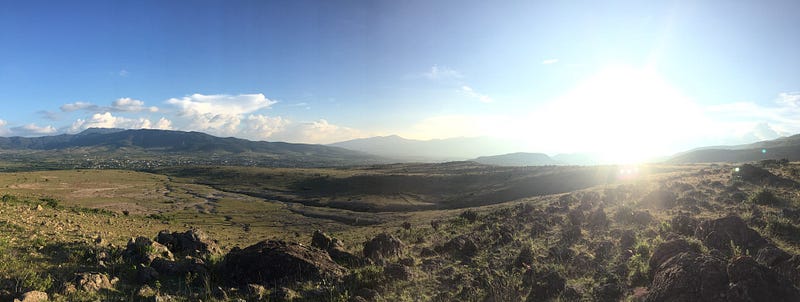
They say there are ten stages to grief. I say ten’s too convenient of a number, and there’s nothing convenient about a dead mother. I’ll admit, though, time does help. Nearly a decade later, Mom being dead is like camping with a Therm-a-Rest. It’s no California king bed, but the cushion of time mitigates the pain. I’m not sleeping with my back to the frigid, unforgiving ground, praying for rest. I’m sleeping soundly through the night. I’m learning new salsa recipes. I’m writing about it.
In other ways, though, time introduces new challenges. Just when I think I have grief figured out, it texts me ex-boyfriend style and asks if I’m up. Queries about Mom’s salsa recipe are child’s play to my mature grief’s unwavering resolve. It asks me harder questions. It does not relent. It makes me wonder, which parts of me are her and which parts of me are me?
I assess. Surely my legs are hers: stout and strong and steady in their conviction. These breasts my 13-year-old-self coveted. My hips. How easily a chuckle leaves my lips. I look at my hands: sturdy, efficient, knuckles wide and fleshy, writer’s callus on the middle finger from our tenacious grip. My small hands sacrifice elegance for function. I am grateful for their maternal resemblance. These phenotypic congruities bring me peace. If I have her hands, then everything I do has her fingerprint on it. If everything I do has her fingerprint, she is never completely gone.
Other traits are harder to reconcile. Do I, for instance, share her troublesome taste in partners? Did she pass down the habit of explaining away the toxic parts of emotionally immature men? But he drives me to work. But he took the trash out. But he loves me. The common refrains echo in my mind and manifest in my own intimate relationships. I so easily find the good to dismiss the bad.
I see my mother’s face in the mirror: puffy eyes and frowning mouth. I see her kneeling over my pink bedspread, where she wonders aloud, “Should I stay?” I’m thirteen. I don’t even like vegetables, yet. How am I supposed to know?
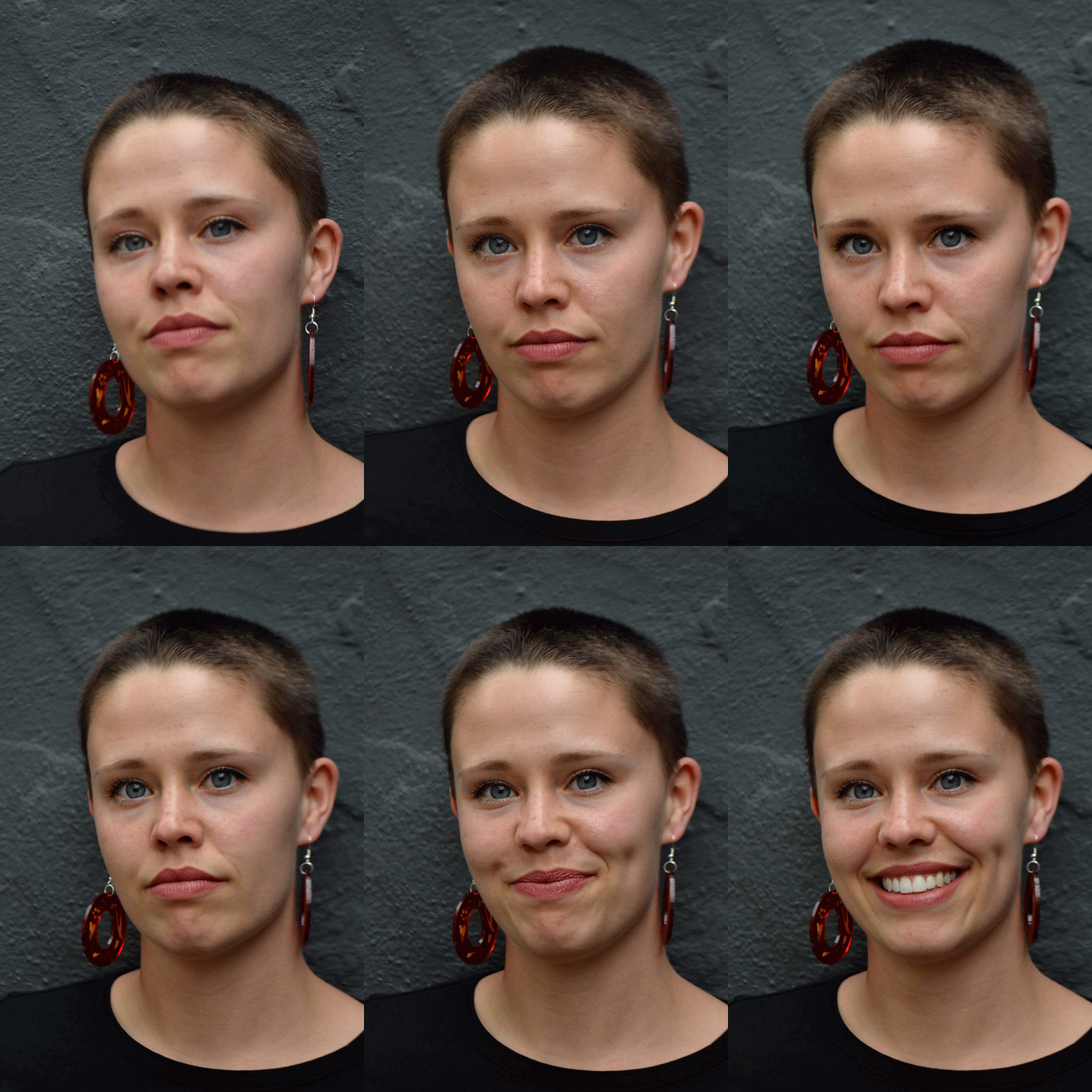
Another question arises. When does a daughter stop becoming like her dead mother? There are signs of it everywhere, that I am already different. There are pieces of me that are not from her. My acquired taste for spicy shit. Evasion of motherhood. That I’m a trilingual democrat with a shaved head. These things are integral to who I am, but she doesn’t know them. Never will.
How do I celebrate who I have become when it represents the distance between her and I? Nine years of growing into someone she never could have imagined. The passage of time makes me wary. Do I lose more of Mom with each year lived? What would she say to her future dentist, who instead got a degree in Sociology and moved to Mexico? If she met me today, would she even recognize me? At what age do my experiences without her chip her away completely?
I look around my kitchen. My countertops glisten. My glass canisters descend by height, tall to small. I stack my dishes on the rack with impossible precision. I am the Tasmanian devil in reverse, leaving nothing but order in my wake. Mexican influences aside, here is the proof: I am my mother’s daughter. This evidence assuages the aged grief, that twinge that hits me randomly, on my ninth motherless year, while I make salsa roja with a blender in the countryside of Oaxaca. It converges the past and the present with her divine presence. There are some things that survive the test of time, I think, and suddenly that kitchen with her in it doesn’t seem so far away.