
My Future TED Talk: Rainbows-N-Out

Could it be that Gen Y, as a generation, is the product of all the battles that our ancestors have fought? Could it be that they are the next stage of human evolution? Their only difference from prior generations is that they are the first generation to have the guts to proclaim to the world, “We are creatures of unlimited human potential, and we expect to be treated like humans.”
I was always an odd kid — a slightly unsocial and reserved kind of odd. While I was quite lovable and had a polite, easygoing attitude, I was also willful and rebellious; I always took the side of the underdog, seeking truth and justice in every situation. As a great student in school, I was often so bored with the standard program requirements that not only did I struggle to master the concentration and dedication, but I would choose the adventure of getting in trouble over the boredom of the classroom. As I moved into adulthood, I swiftly transitioned from odd to misfit. Born a fast decision-maker, my thinking process was similar to Brownian motion. I found both peace and stimulation in the perfect order of chaos and the realm of the unknown, but my friends complained about the lack of structure or evident logic in my actions. The amplitude of my emotions was much larger than that of my acquaintances, often leading me to deeper-than-average pain but also allowing me to experience greater-than-average joy. Nothing was obviously wrong with me. Yet deep inside, I felt slightly off. It was as if a few notes within me were off-pitch, screwing up the ultimate perfection of the song, the Song of Me.
Being an observer and an experimenter by nature, I decided to take a scientific approach to my personal challenges. I began to scrutinize my traits and values in comparison to those in my close circle as well as to historical figures. It wasn’t a planned, coherent decision. On the one hand, this process fed my mind’s ever-growing need to be entertained and occupied. On the other hand, I instinctively continued my search for my “tribe,” people I could communicate with on the same level of comprehension. I refused to believe I was alone in the world.
It wasn’t until a few years later that I stumbled upon a group of people with whom I could identify through our common characteristics. These people have existed throughout the centuries as social solitaries. Geographically, they have always been clustered mostly in Europe or in neighboring areas of the Middle East and Russia and, later on, in the United States. Some distinct commonalities in their characters include:
· polar interpersonal traits (e.g. wisdom and childishness, single-pointed focus and multitasking),
· inconsistency in academic performance,
· the ability to “transcend time” by altering the proportion of sleep/work hours when keenly interested in a project,
· heightened spiritual connectedness,
· the mind’s uncontrollable ability to “drift off” for long periods, leading to occasional short-term loss of a sense of reality,
· various social challenges, frequently resulting in a feeling of being unaccepted or misunderstood and often expressed in insubordinate behavior,
· exceptionally fast or slow speech patterns (when one hears these individuals talking among themselves, one may perceive that they vibrate on a different frequency),
· an acute awareness of unlimited capabilities and a sharp urge to investigate, propelled by a baffling emptiness at the bottom of their hearts.
These people came to be known by trade as scientists, artists, writers, visionaries, or unconventional leaders. In other words, they are creators, who have historically brought enlightenment and progress to the world. King David, Leonardo de Vinci, Albert Einstein, and Steve Jobs, to name a few, are among these people. They had a reason to be born. They carried a message for the world.
In the course of my research, I have termed this group of creators Rainbow. Scientifically, a rainbow is a diffusion of light that starts out as a single monochromatic ray. When exposed to water at a certain angle of deviation, its single color diffuses and diversifies into a number of colors. In the varying forms of theology, light has been repeatedly associated with a deity. So allegorically, a rainbow is the presence of deity within a human that brings about an unlimited variety of human abilities by touching the water in human bodies. According to the Book of Genesis (Chapter 9, Verse 13), the rainbow is a symbol of the covenant between God and Noah when God guarantees that he will not annihilate humanity with another flood. Therefore, it can be suggested that, in order to help humanity and to keep His promise to Noah, God (often called the Creator in scriptures) formed these creators to advance the evolution of human beings.
Another commonality among the creators, the Rainbows, is the depth of trial and tribulation within their life paths, which significantly supersedes that of the average citizen. In other words, the price they pay for their mental gifts is much higher, and the responsibility they carry before society is much greater than that which is typical. Due to a power struggle between himself and others within Apple, Steve Jobs was forced out of his own company for many years and was unable to participate in the development of his own creation. Albert Einstein couldn’t marry the woman he loved for some time due to a difference in faith. He later had to flee his country to avoid the Nazi regime. Leonardo Da Vinci dealt with deep loneliness in his late years. And King David was on the run from a man he regarded in high esteem, was condemned to witness the rape of his daughter Tamar by his son Amnon, and mourned the loss of his son Absalom who rebelled against him. Each one of them experienced their own share of darkness, their mess.
Authentic Rainbows are still exceptions in modern society, but certain recent observations have struck me with peculiarity. Acting as a consulting executive on several projects, I have been involved in hiring, training, and closely managing employees. The majority of the workforce in these companies is in their twenties and early thirties, and these workers have been labeled as unmanageable, unreasonable, and ambitionless Generation Y. Gen Y is the hottest subject of countless discussions, frustrations, and theories among organizational leaders, teachers, and parents. Being part of this social group not only by age but also through my professional pursuits, I noticed that a more detailed trait and behavior analysis of these young people coincidentally resembled the Rainbow characteristics described above, though with subdued intensity.
Let’s take Jane, for example.
Jane is a 26-year-old California girl, who spent most of her young years hopping between the two households of her middle-class, loving, divorced parents, surfing, working, chilling with her friends, and occasionally smoking pot. She has recently married and moved to Canada. On a lovely October afternoon, I was working from the remote office of my generation (most of you know it as Starbucks), sending emails, getting ready for an important presentation, scanning Facebook newsfeed, and sipping on my pumpkin spice latte. Jane, who was three months pregnant with her first child at the time, texted me: “Do you want to have a good laugh?” “Of course,” I replied to her, feeling relieved at the opportunity to sidetrack from my stressful multitasking. In response, she sent me a few screenshots. I stared at the phone for few seconds before bursting out in hysterical laughter, attracting the attention of half a dozen other curious multitaskers like myself.
The screenshots represented a carefully crafted letter — the letter that she had written to In-N-Out Burger.
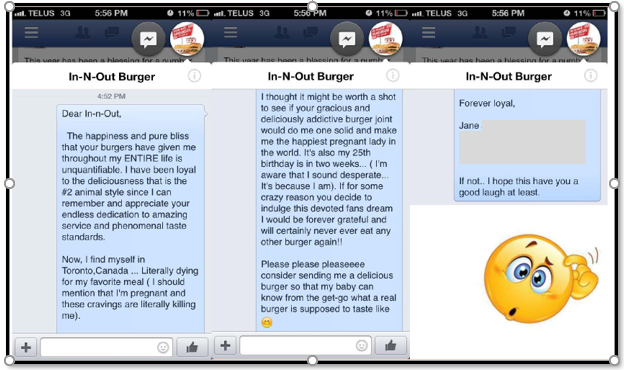
“Dear In-n-Out,
The happiness and pure bliss that your burgers have given me throughout my ENTIRE life is unquantifiable. I have been loyal to the deliciousness that is the #2 animal style since I can remember and appreciate your endless dedication to amazing service and phenomenal taste standards.
Now, I find myself in Toronto, Canada. Literally dying for my favorite meal (I should mention that I’m pregnant and these cravings are literally killing me). I thought it might be worth a shot to see if your gracious and deliciously addictive burger joint would do me one solid and make me the happiest pregnant lady in the world. It’s also my 25th birthday is in two weeks… (I’m aware that I sound desperate… It’s because I am). If for some crazy reason you decide to indulge this devoted fans dream I would be forever grateful and will certainly never ever eat any other burger again!!
Please please pleaseeee consider sending me a delicious burger so that my baby can know from the get-go what a real burger is supposed to taste like 😊
Forever loyal,
Jane
P.S. If not. I hope this have you a good laugh at least.”
What is your first reaction to this letter? What is your first impression of Jane?
OK, let’s start with obvious. She is witty and creative. You may like or hate the concept of the letter asking for a free burger, but the letter is hilarious, and it’s authentic. Moreover, Jane knows how to express herself and is not shy in doing so. Have you noticed that the language of the letter is eloquent, structured, well thought through? Despite the common misconception that Generation Y doesn’t even open books anymore, this girl had to be acquainted with literature to put together a letter with such an easy flow.
Some of you may say that she is delusional. Doesn’t she realize that they can’t send her food? But is she delusional, or is she a dreamer? Or a believer? According to the Merriam-Webster Dictionary, a believer is a person who professes absolute belief in something. As a believer, Jane believes that the world has no limits. Jane has faith. Is faith a bad quality or a good one? Or is it not a quality at all but a natural part of being human?
Not only is Jane a believer, but she is also gutsy and fearless. She has no fear of judgment or rejection. She is not afraid to try, and she is not afraid to fail. Let’s be honest, how many of us are afraid to try because we think we will fail? I was definitely one of those people until one day I woke up and realized that if I keep passing up the opportunities, they will keep passing me by. So just like Jane, I’ve learned to trust my instincts, go with the flow, and just grab at the chances. In this example, she grabs her chance by doing something as extremely simple as hitting the SEND button on the computer to move this letter forward. And by the way, she may come across to others as a believer or a dreamer, but she is in fact very realistic. Look at her last sentence: “If not. I hope this have you a good laugh at least”. She totally understands the unreasonableness of her request, but nevertheless, she decides to move forward.
How else can Jane be described? You can assume she is pretty desperate. And as you realize this, you may hear the scolding voices of your mothers and past teachers rise up. “Doesn’t she realize she’s making a fool out of herself? Where is her pride? If she’s craving a burger, she should just suck it up and go out and eat a burger in Toronto. Why is she asking for a freebie like a common beggar?” Yes, Jane is desperate, and by all societal norms of the past, she should not be vocalizing it. But what is great about her is that she openly acknowledges her desperation in one of the paragraphs. And this is a signature trait of Generation Y. They are transparent. They have no problem with either accepting their weaknesses or acknowledging it aloud to others as long as the communication in their relationships stays open. This generation is a generation of truth seekers. Many of you may mumble, “Great, a truth-seeker, but are you ready to face the truth yourself? What about when you come to the job thinking you’re a rock star, but you have zero practical knowledge or valid accomplishments in the field? Can you handle that truth?” The answer is yes…if the truth is “marketed” right. Cynically speaking, everything in life, just like in business, is about marketing.
What else is Jane? She’s childish. You may be thinking, Woman, you are going to have a baby soon. Isn’t it time for you to become serious and grow up? A letter to In-N-Out? Seriously? But what is childish, really? What do children add to our world? I have two young hyperactive children, so I know that my kids bring in energy. They are running and jumping nonstop to the point where they make my head spin. But their lively energy is very contagious. Children also have curiosity. They ask questions, and a lot of them, including the never-ending “Why?” They aren’t afraid to question, and they have no problem challenging me. It gets especially entertaining when I don’t know the answer to what they ask and have to research it. But think about what curiosity does to our minds. It makes us grow. And is growth a bad quality or a good one? Or is it not a quality at all but a natural human process that we often forget about or are oblivious to? Another quality that children bring to the world is exciting. Couldn’t we all use some of that in our dull office environments or in our even duller everyday lives? What do children want? They want to feel loved and protected. They are looking for security and stability in a stimulating environment. Yes, it sounds demanding, but as soon as you provide it to them, the kids will pay you back with an unconditional love you never imagined possible. Lastly, what do children search for (even if they never admit to it)? They search for guidance. They accept that you are older and more experienced, and as long as you guide them in a non-authoritarian way, like an older and wiser friend, they are willing to listen and learn.
There is one more quality Jane has which is invaluable in the work environment and social commitments. Jane is loyal. Let’s be frank here, is In-N-Out Burger the best burger out there? No, of course not. Go to a fancy restaurant and order a medium-rare beef burger on a Kaiser bun with a goat cheese crust and onion jam. It will be delectable and will absolutely melt in your mouth, and then In-N-Out will seem like a distant bad dream. But Jane craves In-N-Out. Are there other burger joints in Toronto? Of course, there are, and they may be of better quality. But Jane’s roots are in California. She has good memories associated with In-N-Out. So she will think twice (or maybe more than that) before she consumes any other kind of burger. You see, Generation Y is not driven by money or price tags. Money is a tool, but it’s not a goal for us. It doesn’t mean we will slave away for free, but money and career are not a deal-breaker. We are looking for a place where we can grow, make memories, feel a sense of belonging, and make a difference.
How did Jane send the message? She sent it through her Facebook page. And while on the topic of social media, let’s debunk the myth of why we are so addicted to it. Do you think we don’t realize how ridiculous it seems (and I’m guilty of this as much as everyone else) when someone first posts pictures of a six-course meal, then checks into the gym for a boot camp workout, and then three hours later posts an update that he or she can’t sleep because of overeating and over-exercising? Of course, we realize the obscurity of this! But this isn’t the point, it’s only a side effect. The main point is that we want to feel connected, and social media helps us to feel instantly connected with each other as well as to something bigger than ourselves. We also want to feel that we are being heard and that what we do is appreciated by somebody, by anybody. Social media with all of its instantaneous comments and likes does a brilliant job of that.
So if we were to summarize what we have just discussed about Jane:
What does Generation Y have to offer?
Loyalty, creativity, expressiveness, energy, excitement, transparency, curiosity, and fearlessness.
What does Generation Y really want in return?
To feel loved, protected, guided, connected, heard, and appreciated in a secure and stimulating environment.
Let’s be honest here. How many of you would like to feel the same exact way in your personal and professional life? How many of you want to feel loved, protected, guided, connected, heard, and appreciated in a secure and stimulating environment? Isn’t this the ultimate human desire? Isn’t it something we all seek deep inside our hearts? And look at what is offered in return: loyalty, creativity, expressiveness, energy, excitement, transparency, curiosity, and fearlessness. Aren’t these the main ingredients in the emergent human potential that has been written about in books and depicted in movies over the centuries? So if we look at it from this perspective, could it be that Gen Y is not, after all, so different from prior generations? The only difference is that they are the first generation to have the guts to proclaim to the world, “We are creatures of unlimited human potential, and we expect to be treated like humans.” Could it be that Gen Y, as a generation, is the product of all the battles that our ancestors have fought? Could it be that they are the next stage of human evolution? It’s definitely something to think about, isn’t it? What it also means is that Generation Y may be the first that can potentially develop into a full-fledged generation of creators, Generation Rainbow. However, since Rainbows, as one-offs, have been rejected by the public for centuries, assimilation of a full generation of creators will be a true sociological challenge.
The one who has no hope is already dead, but the one who hopes still has a chance in living. At this point in my life, I don’t care about world peace or hungry kids in Africa. You can call me ignorant or cold-hearted, but my soul doesn’t cry for these concepts. My soul cries for young men and women of contemporary civilized society who, in majority, don’t know the physical hardships of the past, see no future in the old order of the world and choose to work low-paid jobs as overqualified and overeducated workers, hide behind computers in chats and forums, and get high on social drugs because these things give them a much-needed escape and a way to tolerate the dissonance of what they see and experience on the outside in comparison to what they feel within. Just like me at their young age, they do not appreciate the assets they possess, and they are in search of their message.
The challenges of these young people are not of a physical nature but are rather of a much higher matter. They are not busy trying to achieve external fulfillment but are stumbling in search of internal fulfillment, something for which there is no scientific guidance with proven results and no mind-soothing solution to nourish logic and common sense. These young men and women are pioneers, lost in the darkness of the unknown between the patterns of the past and the mazes of the future. My soul cries for their darkness and, indeed, for my own darkness, because this may be the most evolved generation to have ever been born on our planet thus far (just like Rainbows, in general, represent the most developed and diverse human minds in history), and I would hate to see their magical resources wasted.
_______________________________________
This article is an excerpt from the essay “Why Message Starts With Mess. Why Assets Start With Ass: Young Woman’s Look At Old Boys’ Dogmas” by Elena Emma. Available on Kindle and Academia.edu.


