
My Friend’s Gay Bashing Highlights Trans and Gay Common Cause
Transphobia is directly relevant to gay people
Warning: explicit discussion of slurs and violence against queer people.
My gay friend went to a popular club last week for a birthday party with his partner’s family. They soon fled, fearing for their safety after being gay bashed. My friend later joked that at least he finally bonded with his mother-in-law, but his worldview got shaken hard.
We need to talk about what’s behind increasing rates of violence against LGBTQ people, and how steady rates of gay bashing show you can’t separate the T from LGBT.
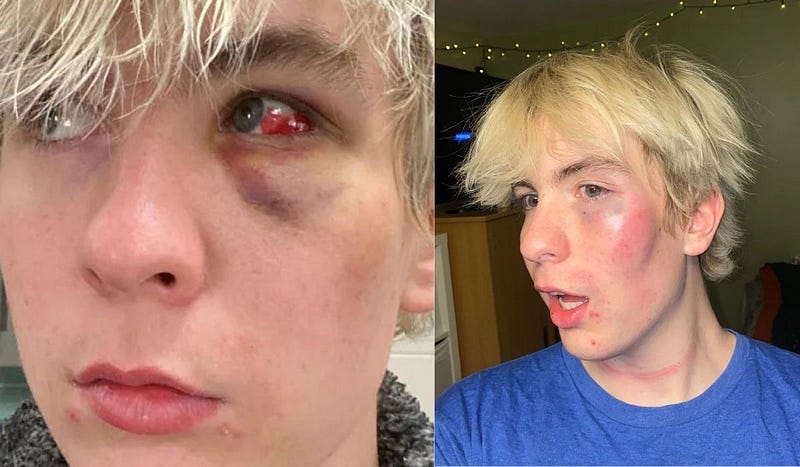
My friend is not the Canadian student Spencer Frey pictured above, who was gay bashed so badly on his liberal Vancouver Island campus that he’s withdrawing from in-person learning. I’m going to write about Spencer in a minute, but when I saw his photo yesterday, my thoughts flew to my friend’s assault and to a column Owen Jones wrote this month on, Why you can’t separate the T from LGB. If you haven’t read it, please take the time, even if that means not reading my story.
* It’s no coincidence that rates of physical attacks against young gay men in the U.K., North America, and Europe have climbed steeply in recent years. *
Like Jones, my friend is a young British professional. Like Jones, he grew up in a world where civil rights for LGB people were beginning to be taken for granted, where acceptance seemed to be growing, like in the U.S., in ways that felt unstoppable.
My partner and I were gay-based in Greenwich Village in 1991 …
… but I never would have dreamed my friend, whose father is my age, would be attacked because he’s gay. I never would have dreamed he and his partner would be shoved around, called faggots, threatened with worse, and run out of a “respectable” bar because they didn’t look or act masculine enough.
One reason I wouldn’t have suspected is that my friend had been sharing snatches of his evening with me. Shortly before he was assaulted, he sent me a brief video of the club’s stage show, which, wait for it … was a drag act. Some patrons looked uncomfortable, but the crowd mostly cheered and laughed.
My friend felt safe, like he and his partner could be themselves, a tad flamboyant like when they’re home in the queer enclave of Brighton. They aren’t activist types, except maybe in the sense of Queer Eye’s Fab Five. They’re just openly, cheerfully themselves. Their mistake was believing a little “fruit in the boot” is OK outside the gayborhood.
After the drag act, they pushed up to the crowded bar to order a round of drinks. Somebody accused them of cutting the line, called them faggots, and started pushing them. They were scared and confused but figured the bartender would sort it out. Her only comment after several rounds of gay slurs and escalating violence was, “If you get beat up, it’s your own fault.”
She didn’t call the police or summon a bouncer, she didn’t tell the bashers they were cut off, she just sneered, unimpressed by a pair of obvious kweens invading middle-class English suburbia.
This is where the story gets interesting.
A drag queen with a funny act was fine in that club, as entertainment. But a pair of young professionals slightly violating gender norms for real became targets of violence. (Anyone thinking about Josephine Baker being welcome to perform at the Stork Club but not have dinner there?) My friends didn’t end up hospitalized like Spencer Frey, but they might have if they hadn’t run out of the bar, bringing the family celebration to a premature end.
Transgender people know what this feels like, of course. My trans friends say they constantly look over their shoulders, hyper aware of their surroundings and any potential threats.
My friends weren’t careful enough, and they learned a harsh lesson that Jones spelled out in his column:
The reason above all else we are bound together is because there is a common basis for our oppression. LGBTQ+ people are persecuted because we are all deemed to be traitors to our assigned gender identity. The root of hatred against gay men, for example, is that we have made the ultimate betrayal of masculine identity, which is to be attracted to and have sex with men.
It’s no coincidence that rates of physical attacks against young gay men in the U.K., North America, and Europe have climbed steeply in recent years. Those rates track closely to rates of violence against transgender people, and it doesn’t take a degree in sociology to see the common cause.
The wave of gender-identity backlash Judith Butler analyzed last October in The Guardian is spreading globally — in Hungary, Poland, London, Manchester, Florida, Texas, and even in traditionally liberal U.S. cities. As Michael Arceneaux wrote recently in Gen, a slim majority of U.S. Democrats say they support Florida’s Don’t Say Gay law, which has been marketed with aggressively transphobic as well as homophobic language. Supporters don’t seem to care about the difference.
My British friend gets it. The universe slapped him silly last week not because he has a boyfriend, but because he’s obvious about it. Because he’s slightly too glittery. A little too feminine. A lot too traitorous to traditional ideas about gender.
That’s the same lesson 19-year-old Spencer Frey learned when he was attacked out of the blue, called a string of highly offensive gay slurs, and sent to the hospital. The photo of his bruised face joins a parade of such images that shuffle daily in the specialized queer press but rarely get attention in mainstream media.
You practically need a trigger warning to open Pink News, which often features photos of bruised and bloodied transgender and gay people. The Pink in their name is not a coincidence. It’s a reclamation of a slur rooted in gender rebellion, from back in the days when I got gay bashed, when “commie pinko faggot” was an everyday insult slung at trans and gay people alike.
The Pink in their name highlights the incoherence of groups like LGB Alliance that pretend the interests of lesbian, gay, and bisexual people are not inextricably intertwined with the interests of transgender people, who have always been central to the queer liberation movement, from the early days of the Uranians in Victorian England, through the roaring twenties of Cabaret fame in Berlin and New York City, right up through 1969’s Stonewall Riots, and into the present.
Trans people face a lot more daily physical danger than my friend in England, than young Spencer in Canada, than a parade of young gay men violently assaulted around the world every day. But something we all need to understand is that the REASONS for the assaults are much the same.
We should all ponder the effectiveness of divide and conquer, a message Judith Butler speaks to often. We really are all in this together. Just ask my gay-bashed young friend.
Breaking: as I published this, I learned the U.K. government just ditched its long-term promise to ban conversion therapy, on transphobic grounds. Divide and conquer wins another battle.
James Finn is a columnist for the LA Blade, a former Air Force intelligence analyst, an alumnus of Queer Nation and Act Up NY, and an “agented” but unpublished novelist. Send questions, comments, and story ideas to [email protected].
My writing is always free to readers who click my social media links, but if you’d like to browse more, click here to join Medium. Your nominal membership fee will help support my work. To get an email whenever I publish a new story, Click Here.