My Friend Won the US$100,000 Debate on the Origin of COVID-19
An achievement that we hope will make a greater impact.
Back in July 2023, Peter Miller asked if I wanted to help him win a $100,000 debate against Rootclaim’s stance that the source of Covid-19 is a lab leak. He offered to compensate me for my research help, so I became his research assistant for the latter half of the year.
I was hesitant to help Miller at first, as I was unsure how much time and energy this would take. But I admired his courage and wanted to help him win. Although Miller offered to pay me regardless of the debate outcome, I wanted to take the risk together and insisted on payment only if he won.
And he won by a huge margin that it wasn’t even close.
In this article, I’ll describe Miller’s victory from my perspective after exchanging hundreds of emails with him for nearly six months.
Author’s note: Here’s a friend link for non-members to read for free.
The Rootclaim Debate
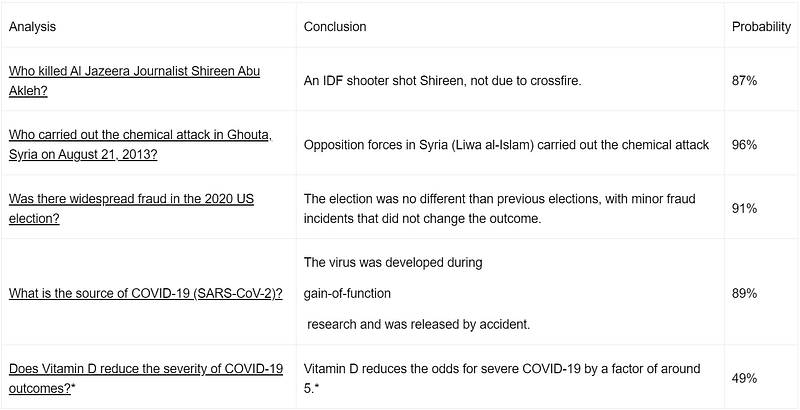
Founded by Saar Wilf, an Israeli businessman, Rootclaim is an organization that uses probability to determine the most likely answer to controversial issues. The “Rootclaim Challenge” invites anyone who wants to contest their stances (Figure 1), but they must place a $100,000 wager and participate in a debate before two neutral judges. Both parties must escrow the money to a third party before the debate. If the judges unanimously agree on the outcome, the victorious party wins $100,000.
The judges were Will Van Treuren, PhD, a gut microbiome scientist and co-founder of Interface Bio, and Eric Stansifer, PhD, a mathematician from MIT. Van Treuren has also coached and judged hundreds of debates. Both judges are not virology experts and have no financial or social conflict of interest that could be affected by the debate results.
Miller’s team mainly consists of me and an anonymous X/Tweeter user (@_everythingism), while Wilf’s team has Yuri Deigin, a biotech entrepreneur, and several Rootclaim researchers. Deigin, in particular, is an early pioneer of the Covid-19 lab leak hypothesis and co-founder of DRASTIC (Decentralized Radical Autonomous Search Team Investigating COVID-19), the leading lab leak theorist group.
So, Miller debated those who are very well-versed in the lab leak narrative and won at their own game by a large margin.
The debate occurred from October to November 2023. After ~18 hours of debate footage and >750 slides presented by both sides, both judges unanimously voted for natural origin as the most likely source of Covid-19.
The judges’ written reports (here, here, and here) and video evidence (here and here) can be found on Miller’s YouTube channel. Links to the slides of both parties can be found on Judge Stansifer’s blog.
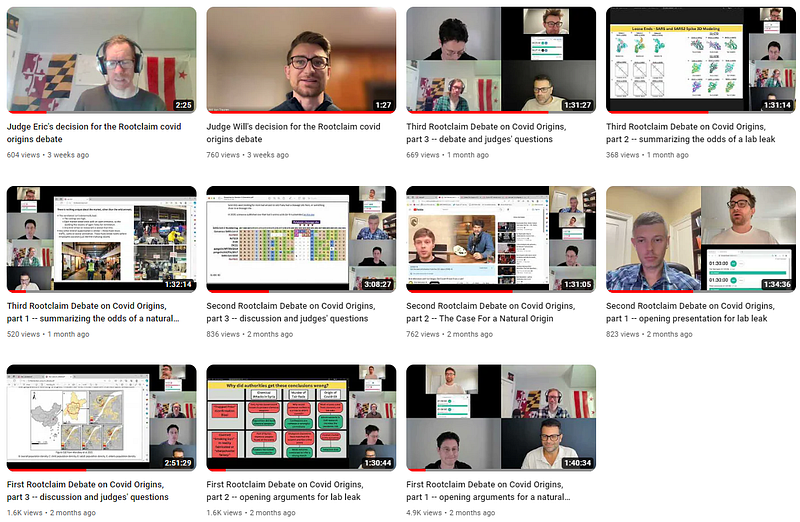
On his YouTube channel, you’ll find the debate is split into 3 sessions, with each session further split into 3 parts (opening presentation of natural origin, opening presentation of lab leak, and discussion with judges):
- Session I: A debate between Miller and Wilf on the epidemiology of SARS-CoV-2, split into 3 parts (here, here, and here).
- Session II: A debate between Miller and Deigin on the genetics of SARS-CoV-2, split into 3 parts (here, here, and here).
- Session III: A debate between Miller and Wilf on summarizing the odds of natural origin vs. lab leak, split into 3 parts (here, here, and here).
Before the debate, Rootclaim deemed Covid-19 was a product of gain-of-function research that leaked from the lab with an 89% probability. After losing the debate to Miller, however, Rootclaim remained unconvinced and delayed the announcement of the debate results for weeks. During that delay, Rootclaim tried to overturn the judges’ decisions but to no avail.
Rootclaim ultimately admitted their loss in their blog but emphasized they think the judges made several mistakes and still open their lab leak Rootclaim Challenge to anyone who’s willing to wager $100,000. Notably, one of the judges, Stansifer, wrote another report defending his reasoning and analyses against the criticisms made against them.
Philip Markolin, PhD, a former data analyst at ETH Zurich in Switzerland and now a science blogger, described the debate outcome in detail in his Substact and Medium articles— explaining possible reasons why Rootclaim’s founder doesn’t want to admit defeat. I highly recommend reading Markolin’s article — it’s very engaging yet illuminating.
The Preparation
During my early interactions with Miller, it was clear that he wasn’t financially motivated. Although Miller could win $100,000, he could also lose that amount. The process would take many months, and Miller, a former software engineer at Google, could’ve earned more during that time with practically no risks. If anything, the debate would be highly stressful for Miller, who was also suffering from certain medical issues.
My biggest fears are in this order: [1] I'll lose and scientists will be angry, because that will perpetuate the lab leak theory. [2] It will be scary and stressful. [3] I will lose money. But, stress won't kill me, I can always make more money. — Peter Miller
I then responded that perhaps he doesn’t need to be worried about point #1. As he’s not a professional scientist, the lab leak camp won’t have much to gain from winning a debate against him.
If anything, the lab leak camp has everything to lose if they actually lose against a science blogger, albeit a very knowledgeable one. In fact, I was amazed at Miller’s scientific literacy, which far surpassed mine and perhaps many other scientists as well.
To start off, I helped Miller research the genetic sequence of the infamous furin cleavage site (FCS) of SARS-CoV-2 — whether scientists have previously inserted the same or similar FCS in previous coronaviruses.
SARS-CoV-2 has a peculiar FCS with the amino acid and nucleotide sequence of PRRAR and CCT’CGG’CGG’GCA’CGT. This FCS appears inserted out of nowhere because it’s absent in other closely related coronaviruses. The CGG’CGG codons coding for RR in PRRAR seem particularly suspicious because CGG is not a commonly used codon in bats. As a result, some lab leak theorists believe that the double CGG codons are a smoking gun for lab manipulation. Some even claimed that labs used CGG codons to insert FCS all the time.
But after going through hundreds of studies, there’re only a handful of studies that introduced an artificial FCS into coronaviruses. But none have used exactly PRRAR, and none have reported using CGG codons.
For instance, one Dutch 2014 study introduced FCS (amino acid sequence, RRRRR; nucleotide sequence, AGA′CGC′CGA′AGG′CGT) into mouse hepatitis coronavirus (MHV). “That’s hilarious,” Miller said. “The Dutch study used all 5 spellings of arginine except for CGG.”
For proper context, R refers to the amino acid arginine, and R can be coded by 6 different nucleotide codons: CGU, CGC, CGA, CGG, AGA, and AGG. So the Dutch study used all codons but CGG to code for R in the FCS of a mouse coronavirus — contrary to the claims that labs will use CGG, let alone double CGG codons to code for the FCS of SARS-CoV-2.
Ironically, it was only after the debate that Miller realized we missed something vital. Apparently, none of the studies we identified inserted a full FCS into coronaviruses; they only introduced an FCS by mutating existing amino acids. This strongly counters the lab leak argument that scientists are familiar with inserting a full FCS into coronaviruses.
And of course, the scientific discourse on the FCS and double CGG codons of SARS-CoV-2 runs much deeper than that, which Miller covered in session 2 of the debate (video here and slides here).
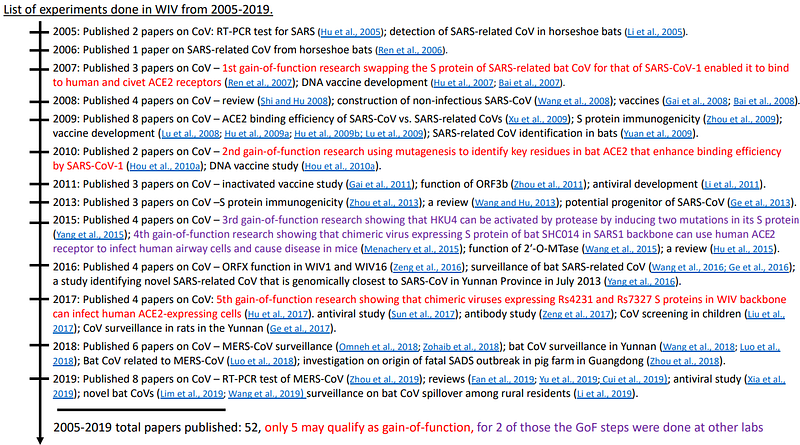
Besides that, I also helped with research in other areas, such as SARS-CoV-2 adaption pattern in cell culture and other animals, susceptibility of the animals sold in the market to SARS-CoV-2, patterns of the early spread of SARS-CoV-2, details of the DEFUSE grant, prior lab activities at the Wuhan Institute of Virology (WIV) (see Appendix), and others.
But to be honest, I doubt I helped Miller a lot. He did most of the research and nearly all his slides. He debated Saar Wilf and Yuri Deigin on his own. He handled all the logistics, communication, and legal issues.
Without my help, I’m sure Miller would’ve won.
The Outcome
And so Miller won — by a huge margin that it wasn’t even close.
Judge Van Treuren “concluded that there is approximately a 1 in 300 chance that SARS-CoV-2 was the result of a lab leak.” That’s a 0.3% chance of a lab leak—not even close to the over 50% chance of winning.
Judge Stansifer concluded that there’s a 0.075% chance of a lab leak—that’s a 1 in 1,300 chance. Again, it's not even close to 50%.
How did the judges arrive at their conclusions then?
It’s a very lengthy but understandable process, so I’ll try to explain it as simply as possible without compromising accuracy.
Both judges used Bayesian analyses preferred by Rootclaim to estimate the probability of lab leak vs. natural origin of Covid-19. In brief, Bayesian analyses use probability to address statistical problems, incorporating prior knowledge alongside new evidence to update beliefs.
But Stansifer, a mathematician, was not so keen on this method because it’s prone to human bias and may introduce error the more factors we consider, especially uncertain factors. Nevertheless, both judges agreed to use this method to determine the winner of the debate.
***
First, Judge Van Treuren calculated the answer to this equation:
[P0(lab leak) / P0(zoonosis)] * [P(lab leak) / P(zoonosis)],
where P0 refers to prior probability and P refers to updated probability.
The prior probability, P0, is further calculated by estimating the probability of labs creating SARS-CoV-2 and then leaking it vs. the probability of nature creating SARS-CoV-2 and then leaking it via animal spillover:
In [P0(lab leak) / P0(zoonosis)] * [P(lab leak) / P(zoonosis)],
P0(lab leak) / P0(zoonosis) = [P(lab made by 2019) * P(lab leak in 2019)] / [P(nature made by 2019) * P(natural leak 2019)]
Specifically, P(lab made by 2019) is calculated by estimating the P(WIV was carrying out some DEFUSE-style research) * P(WIV researcher would have made SARS-CoV-2 if they could) * P(WIV had undisclosed and sequenced backbones) * P(WIV had an undisclosed backbone with genetic similarity of >98% to SARS-CoV-2) * P(WIV made >10 fully functional gain-of-function mutants), which equals to 1 * 0.5 * 1 * 0.01 * 0.1 = 0.0005 (or 0.05%).
For a brief context, Van Treuren gave:
- A 100% probability that the WIV carried out some experiments in the DEFUSE grant, as scientists often did some preliminary experiments before applying for grants. The DEFUSE grant, despite being rejected, involves genetically engineering new coronaviruses.
- A 50% probability that the WIV would have made SARS-CoV-2 if they could; after all, being able to do something doesn’t mean it’ll be done.
- A 100% probability that the WIV had some undisclosed coronavirus sequences, which is expected as not every raw data gets published.
- A 1% probability that the WIV has an undisclosed coronavirus sequence with >98% genetic similarity to SARS-CoV-2 because no evidence of a ‘secret’ virus from the WIV has surfaced to date.
- A 10% probability that the WIV has made over 10 functional novel coronaviruses as this is an arduous experiment and the WIV is not a huge research institution.
Of course, these details have been simplified by me. You can find more in-depth explanations in Van Treuren’s Excel sheet here. Note that I am simplifying the remaining calculations below as well.
Next, P(lab leak in 2019) is estimated to be 0.05 or 5% based on past incidences of lab leaks. Van Treuren noted this is a conservative estimate, as he feels 1–2% would be the more likely probability.
Thus, combining P(lab made in 2019) and P(lab leak in 2019) gives a prior probability, P0(lab leak) of: 0.0005 * 0.05 = 0.000025 (or 0.0025%).
Next, the prior probability P0(zoonosis) is estimated at 0.015 (or 1.5%) by calculating P(nature made in 2019) and then P(nature leak in 2019). Van Treuren estimated this based on past spillover incidents, the diversity of coronaviruses, and how often a major pandemic emerges.
Altogether, the following prior probability can now be calculated:
In [P0(lab leak) / P0(zoonosis)] * [P(lab leak) / P(zoonosis)],
P0(lab leak) / P0(zoonosis) = [P(lab made by 2019) * P(lab leak in 2019)] / [P(nature made by 2019) * P(natural leak 2019)]
= 0.000025 / 0.015 = 0.0017
This means that our starting point—prior probability—of lab leak vs. zoonosis is 0.0017—a 1 in 588 chance that Covid-19 is a lab leak.
Now, Van Treuren wants to update this prior probability with more recent knowledge to complete the second half of this main equation:
In [P0(lab leak) / P0(zoonosis)] * [P(lab leak) / P(zoonosis)],
[P0(lab leak) / P0(zoonosis)] = 0.0017 and [P(lab leak) / P(zoonosis)] is to be calculated.
To calculate P(lab leak) / P(zoonosis), Van Treuren estimated the following long list of factors:
In [P0(lab leak) / P0(zoonosis)] * [P(lab leak) / P(zoonosis)],
P(lab leak) / P(zoonosis) = [P(Wuhan is epicenter | LL) / P(Wuhan is epicenter | ZO)] * [P(Only one major outbreak | LL) / P(Only one major outbreak | ZO)] * [P(market is first superspreader event | LL) / P(market is first superspreader event | ZO)] * [P(market environmental SARS-CoV-2 samples look like they do | LL) / P(market environmental SARS-CoV-2 samples from the market | ZO)] * [P(2 lineages | LL) / P(2 lineages | ZO)] * [P(viral evolution rates are as observed | LL) / (P(viral evolution rates are as observed | ZO)] * [P(FCS exists | LL) / (P(FCS exists | ZO)] * [P(FCS is initially coded as PRRAR | LL) / (P(FCS is initially coded as PRRAR | ZO)] * [P(FCS mutates away from PRRAR | LL) / P(FCS mutates away from PRRAR | ZO)] * [P(PRRAR initially coded as CGGCGG | LL) / P(PRRAR initially coded as CGGCGG | ZO)] * [P(PRRAR maintained as CGGCGG | LL) / P(PRRAR maintained as CGGCGG | ZO)] * [P(12 nt insert | LL) / P(12 nt insert | ZO)] * [P(insert out of frame | LL) / P(insert out of frame | ZO)],
where P(x | y) refers to the probability of x given y, ZO refers to zoonosis/natural origin, and LL refers to lab leak.
#I’ll not delve into the reasoning behind these estimations but basically, the numbers Van Treuren arrived at are as follows:
= 50 * 10 * 0.001 * 1 * 1 * 1 * 1 * 0.1 * 1 * 10 * 1 * 25 * 0.17 = 2.1
Finally, we can now complete the main equation with Van Trueren’s numbers:
[P0(lab leak) / P0(zoonosis)] * [P(lab leak) / P(zoonosis)]
= 0.0017 * 2.1 = 0.00357 (or 0.36%)
So, these calculations arrive at the conclusion that there’s a 0.36% chance that Covid-19 is a lab-leaked virus. Van Treuren then rounds it off to 1 in 300 chance (i.e., 1 / 0.00357 = 280) that Covid-19 is a lab leak.
Again, what I presented here is a highly simplified version of Van Treuren’s work (more details in his Excel sheet and PDF report).
***
Moving on, Judge Eric Stansifer did Bayesian analyses to calculate the same equation as Judge Van Treuren, albeit with different factors:
[P0(lab leak) / P0(zoonosis)] * [P(lab leak) / P(zoonosis)],
where P0 refers to prior probability and P refers to updated probability.
The prior probability, P0, of a lab leak vs. zoonosis is estimated as follows:
In [P0(lab leak) / P0(zoonosis)] * [P(lab leak) / P(zoonosis)],
P0(lab leak) / P0(zoonosis) = [P(WIV conducted DEFUSE research) * P(WIV used a suitable starting virus) * P(WIV research is successful) * P(lab leak occured at WIV)] / [P(outbreak occuring naturally in a given year) * P(the outbreak leading to a pandemic) * P(pandemic emerged from the market)]
= (0.02 * 0.59 * 0.5 * 0.5 * 0.02) / (0.05 * 0.25 * 0.5 * 0.005) = 0.000059 / 0.00003125 = 1.89
I won’t delve into the intricacies of how Stansifer arrived at these numbers; otherwise, I might as well have reproduced his lengthy report. For more details, you can read section 7 of his report.
Next, like Van Treuren, Stansifer has to now update his prior probabilities with more recent knowledge:
In [P0(lab leak) / P0(zoonosis)] * [P(lab leak) / P(zoonosis)],
[P0(lab leak) / P0(zoonosis)] = 1.89 and [P(lab leak) / P(zoonosis)] is to be calculated.
To calculate P(lab leak) / P(zoonosis), Stansifer estimated the following factors:
In [P0(lab leak) / P0(zoonosis)] * [P(lab leak) / P(zoonosis)],
P(lab leak) / P(zoonosis) = [P(outbreak at market | LL) / P(outbreak at market | ZO)] * [P(12 nucleotide insert at FCS | LL) / P(12 nucleotide insert at FCS | ZO)] * [P(ACE2 affinity | LL) / P(ACE2 affinity | ZO)] * [P(secret doesn't leak | LL) / P(secret doesn’t leak | ZO)],
where P(x | y) refers to the probability of x given y, ZO refers to zoonosis/natural origin, and LL refers to lab leak.
#I’ll not delve into the reasoning behind these estimations but basically, the numbers Stansifer arrived at are as follows:
= 0.00001 * 20 * 2 * 0.1 = 0.0004
Finally, we can now complete the main equation with Stansifer’s numbers:
[P0(lab leak) / P0(zoonosis)] * [P(lab leak) / P(zoonosis)]
= 1.89 * 0.0004 = 0.000756 (or 0.0756%)
So, all these calculations deduce that there’s a 0.076% chance — i.e., 1 in 1,320 chance — that Covid-19 is a lab-leaked virus, much smaller than Van Treuren’s estimated at 0.36% or 1 in 280 chance.
Again, what I presented here is a highly simplified version of Stansifer’s work (more details in his PDF document).
The Ending
So, Miller has undoubtedly won the debate at Rootclaim’s own game and earned $100,000. But after paying for the judges, legal, taxes, and research assistant (me) fees, the amount left may not be worth the time, effort, and risk he put into the debate.
While the financial reward may not be there, I hope Miller’s effort will at least be awarded via media publicity. You see, it takes just a science blogger who was formerly a software engineer to win against the leading lab leak camp— particularly Yuri Deigin who pioneered the lab leak hypothesis — in a fair debate, providing hope that science ultimately prevails. But unfortunately, not many news outlets and journalists have not covered Miller’s achievement despite that it’s a major win for science.
Remember that I told Miller the lab leak camp has nothing much to gain if they win against a mere science blogger? In hindsight, my encouragement was probably unwise.
Philip Markolin, PhD, who also covered Miller’s achievement in his articles, initially discouraged Miller from taking on this debate because if Rootclaim had won, the lab leak camp would just grow stronger.
“Having an “Israeli multi-millionaire maverick win a 100.000$ debate by defeating a zoonotic origin proponent” would deliver just enough substance and salacious headline to really cascade well to the top of the attention economy on social media,” Markolin wrote.
“The opposite is however not true. No amplifier will hail the debate outcome as proof of zoonosis … because there is no audience demand for it,” Markolin added. “We want to hear about a maverick proving the scientists wrong; to confirm our own suspicions. Nobody wants to deal with the reality that they might have been misled and the pesky experts were right all along. This just doesn’t sell in the attention economy.”
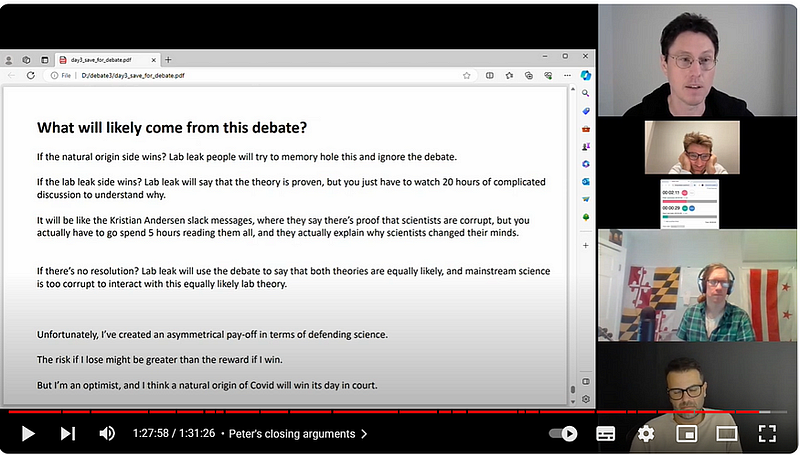
Miller was aware of this. At the end of session III of the debate, he admitted, “Unfortunately, I’ve created an asymmetrical pay-off in terms of defending science.” “But I’m an optimist, and I think a natural origin of Covid will win its day in court” (Figure 2).
In the end, Miller won the Rootclaim debate against one of the very best lab leak theorists, demonstrating that the origin of Covid-19 is more than 99% likely a product of natural spillover or zoonosis.
Please help share this significant moment in scientific progress. Hopefully, this will encourage other news outlets to do the same.
If you’re still unsure about this issue, consider watching the debate on Miller’s YouTube channel to learn more. Here’s the first video to start!
Thanks to Peter Miller for reviewing my draft and involving me in his debate journey. If you have made it this far, thank you. Subscribe to my Medium email list here, and you can also tip me here.
Corrections/edits:
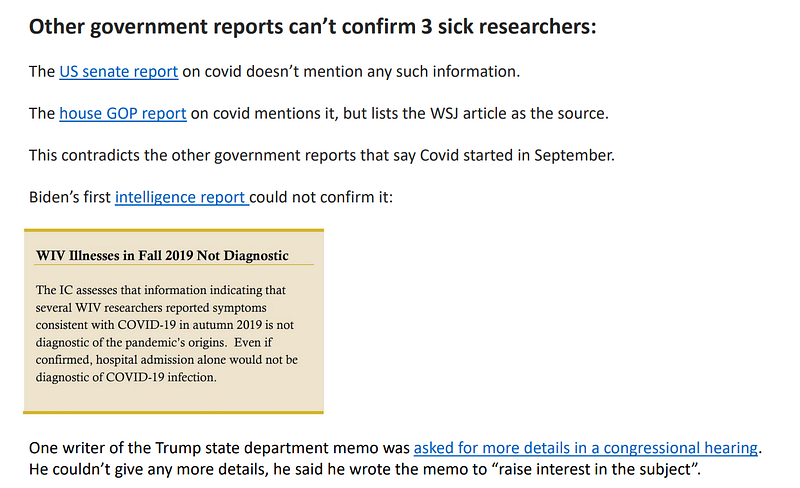
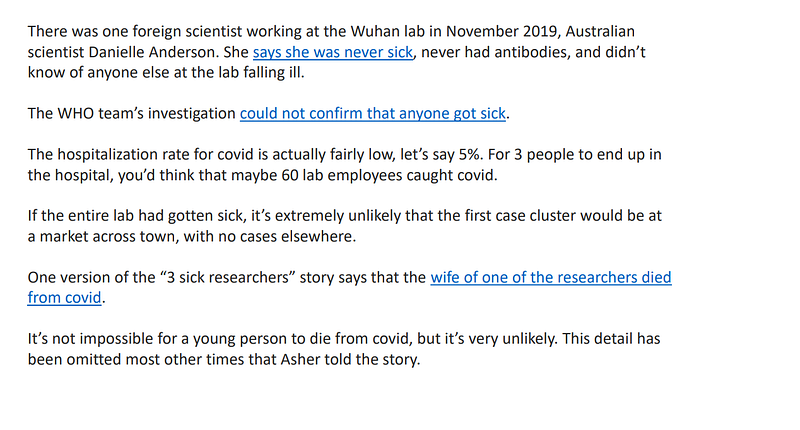
- March 18, 2024: I added two more slides in the Appendix on the three researchers at the WIV who allegedly fell ill in the fall of 2019.
Appendix
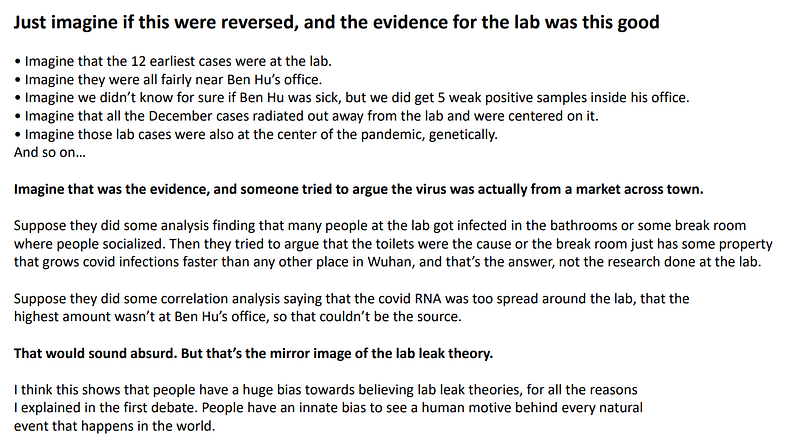
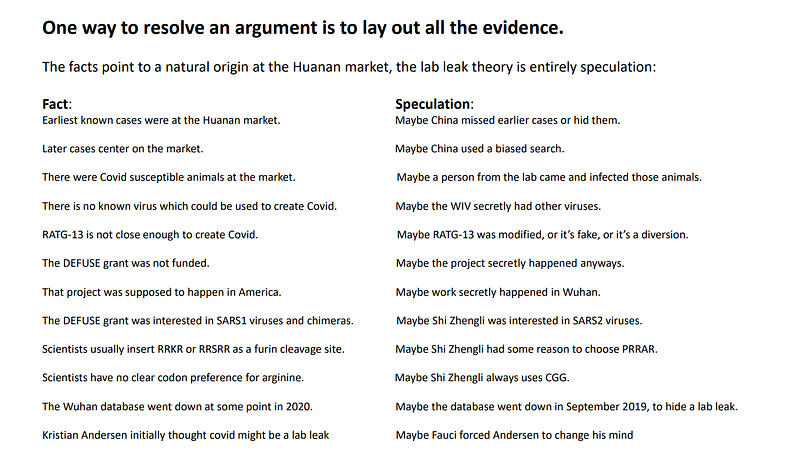
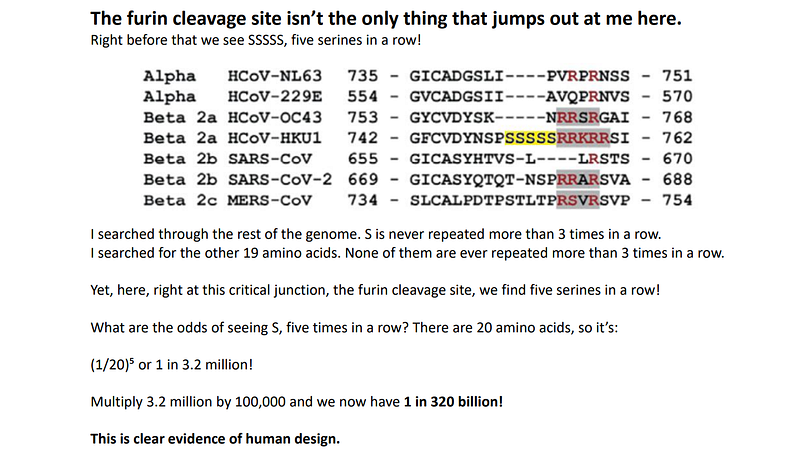
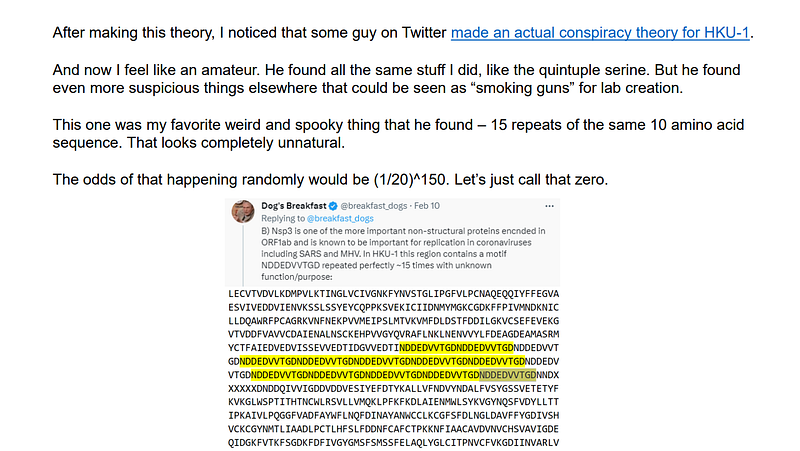
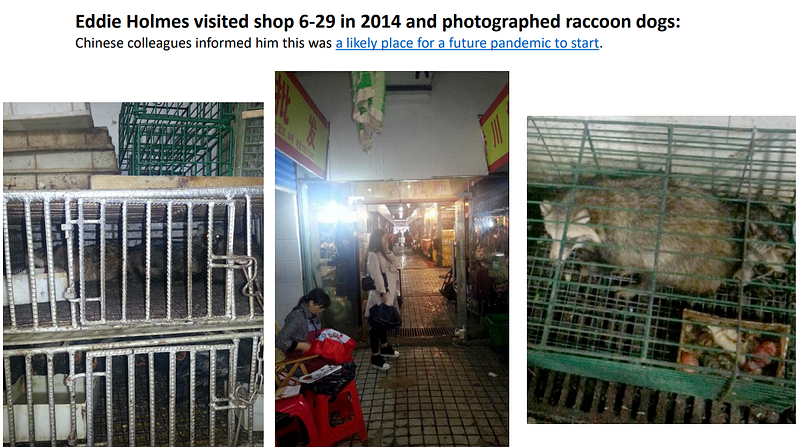
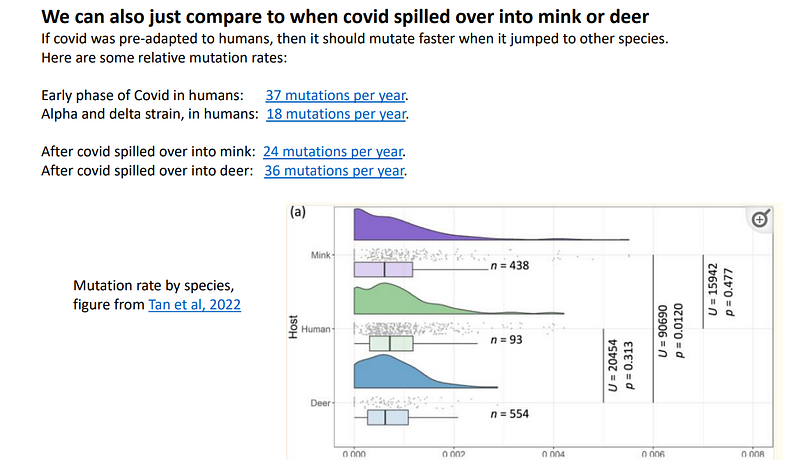
Here are some enlightening slides — which I hope can stand on their own with some description — from Miller to offer you a glimpse of his work:
- From session I:
- From session II:
- From session III: