
Cancer Screening | Genetic Condition
My Friend Recently Lost Her Life But Might Have Saved Mine
I may never have taken action if it hadn’t been for the message that came up in my Facebook feed
In January 2023, a message came up in my Facebook (FB) feed telling me that a Facebook friend had passed away. I had no idea she had even been ill, so it was a shock.
We had been working as colleagues twenty years ago. We were still FB friends. I liked her posts about her travels, her son’s marriage, the birth of her grandchild and her garden.
But like most FB friends, we never met up. We didn’t pick up the phone to speak. But we were still friends, well in the modern way.
Her family posted about their loss because they said she had ignored the symptoms until it was too late. They urged her friends to be more aware of bowel cancer.
The universe has a way of aligning because a few days later I received a screening letter from our health services asking me to take part in a national bowel cancer screening. Apparently, I was now in that age group.
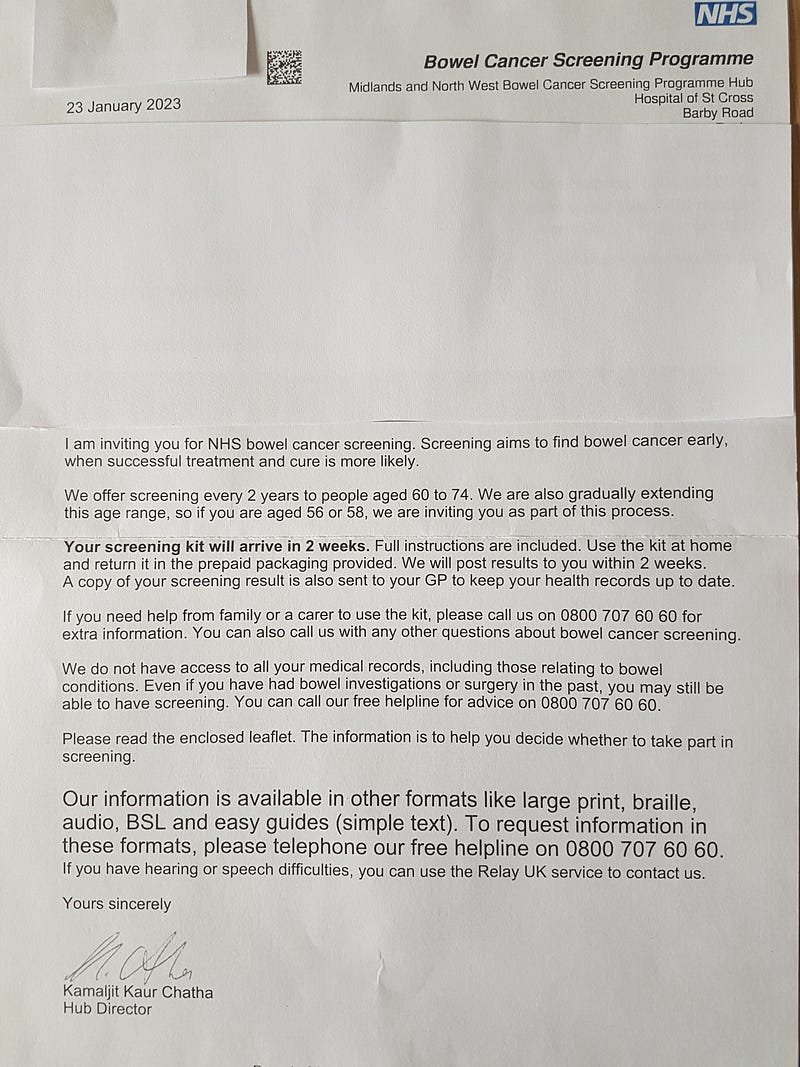
Under usual circumstances, I might have squished the screening letter up and sent it to the recycling pile.
But my FB friend’s death spoke directly to me.
She may have lost her battle but she may just have saved my life.
I don’t know why I didn’t take the letter seriously, because my first husband, Mark died of cancer, which had started in the bowel.
Mark had a faulty gene which had caused his condition, so I guess in my head, the screening and his faulty gene did not connect at first.
Mark had a condition called FAP (Familial Adenomatous Polyposis).
FAP is a rare genetic condition, and whilst it is usually passed down within the family line, Mark was found to be the start of the gene mutation in his family.
Familial adenomatous polyposis (FAP) is a rare, inherited condition caused by a defect in the adenomatous polyposis coli (APC) gene. Most people inherit the gene from a parent. But for 25 to 30 percent of people, the genetic mutation occurs spontaneously. Mayoclinic.org
If not discovered and treated in time, polyps in the bowel turn cancerous, which is what happened with Mark. His condition was only found in his mid-twenties, and it was too late by then. The polyps had turned cancerous and secondary cancer had spread to his liver and lungs.
When we discovered Mark’s condition, I was already four months pregnant. We were told that our baby had a 50 percent chance of having this faulty gene. But would not be able to find out till she was in her early teens. This was back in 1992.
Because testing was an invasive procedure to find out, it was left till much later. The testing technique had not developed as they have now.
When my daughter was 14, she had to undergo a sigmoidoscopy to check for any polyps.
I can remember that day waiting for her to come through her surgery. Though I tried to tell myself it would be alright, I think I knew deep down, because an ominous feeling had lodged in the pit of my stomach.
The consultant’s face confirmed it all.
Her large bowel was riddled with polyps — hundreds he told us. I can’t remember a lot else he said, just the fear of losing my little girl like I had my husband.
The next step was to schedule surgery to remove her large bowel, except for 10 cm, which would be turned into a special pouch so that she did not need to have a stoma in place.
She was 15 when she underwent major surgery which probably saved her life. Since then she has had to have six-month checkups to keep any polyps in the pouch at bay.
Any polyp that grows too big could end up turning cancerous or result in her having to have the J-pouch removed and be left with a stoma bag instead.
The medical team around her have been fantastic, she is under St Mark’s Hospital (the irony), which is the specialist bowel centre in London.
She has been able to lead a mostly normal life except she can’t be far from a loo. Without the large bowel, food goes right through her and she has to take anti-diarrhea medication regularly. Like I mean she takes a lot of medication, and if you or I took in the quantity that she does, we would be bunged up for months to come.
Certain foods affect her like sweet corn and tomatoes, both of which have been her favourites. Over the years, it has been trial and error about what she can and cannot eat, but it is a small price to pay, for being able to have a life which her father did not.
Now she has two young children. The journey continues to find out if they have this gene too. Luckily since then, a blood test has been developed. My late husband had left his blood sample and the labs have since been able to identify the faulty gene coding within the family.
Her children will only need a blood test to find out if they have this gene.
That is the next step on her list, the next on my list is to complete my bowel cancer screening test.
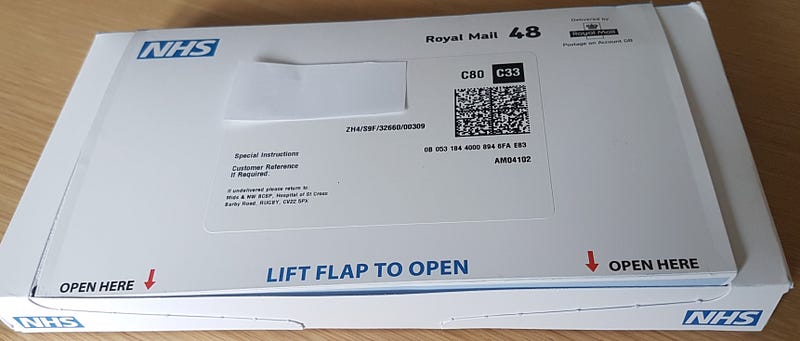
I received a testing kit in the post to complete the test at home.
The instructions are clear and as yucky as it may sound, it was quite simple to do.
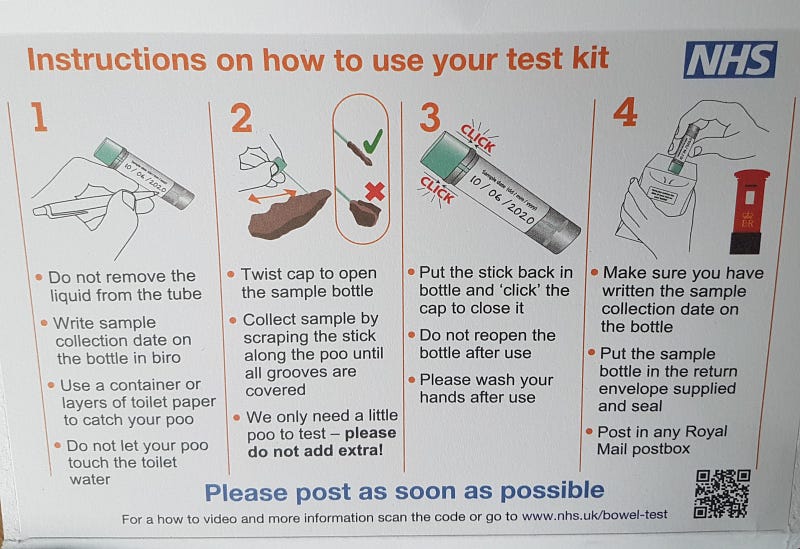
You are provided with special packaging to send the sample off.
I received my results back within two weeks. All clear.
To my FB friend who may just help to save other lives, thank you for prompting me to take my screening test.
Here are the symptoms of Bowel Cancer NHS
- a persistent change in bowel habit — pooing more often, with looser, runnier poos and sometimes tummy (abdominal) pain
- blood in the poo without other symptoms of piles (haemorrhoids) — this makes it unlikely the cause is haemorrhoids
- abdominal pain, discomfort or bloating always brought on by eating — sometimes resulting in a reduction in the amount of food eaten and weight loss
© Bernie Pullen, All Rights Reserved


