
My First Thirty Days of Duolingo
How Much Dutch Can I Learn in Two Months — For Free?
At the end of December, I booked a trip to Amsterdam, travelling in March. Despite knowing that the Dutch almost all speak impeccable English, I nevertheless decided to learn some of the language.
Firstly, I believe it is only polite to try to learn at least a few phrases of the local language before any trip. I have often found the local people to be more friendly when they see that I am making an effort, even if I am strangling my vowels in my frantic attempt to order a beer.

Secondly, I just love learning languages, and get a real kick out of reading or hearing a slightly-familiar word in a foreign country and knowing what it means.
Full disclosure, as it may affect my results on Duolingo — I studied Modern Languages at university and spent a year living in Germany. As Dutch is a Germanic language, I can recognise some unknown words based on their similarities to German. However, I also often try to spell or pronounce Dutch words as if they were German, so my prior knowledge is both a blessing and a curse.
As a side note, Scots is also a Germanic language. A close relative to the English language, Scots developed from the same Anglo-Saxon language ancestor as English, German and Dutch. Some of our words more closely resemble Dutch than English. For example:
- English — Church
- German — Kirche
- Dutch — Kerk
- Scots — Kirk
All of which is to say, I should have a linguistic advantage while learning Dutch on Duolingo.
About Duolingo
Duolingo claims to have 40 million users worldwide. Their mission is to provide personalised education, tailored to each student, to make learning fun, and to be universally accessible by providing free content.
Their approach is to gamify language learning, and teach real-life communication using “implicit learning” (the way a young child learns their first language). They currently offer courses in 43 different languages for English speakers, and provide courses for native speakers of 27 other languages.
The Learning Program
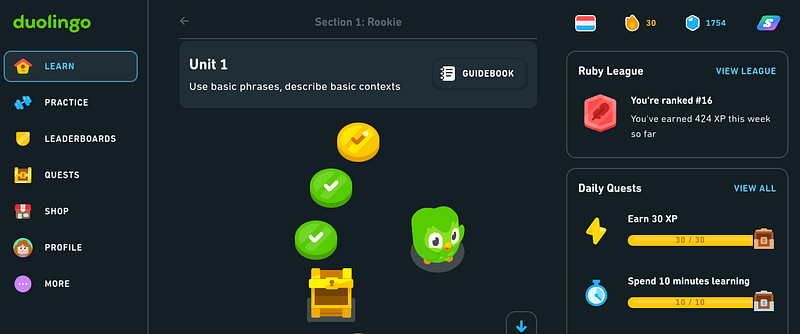
When you begin a course with Duolingo, you are asked to select a Daily Goal. I opted for “Casual”, which has a target of 10 “XP” (the points earned by completing lessons), and is very low effort— it’s possible to earn 10 XP in under 3 minutes per day.
Each unit has regular tests and the opportunity to earn further XP. Students can re-visit each section as many times as they like until they are confident.
How Is It Fun?
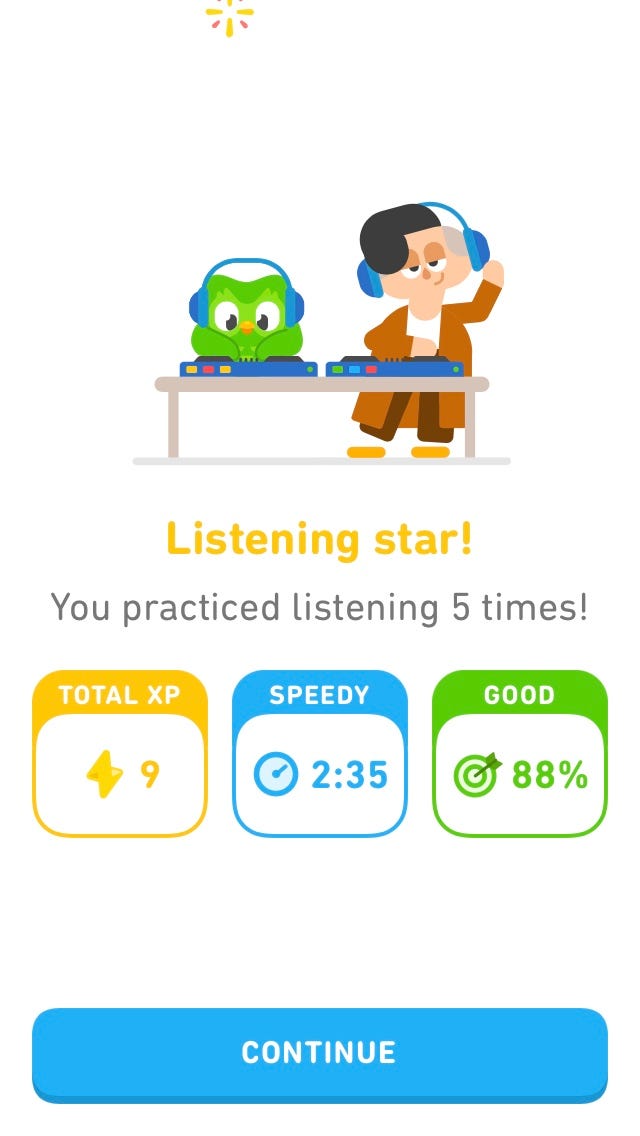
Duolingo exercises are varied in format: reading, listening, writing and speaking, to keep the learning experience fresh. The lessons are presented by colourful cartoon characters, and there are numerous challenges and quests to earn extra XP — for spending 10 minutes per day learning, or for scoring 90% on 4 lessons per day, for example. I’m a little unclear on the benefit of completing the “Nocturnal” quest, to complete a set number of lessons after 10:00 pm.
There are leagues, with the top students in each league being promoted to the next league, and the bottom students at risk of demotion.
Duolingo sends regular notifications to encourage students to complete lessons or strive to ascend to the next league — though if you find these intrusive or annoying, then you can of course switch off notifications.
Duolingo also encourages community spirit, by allowing you to connect with real life friends, compare scores and send congratulations on each achievement.
Is It Really Free?
It can be, though your learning time is limited by the number of mistakes you make. Each student is awarded 5 hearts per day, and can lose hearts for any errors. This can be quite frustrating, if you accidentally mis-click on a word and it fails to register, or you select “an apple” instead of “the apple” and lose 20% of your hearts for a simple typo rather than a language error. Hearts replenish at a rate of one every 5 hours.
There are ways of earning extra hearts, by completing extra practice sessions or watching ads, but Duolingo never misses an opportunity to advertise Super Duolingo, which boasts unlimited hearts and no adverts, and starts from £4.99 per month in the UK or $6.99 in the US.
In the 30 days I have been practicing Dutch, I have been rewarded with two free 3-day trials of Super Duolingo.
So, How’s It Going?
After 30 days of free practice, with a “casual” goal, I have reached Unit 3 of section 1, covering common phrases, food and animals, and totalling 146 words.
Not entirely useful words, admittedly. I feel the scope for me to use the word “rhinoceros” in my trip to Amsterdam is limited.
I noticed quite quickly that some of the phrases which cropped up repeatedly were somewhat odd.
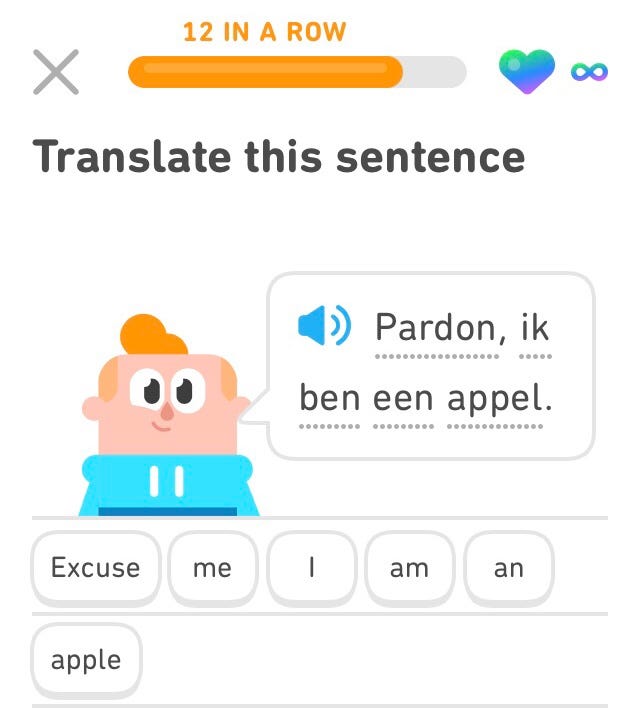
“I am an apple”
“You are an apple”
“Excuse me, I am an apple”.
I began to suspect that this was some peculiar bizarre Dutch insult. “Oh, you’ve burnt the poffertjes! You’re an absolute apple!”
By the time I had reached “The apple speaks a bit of Dutch”, I was certain that some strategy was in play. According to Duolingo’s approach, these “quirky” sentences are deliberate, as they are more memorable and challenge learners to really think about the language they are learning.
While these phrases won’t be much use on my trip, I should note that Duolingo does not claim to teach Dutch for tourists, and that there are plenty of courses out there specifically for tourists if that is your thing.
For free, I really can’t complain about my results, and I find the practice easily as much fun as playing a game of Royal Match. Time will tell if the next 30 days will equip me to politely order a stroopwaffel in flawless Dutch, or if I am destined to call the canal tour guide an apple.