
My First Course Launch Flopped With 0 Sales. 140+ Sales Later, Here’s What I’ve Learned.
These three rules help me market better.

Around two years ago, I hopped on the course bandwagon. I spent ten hours lovingly crafting, editing, and polishing my course. And then I finally hit send on my very first (and I assumed last) marketing email.
Then I refreshed my inbox several times, waiting for that first email to come in to say someone had bought my course.
Nothing happened. No sales at all for a whole day.
At the time, I thought I’d done everything right:
- I had a sizeable, active list — around 3k subscribers and a ~50% open rate
- I polled my audience to discover what course would best suit their needs
- I built trust with my audience, with tons of free content on YouTube and my blog, on exactly the topic of my course
So why no sales?

Two years later, that course has sold over 140 times. Not only that, but I’ve sold other kinds of digital products (templates and subscriptions), made over $5,000 in affiliate sales, and have even run two fully booked live cohorts.

Here’s how I course-corrected (pun intended) my marketing strategy and became a better marketer for my own products.
1. Short and sweet sales emails
The first sales email I ever sent was over 500 words. That’s two to three minutes of read time. And I didn’t actually get to the sale until 2/3s of the way down.
Although that email had an open rate of 38%, most email subscribers probably clicked it, read the first paragraph, and bounced. And I can’t blame them!
I sent much shorter emails after that, ensuring that I made my point early on.
Long emails at the start of a launch don’t value my subscribers’ time. If I want readers to buy my course/book/template/thing, I need to make it much more explicit higher up in the email and make my case faster. The fact that it took me 500 words to sell meant a lot of people wouldn’t be convinced.
In that particular launch, I crafted my point in 125 words and made many more sales from that shorter, concise email. In future launches, I copied that strategy and found success.
Now, here’s my formula for my launch email:
- Talk about a problem I think readers have
- Explain I’ve made something to help them overcome that problem — this is the sales bit
- Add just one or two sales elements — a testimonial, a deadline, an FAQ, something like that
And that’s it.
Note: There is a place for long sales emails. I typically reserve those for the end of the sales period, when I have an audience who I know is possibly interested, but still debating whether or not to send. That’s when a longer email that tells a story, addresses possible doubts, and. But to start? I keep it short and sweet.
2. Send more emails than you think you need
I really thought I was special. I assumed readers would clamor to buy anything I had to sell, a la 2006 Black Friday waiting in line at five AM for that new TV. So initially, I thought I’d send that one email and be done with these distasteful sales.

But no. I’m not special. I learned that a successful launch requires multiple emails. I tend to go for 4–8 emails now for a launch.
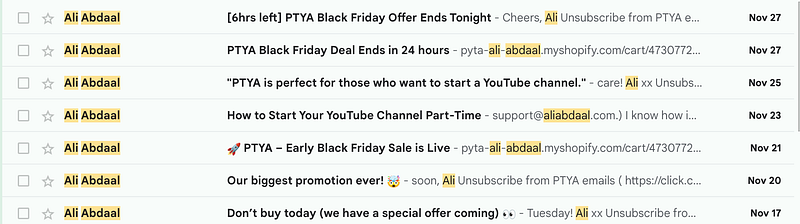
(I typically offer readers a way to unsubscribe just from those emails, in case they’d like to stay on the list but not get more sales.)
There are so many reasons people don’t buy when they get that first email. Maybe they don’t have their wallet handy. Maybe they just need time to think about it. Maybe they were going to buy it, but their cat came up for a snuggle so they got distracted. It happens.
By giving my email subscribers multiple chances to think about it before they bought, I was able to turn my failed launch around, and have more successful launches thereafter.
Note: Sometimes even after sending eight emails about a course launch or deadline, I will still receive emails from subscribers a day late who say they somehow missed the cutoff. People are not glued to their inboxes!
3. Don’t assume you can get away without actual sales strategies
I have a long and slightly complex history with sales. In short, at first, I thought sales and sales tactics were slimy and that I was better than them. Then I tried to unsuccessfully sell something and understood why people use sales tactics: they work.
In that first launch email, I pretty much said what was in the course, like literally just the curriculum. That’s it!
When you’re selling your digital course, you have to really grasp what your students want to achieve from the course, not what they want the course itself to be.
A list of features won’t sell — but telling students what they’ll be able to accomplish after the course is what will get people to understand the value of what you’re offering.
In my case, what subscribers really wanted from my course was to:
- gain followers
- write stories that find an audience
- build connections with influential writers
What they hoped it would help them avoid was:
- the cold sting of rejection
- getting bad results with stories they worked really hard on
- seeing other people do better than them with worse writing
By communicating those benefits, instead of just what was in the course itself, I was able to tap into what my students actually wanted and make more sales.
There’s no shame in selling unless you’re tricking or fooling people in some way. If you stand behind your sales, that’s not an issue.
Most of my hard-won advice could be boiled down to the following few rules:
- Don’t assume you can sell stuff without actually doing any sales
- Respect your audience — their time, their energy, and their decision to buy or not buy
- Believe in your products
Marketing is weird, especially for indie creators. I never got a degree in marketing or course creation or email crafting. I just learned on the job, applied what I learned, and improved as much as I could on each iteration. Hopefully, this helps you avoid some of my mistakes and do better yourself.
Want more marketing tips and tricks? Subscribe to the Better Marketing newsletter the Marketing Memo here.


