
My First Clues about Social Injustice
It’s why I am so passionate about education.
I was fortunate enough to go to university at a time when it was affordable. Tuition was under $3,000 a year, and a combination of Pell grants and working part-time jobs could pay for your education. That was back when university “work-study jobs” offered meaningful academic-related employment with adequate compensation. (An aside: when I was an undergraduate, you could work about 400 work-study hours to pay for your tuition, but today’s students would have to work over 2,000 work-study hours.)
Recently, a news story reminded me of two work-study jobs from which I benefited, and not only financially. They were piddly, grunt jobs to be sure, but they were far more than working as a cashier at the rec hall. Those two jobs immersed me in history and ideas that opened my eyes and expanded my horizons.
Dusty Journals Taught Me about Workers’ Rights
The first of those work-study jobs was as a research assistant. That job title made it sound more prestigious than it was. I was a dogsbody for a political science professor who was as dull as dirt. Well, to be honest, dirt was sparkling excitement compared to him.
His research project was also fairly soporific. He was drafting a paper on the history of the unanimous consent decree in the US Senate before 1920. He was particularly curious about the use of the parliamentary procedure before and after a rule about it was established in 1914.
I was tasked to find all mentions of “unanimous consent” mentioned during Senate proceedings as recorded in the Senate Journal. Keep in mind, this was in the olden days before anyone had digitized books. (Yes, I’m dating myself.) To find the requested information, I had to go into the stacks of the university library and pull out the hardcover copies of the Senate Journal. They looked like this:
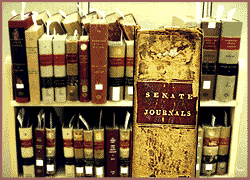
So, I dutifully pulled every volume of the Senate Journal from 1874 to 1919, skimmed through every page, and wrote down every page on which the words “unanimous consent” appeared and to what bill or motion the request referred. I am sure that I was the first person ever to open some of those volumes; the 1890s in particular seemed to have attracted little interest.
Being a curious sort, I read many of the journals’ entries detailing the Senate’s business. What struck me more than all the rest was how many bills were introduced for workers’ rights, especially for the relief of railroad workers.
Year after year, bills were introduced attempting to cap the number of hours that corporations could require their employees to work. What shocked me was that the proposed caps were 60 hours for the work week and 10 or 12 hours for the work day. What shocked me even more was that year after year, these bills were voted down by the senators.
The journals usually didn’t include floor speeches, especially the oldest volumes, but sometimes there were summaries of what senators presented in support of their workers’ rights bills. There were multiple mentions of how many thousands of railroad workers were killed on the job each year, which were understandably attributed, in part, to workers being overworked. There were also massive safety issues that other bills tried to address, bills also usually voted down. Between 1890 and 1917, there were 230,000 on-the-job deaths of railroad employees in the US. This was a major reason for railroad workers to form labor unions — to demand better safety for workers.
The railroad unions finally succeeded in 1916 when they threatened a nationwide strike. Congress passed the Adamson Act that granted rail workers the protection of an eight-hour day. Because of Adamson and other worker protection acts of Congress, railroad worker deaths decreased from over 8,000 a year to under 12 a year today.
It shocked me then and it still bothers me now that the US Senate opposed the idea that people shouldn’t be forced to work over 12 hours a day.
A Chaotic Library Taught Me about Discrimination
Later, I took on a work-study job for the women’s studies department to catalogue their library. Well, to call it a “library” was generous, as the professor I reported to readily admitted. It was the first department to offer a major in women’s studies, and they were justifiably proud of who they were and what they had accomplished. Like all women’s studies departments, however, they were underfunded, and their offices were relegated to one of the oldest buildings on campus, their library being a small attic room.
The task assigned to me was to go through the second-hand shelving units and cabinets, and the considerable number of cardboard boxes that held hundreds of books collected by the department over the years. “We really don’t know what we have,” the professor said. My job was to create their card catalog, writing down each book’s title, author, and subject matter. Yes, on paper. My students today don’t even know what a paper index card catalog is.
Naturally, I can’t pick up a book without leafing through it. Those books were my first exposure to feminism, feminist philosophy, queer studies, and related subjects. I was granted permission to check some of those books out of the library, and I read those books. I didn’t agree with them all, I confess I didn’t understand them all, but I did learn from them all.
I also confess that I had a very stilted upbringing. Growing up in an all-white middle class suburb in Minnesota has that effect. Maybe the realities that blue-collar workers and women were treated abysmally is something many people have always known, but for me, learning about these realities was transforming.
I’m not saying I had an instantaneous Zen enlightenment. I am saying that these two jobs planted seeds in me that contributed toward my general awareness of social injustice, an awareness that continues to grow the more I learn, and I still have a lot to learn.
Learning about other people’s lives opens one’s mind. It is why education, especially the liberal arts in higher education, is so important. There’s a whole big world out there, and people benefit from learning about it. I know I did, and I want to pass that along to my students today.