
My Final Touching, Harrowing Weeks with My Father.
Slammed: a Memoir — Chapter 14 Part 2

Mom, my brother Jeff, and I helped Dad into my car. His movements were slow because balance had become a real issue. When he was finally in the passenger seat, I hopped around and jumped in the driver’s seat while Mom and Jeff got in behind us.
I was about to start the car when Dad said, “You forgot to race me.” His tone was whimsical and lighthearted. Whenever we’d be out to dinner before seeing a show, I’d ask him if he had the tickets. “I thought you had ’em,” he’d joke.
“Race you?” I asked.
“Race to put our seatbelts on.”
I laughed. I hadn’t thought about that in years! When I was little, Dad got me to buckle my seatbelt by making it a race. I’d jump in the car and immediately buckle my seatbelt before Dad even had a chance to get in. “I win!” I’d exclaim.
“Ya beat me again,” he’d say, admitting defeat and claiming a parental victory.
I smiled at dad in the passenger seat. For a brief moment, we went back in time, our roles reversed. “Ready. Set. Go!”
Slow as he was, Dad made a real effort while I held back, letting him win as he had let me win countless times 30 years earlier.
“I win,” he celebrated.
“Ya beat me,” I said. I chuckled as Dad let out a soft “Woo Hoo.”
I started the car and looked in my rearview mirror. Mom and Jeff sat stone-faced behind us. The torture of inevitability — where the only thing worse than waiting is not having to wait anymore — had them suspended between shock and grief.
I put my car in drive and pulled away from the sidewalk.
Five minutes later — literally just up the street — we pulled into RiverStone Health Hospice Care.
It had been a hard couple of months. After receiving the call from Mom about Dad’s cancer diagnosis, I kissed Michael goodbye and drove the three days out to Montana. When I arrived for my indefinite stay, I found Mom and Dad as I would have expected to find them: in their respective recliners, happy to see me, betraying nothing of the hard reality we were facing.
About a week earlier — on their 50th wedding anniversary, in fact — my father was diagnosed with Bile Duct Cancer.
“Chemotherapy isn’t going to cure this,” the oncologist said. “What it will do is extend your life, but I can’t guarantee it’ll be a good life.” It was a case of the cure — or life extender in this case — being worse than the disease.
“And without treatment?” my mother asked.
“If you have children who don’t live here, you should tell them to come home,” the doctor replied.
It was a shock, but Mom and Dad had discussed the possibility that his recent health issues might be cancer. Now that cancer was confirmed, Dad faced it quite stoically. “Well, we’ve had 50 good years, we have two great sons. All and all we’ve had a great life.”
“Yes, we have,” Mom agreed, though she was far from ready to see their life together end. Still, she held strong for him as, I believe, Dad was holding strong for her.
Dad continued, “But I don’t want to live the rest of my life sick from chemicals.”
So Mom took Dad home.
The first few weeks I was there, you honestly couldn’t tell anything was wrong. Dad, at 75, perhaps seemed more like a man of 85, but not an unhealthy 85.
And a can-do 85. He took full charge of planning his own funeral. I went with him to Dahl Funeral Chapel, run by John Dahl, a fellow Knights of Columbus member with my dad. They went over the life insurance paperwork and other logistical details. It was a blessing Dad was being proactive. I don’t think any of us would have had the wherewithal to try and handle any of the logistics after he passed.
While they talked, I flipped through a catalog of urns and other offerings to hold loved ones cremains. There were jars and boxes but also novelty options like urns shaped like footballs or soccer balls.
“Dad,” I interrupted them, not being able to help myself. “Should we put you in a bowling pin?”
Dad and Dahl chuckled with Dahl saying “You’d be surprised. The bowling pin is a popular one.”
There were urns with national sports teams colors and logos and urns in the shape of motorcycle gas tanks. There was the option to have the cremains made into a glass figurine or smaller pieces of jewelry. There was even the option to have the cremains stored in pieces of a chess set. I was fascinated!
When Dahl stepped out to make some copies, I turned to Dad.
“So, you’re definitely going with cremation, correct?”
“Yeah.”
“So,” it felt so morbid, but I had to ask, “what are they gonna do with the titanium?” Both of his hips had been replaced by this point.
“Huh. I don’t know.” He was curious himself.
“Maybe we could have them refashioned into candlesticks or something,” I joked.
Dad was chuckling when Dahl returned.
“Ok,” Dahl said, sitting down. “Let’s talk about the funeral itself.”
Dad would have his funeral at St. Thomas Catholic Church. The same church he took me to every Sunday growing up where I found my love of singing.
Since it was to be a Mass, it was pretty cut and paste. He told Dahl he’d leave the choice of reading to Jeff and me.
“And I want John to sing ‘Ave Maria’ during the service.”
“What?!”
I was incredulous. Dad hadn’t said anything before this about wanting me to sing at his funeral. I had planned on a eulogy, but singing?
“Absolutely not.”
They both looked at me startled and surprised.
“Sorry, that came out more forcefully than I intended. Dad, I’m sorry. There is no way that’s happening.” Dad looked at me, confused. I continued. “Look, it’s gonna be an emotional day, guaranteed. It’s not…it’s not that I don’t want to, but I don’t trust that I’ll be able to pull myself together enough to do the song justice.”
“Ok,” he said, simply accepting my reasoning and moved on.
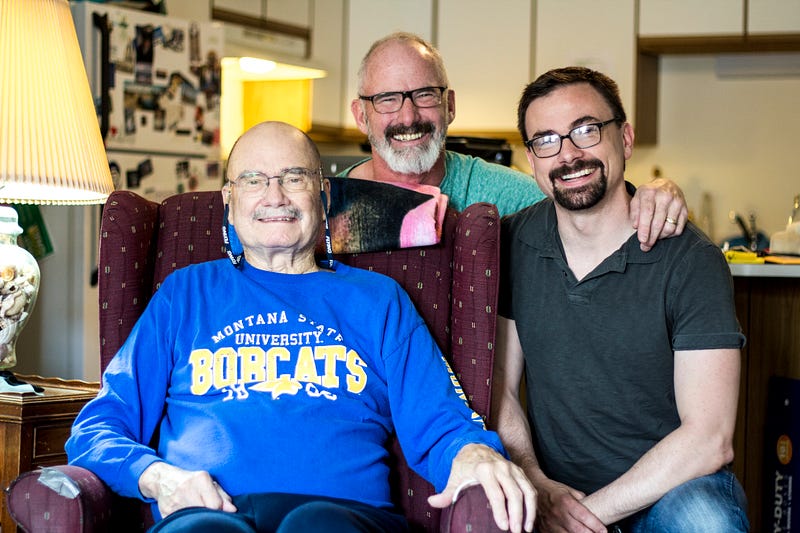
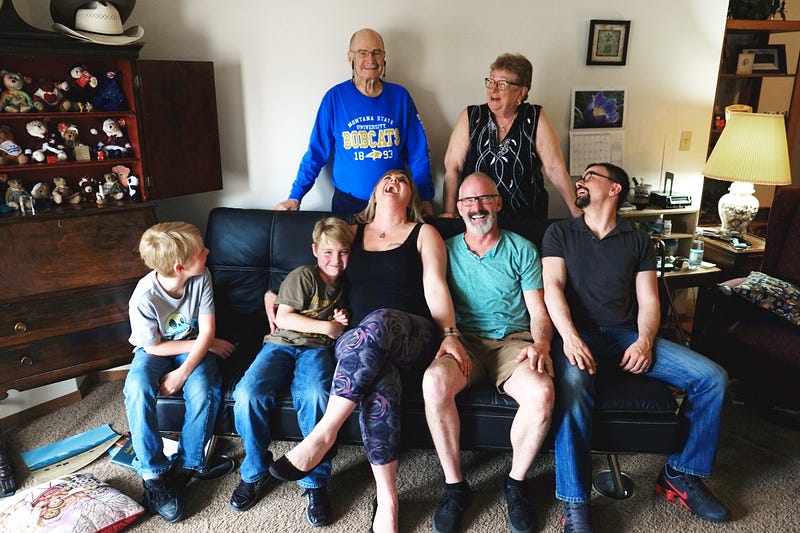
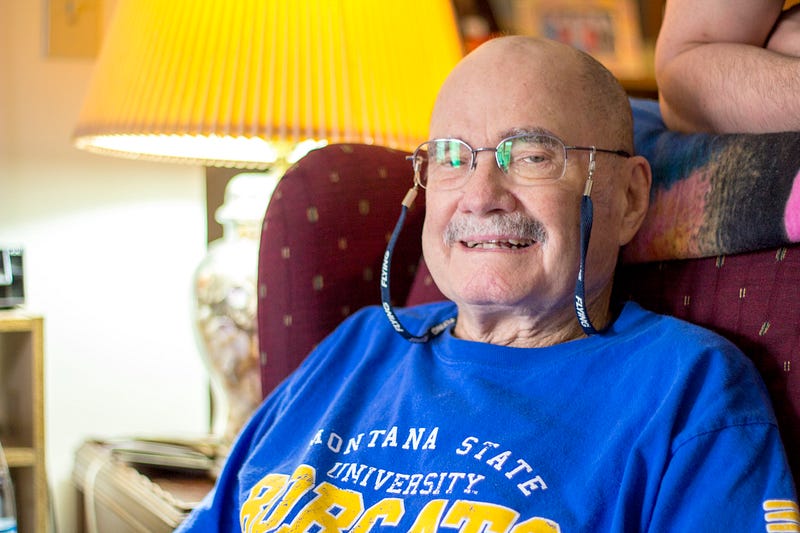
After three or four weeks, Dad started to deteriorate. He’d wander the apartment constantly looking for things — without the faintest idea why he was looking — getting more and more angry when he couldn’t find whatever it was.
He stopped being able to have real conversation as his attention span and memory were nearly non-existent.
When I first came home, every time I went out Dad asked me to bring him back a chocolate shake from McDonald’s. Eventually I would do this without him asking. Only now the shake would end up melted and room temperature, forgotten on the end table next to his chair.
Going to the bathroom was becoming more and more of an issue. For as stoically as he faced his death, he was an incredibly proud and stubborn man when it came to the bathroom. He would not accept help, and he absolutely would not pee in a container provided by the visiting hospice nurse.
The other thing he absolutely would not do was go into hospice.
We assisted him as much as we could, as much as he would let us, but the level of care he needed was increasing by the day. We were losing confidence that we could give him the care he needed to see him through to the end or even to keep him safe.
But when the four of us sat down for a family meeting to discuss the option, he declared again, unequivocally, “No, I’m not going into hospice.”
Where I saw this as the beginning of a negotiation, my brother saw it much as Dad did: the end of the discussion. “Well, there it is, Dad’s made his decision.” With that, Jeff got up and excused himself.
Jeff wasn’t frustrated; he was relieved. I didn’t fully appreciate it at the time, but I think we were looking at hospice differently.
I saw hospice as an environment of professional care that we simply weren’t qualified to provide.
Jeff saw it, not incorrectly, as the end. You go to hospice, you don’t come back. Hospice meant death. It meant facing death. For as much as Dad was deteriorating, as long as Dad was home, we didn’t have to truly face the inevitable till the moment it came.
I thought Dad just hated any kind of medical setting, hospital or hospice. I couldn’t really blame him as our family had more than its share of hospital visits in our lives, including the loss of a child.
Years later, Mom would correct me. He didn’t want to die, regardless of how stoically he faced his diagnosis, but it was much more than that. He was enjoying having both his sons home. He was enjoying being together as a family again. He didn’t want to leave.
He didn’t want to leave us.
So, hospice was off the table and we continued to do our best with our caregiving.
Until one night in mid June.
Despite the dry Montana summer heat, Dad’s body had lost its ability to self regulate leaving him constantly feeling cold. He had the heat turned up so high that we did whatever we could — opening windows and shutting vents — to bear it.
Mom decided to sleep on the couch in the living room one night. She didn’t want to. She didn’t want to give up any amount of time to be close to Dad, but the bedroom was sweltering and she was exhausted. She needed to at least try and get some sleep.
“John. John, wake up!”
It was past two in the morning. She wasn’t panicking, but she was insistent. As I sat up on the bed, she said, “Your dad’s fallen in the bathroom and I’m not strong enough to pick him up.”
Dad got up in the middle of the night to pee, totally “ride or die” about being able to go to the bathroom by himself. Using a walker, he got all the way to the toilet. He then lost his balance and fell. His yelling is what woke up Mom.
I got to the bathroom doorway to find Dad naked, yelling, wedged between the toilet and his walker. It was one of those moments that I’d dreaded, witnessing the man who’d raised me become completely helpless, scared I wouldn’t be strong enough to face it and step up when the moment arrived.
Yet, when the moment arrived, a switch was flipped somewhere inside me and I just acted.
“Go get his wheelchair,” I said to Mom. I lifted the walker out of the way, bent down and took hold of Dad underneath his arms. “Ok Dad, I’m going to lift you.”
“Get me up, Goddamnit!”
“That’s what we’re doing.” I stayed calm and determined, not reacting to his anger. “Ready? On three. One. Two, Three.” I gently lifted him up, surprised at how light he was. I got him up to almost standing but didn’t let go, not trusting that he could support himself enough to stand. Mom brought in the wheelchair.
“Ok, I’m going to lower you into the chair, ok? Here we go.” Slowly I lowered him down into the chair. He was still angry, muttering under his breath, not looking at us. He started shivering.
“Wheel him out into the living room. I’ll grab a blanket.”
Back out in the living room with a blanket covering him, Dad sat, muttering.
“What should we do?” Mom asked.
“We should call the hospice on call nurse.” Though he wasn’t in hospice, he’d been receiving regular visits from a hospice nurse and an on-call nurse was available for just this kind of situation. “He might have hurt himself, broken something. We need help.”
Blessedly, a short time after we made the call, a young Latina nurse, pretty with long, straight black hair, arrived. After letting her in, she went over to Dad. “Hey there, Gary. I hear you took a fall?”
“They treat you like shit here! Sons a bitches, I don’t want to be here. I want to leave!”
This caused both Mom and I off guard. It really hurt. We were doing the best we could.
I was confused. Did that mean he wants to go into hospice now? I might have cried if I hadn’t been so exhausted.
“Ok,” the nurse said, not reacting to his complaint. Turning to us, she said, “I’m going to take him into the bedroom and examine him, okay?”
We waited in the living room. I stood by the open balcony door to try and get some air. Mom stood in the kitchen holding a glass she’d filled with water but wasn’t drinking.
When the nurse came back out, she asked us to sit down.
“Ok, he’s back in bed and sleeping. It doesn’t look like he’s injured himself, so that’s good.”
Mom and I exhaled in relief.
“Also, he seems to be experiencing some dementia.”
When we looked at her somewhat confused, she said, “He thinks he’s in hospice care.”
It took me a moment to process. “Wait, like, in hospice care as in…at hospice care? He doesn’t know he’s at home?”
“Correct.”
Though it felt inappropriate, I was so relieved. His outburst wasn’t about Mom and me. He thought were the staff at the hospice care center.
“Have you had any conversations about moving Gary into hospice care?”
“We have,” Mom said. “He doesn’t want to go.”
“Okay. I think you should try having that conversion again. Hospice isn’t just about care. It’s also about safety. We have staff 24 hours to help with just this kind of situation.” She leaned forward. When she spoke again her voice was full of loving kindness. “I can see you both are exhausted. If you bring him into hospice, we can take the job of caretaking off your shoulders so you can focus on just being his family. On just being his wife. On just being his son.”
The idea almost made me cry, but I immediately felt guilty.
Isn’t it my job to take care of my parents as they took care of me?
I knew I wasn’t qualified to provide the kind of care that Dad needed, which felt like failure. Yet, in his final days, I didn’t want to be his caretaker. I just wanted to be his son.
Mom thanked the nurse. “Tomorrow we’ll talk with him. But it has to be his decision.” In her voice I could tell she didn’t believe he’d change his mind.
Which is why it surprised the hell out of us the next day when Dad, before we had a chance to even broach the subject, said out of the blue, “I think it’s time I go into hospice.”
His lucid moments were far less frequent, but when he had them, he saw the strain we were under. Not just from the events of the previous night, but over the several weeks of his fast decline.
We gave RiverStone Health Hospice Care a call and, later that day, took him on a short drive just down the street.
Next Chapter
Chapter Guide
A lot of heart, time, and work goes into each piece. One way you can support me is by signing up for a $5/month Medium Membership. Use this link and I’ll get a percentage of your subscription fee. Huzzah for supporting artists!


