
My final Guide to a Killer UX Case Study Presentation - A Gift to You
Use This Guide to Delight Recruiters, and create a killer presentation.

A Case study presentation happens when the company wants to learn:
- Who you are
- Your passions
- Your values
- How do you solve problems
- How do you deal with adversities
- Your participation in the project
- Your time management skills
- Your public speaking skills
- Your coping skills
- If you know how to apply UX tools, when they are needed and when they aren't.
- How do you work as a team
- How do you articulate your Design decisions
- Your UX Design Skills
- If you knew what you were doing on that project
- What skills were applied, what tools, and why
- Why did you apply for their company
- Why they should hire you
- (this, but is not limited to it, can vary from company to company)
This guide is a junction of my knowledge on public speaking, storytelling, interviews, presentation knowledge, things learned at work, things my mentors advised me to do, plus paterns that I found on other designers presentation.
There is no such thing as the only way to do things or the only best presentation format, I am sharing my perspective, and as always, take what resonates and leave what doesn't.
Today I consolidated all my research and learnings to share with you:
🎶 drum beats 🎶
MY ULTIMATE CASE STUDY PRESENTATION
What I am sharing today with you took me time to learn, I paid expensive mentorships and also made a lot of mistakes to arrive at new ideas and understanding of what a great presentation could look like.
So, there is a lot of value to be shared, and I hope you can use it to create insights and maximize these learnings to make your own presentation even better.
If you are already a Medium member, or if you are using one of your monthly stories. Today this knowledge will be yours.
Before we start, if you are looking for how to compose your portfolio case studies, today we won't talk about it, but you might find what you are looking for in this article 👇
Today we will talk about portfolio presentation, which means, you will make a presentation to talk about yourself and your projects in front of an audience.
The intention of this article isn't to give you a ready slide deck, you won't find it here, my father always told me to teach people how to fish instead of giving the fish to them.
I will walk you through the thinking process behind the slide deck because the slide deck is a very small piece of what builds a great presentation.
This article is separated into three main sections
1- Best practices while composing your slide deck.
2- The storytelling behind every single case study, and how to present it.
3- Best practices while doing the presentation.
Every time I have to do a presentation, I try to improve, I go through research, and create something better, this is exactly what this guide is all about.
I finished another project, and I still didn't create the slide deck for it, so, that's why I created this guide, to get things organized on the best practices while preparing for the presentation, today, it is also yours.
1- Best Practices while composing your Slide Deck
I found four different places where people would normally create their slide decks:
- Figma/Sketch
- Canvas
- Keynote
- Powerpoint
You can use any tool where you feel comfortable with, but don't forget about the most important thing, this is a great moment to show your UI ability too, and even if you aren't into UI, try your best to create a great impression on your visuals.
How long it should take to change from one slide to another?
That's a hard one, I saw people doing 1 min or less and others talking for more than 5 min, so it depends. The best way to go here is to make sure you won't need to rush, if you think you are rushing, try to cut a few more pieces of the talk. — Test - Improve - Test again —
Here is the best way to go about it:
a- Don't put too much text in the slides, you don't want your audience to lose focus on you while struggling to read something.
b- Use great visuals, and tell a story by connecting one slide to the next.
c- Only talk about the most important things that happened in your project.
d- Pick case studies where you used the skills applied to what the company is looking for.
What to cover in the slide deck presentation?
a) Who you are and what brings you here
A slide(s) about who you are and what brings you to this point — Talk about your background, what you like to do, volunteer work, your passions, your values about Design, and anything interesting that you have done in the past.
I love how Tony Aub (Hired at Amazon) starts his presentation by talking about 7 curiosities about himself. I think it was a great way to connect with the audience and drive attention.
He uses the number 7, which is very specific, and also ''curiosities'', this definitely gets everyone curious and interested in what he has to say.
You don't have to do it that way, but definitely have a nice picture of you while having fun or doing something interesting, it will help the audience to connect straightway.
Don't forget to know your audience, the first impression is the most important.
b) Summary
Let your audience know what is going on and what you will be going through in your presentation.
c) Case study
Here is the place to tell your case study story, but only highlight what is most important to your audience. Please, don't make it boring by showing phases of the process as if robots were working on the project.
Real people have struggles, make mistakes, do reflections, and have happy or hard times, that's something your audience will be very interested to learn.
We will discuss more of the storytelling later on in this article.
d) The conclusion
The conclusion should link back to the problem that started everything, talk about the main takeaways, and use it to summarize your leanings, and also demonstrate your project impact.
I found it interesting how femke.design talks about her final pitch by telling the interviewer why she is the best fit for the position, she also likes to feature what people think of working with her, just like showing great reviews from her previous projects.
But, before having this piece on your slide deck, make sure it is adequate for the company you are presenting for.
e) Thank the audience
At work I am very used to slide presentations, we use them in every single meeting, and although it happens many times a week, our project managers and other colleagues will always end the meeting by thanking everyone for their time, attention, and participation.
It is very important to create empathy with your audience and imagine what is going on on the other side of the screen, and how many Designers they already interviewed on that day.
Are they tired? are they hungry because it is lunchtime in their time zone? Did they just wake up?
Get them surprised by showing some empathy.
2- The storytelling behind every single case study, and how to present it.

There was one day when I was caught by surprise by the recruiter and he wanted me to present the case study, but I hadn't prepared because it was our first interview.
I started in a very technical way and I could see how the recruiter was bored. Now I laugh, but at the moment I was burning my brain to find something more engaging to say. So my advice for you is to have it prepared, even though it wasn’t asked yet.
Always have at least a 3 min talk prepared for every portfolio. It doesn't matter if a presentation was required in the interview.
Start with what connects you to this subject, why are you passionate about this problem, and is there any particular story that connects it to you?
I don’t know if you are familiar with TED talks, but the speaker always starts every presentation with a personal story, full of emotions to connect it to whatever they will be talking about.
- Why you are passionate about solving this problem?
- Do you have any emotional reason connected to it?
a) Make it engaging — You can practice presenting it to your partner, your mother, sister, or brother. If they get bored, you got to change something.
b) Who is the hero and who is the villain in your story — The hero and the villain can be situations, but you can have many villains in the middle, like time, budget to build tools, lack of resources, and so on.
c) Scenario — When and where this history takes place? transport your audience to your project story.
d) Facts — What is happening? Create flow in your story with the development of facts.
e) Connect your ''why'' to the project's big ''why'' — Martin Luther king once gave a speech called ''I have a dream'', the people in the audience didn't stay because it was Martin Luther King, they stayed because they believed in his big dream, in his big why.
Try to connect the company's values to the project why.
Simon Sinek uses Apple as a great example of a product that tells its why before anything else.
Look at the example below, first, we started with what, and in the second, we start with the why, see the difference:
Starting with What - “We work perfectly with computers. They are beautifully designed, easy to use and have a user-friendly interface. Want to buy one?”
Starting with Why - “Whatever we do, we do because we believe in challenging the status quo. We believe in thinking differently. The way we challenge the status quo is to make our products beautifully designed, easy to use and user friendly. We ended up making great computers. Want to buy one?”
The second one was way better, right?
So, what we take from Simon Sinek's knowledge to our presentation is to start with the why, move to the how, and finish with the what.
Ok, let's have a look at what a case study story could look like:
Again, highlight the most important points, you don't have to tell the whole story in a Case Study presentation, if the recruiter gets interested in how something else happened he will ask.
This is just an example, your project won't be the same:
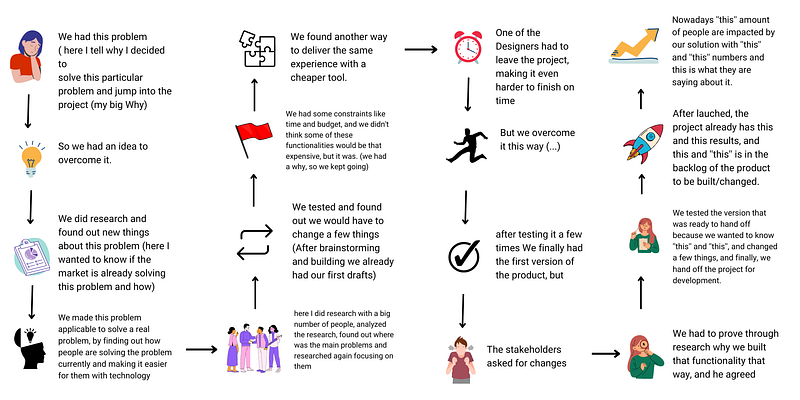
Real-world is happening while we build things and we should demonstrate how we deal with adversities by keeping our values in mind.
Also, make sure to provide live pictures on the slide decks, because the audience will connect better by visualizing real-life happening (you and your team on the table filled with post-its, doing interviews with a group, etc.), just like speakers do in TED Talks.
3- Best practices for your presentation

Here are a few tips to improve your presentation, because public speaking skills will be very important to you.
The opening — Start by thanking the audience and creating empathy for whatever condition they might have at the moment.
Maybe it is lunchtime, maybe is too late in the night, or early in the morning. Maybe Friday or Monday, use whatever information you have to acknowledge that you know there are real people on the other side.
I know you maybe will be feeling super nervous and tense at the start, but breathe and remember that there are humans in the audience also going through their own struggles to be there, (make use of your coping skills).
a- Know your audience — It doesn't matter if it is an interview or a presentation, while you are preparing, as better as you know what your audience is looking for, the best presentation you can make.
b- Don't use jargon — Even if you think your audience understands some technical language, in case you use something, make sure to explain, so everyone can follow you. (talk slowly, with your softest voice).
b- Connect with your audience — As I mentioned before, connecting with your audience is one of the most important things in a public presentation.
Try to cut off the presentation on everything that is not necessary, and be very objective, so your audience doesn't get bored.
It is good to tell the interviewers that they can interrupt you if they have any questions, but also that you will open for questions at the end of each case study presentation.
c- Practice the presentation — Use slides to show images and help your audience to know what you are talking about, but make sure to know everything by heart.
Don't read on the slides, instead keep eye contact with your audience, or camera, and don't make them think you are reading.
d- Check your equipment — Before the presentation, make sure your webcam, software, and presentation are working fine, you can practice by calling a friend, sharing the screen, and practicing the tools that you will need to use online.
Have anything that you might need during the presentation because a participant can ask for your portfolio link or anything like that, make sure to have everything very easy to find and share.
For an on-site presentation, make sure you have everything you might need, and make a list so you can check it before leaving your house.
Also, try to get information about which equipment will be available for your use.
e- Be flexible and ready to improvise — Don't practice only the things that you are going to speak about, think about questions and have some slides on hand if necessary while answering that questions.
Conclusion
I hope you have enjoyed this guide, because this is something I use myself, and I really wish it will help you somehow. As always take what makes sense for you and leave what doesn't.
Key takeaways
- Connect your Why to the company values and project.
- Remember that you have people in the audience, so, make sure to open for questions and connect with them.
- Smile, speak slowly, and use tonality according to each moment of your presentation.
- Only highlight the most important pieces of the project, and connect them to the skills the company is looking for.
- Have visuals and real-life pictures along the slide deck presentation
- Show why the company should hire you
This piece contains affiliate links
Recently I joyned this knew platform of Designers, Uxcel it is a place to learn, share your expertise by earning certificates and even get hired.
Do check it out, You will get 25% discount for the Pro Uxcel Yearly subscription if join through this link. You can start for free, no credit card is required. If you subscribe by using my link, I will earn a small commission. It is also a way to support my work.
Medium is also a great resource for UX Designers to learn more and stay updated. If you didn't yet, consider signing up to become a member. It’s $5 a month, giving you unlimited access to Medium content, including mine. If you sign up using this link, I will get a small commission. It is a way to support my work and thousands of writers around the world.
Thanks for reading and I hope you enjoyed the article, as always I will see you in the next one.
👏🏻Clap if you enjoyed the article
If you found this article helpful, please, let me know by clapping 😊
See you in the next article 👋🏻
Cheers!


