
My Favorite Panhandler
A true story.
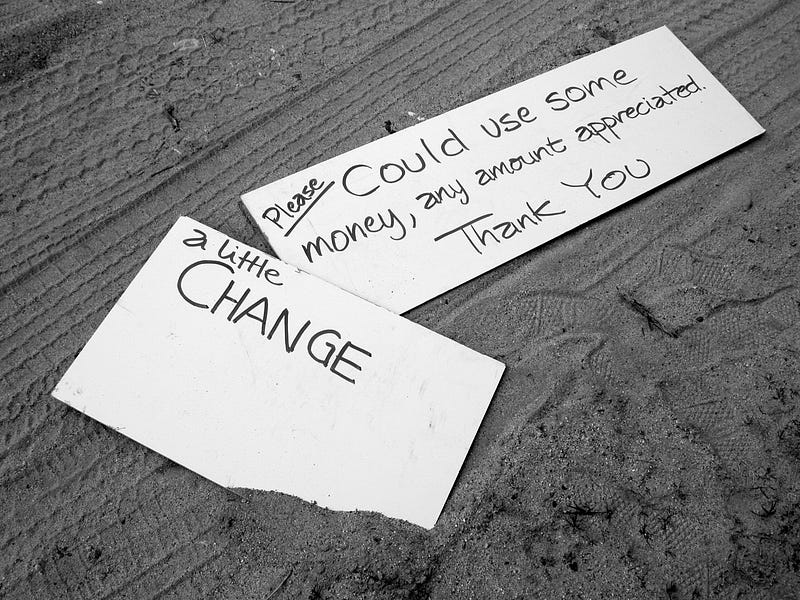
Every morning, I funnel into the historic city of Elizabeth by way of New Jersey Turnpike Exit 13, which is punctuated by a traffic light. The exit ramp doubles as a station for a sprinkling of panhandlers. For the sake of this true story, I’ve carefully chosen the word panhandler, which sounds more like an endeavor than an offensive term to mean struggling individuals who position themselves outside where they rely on the kindness of strangers for money.
As a self-proclaimed professor of people, I routinely talk to strangers although I was taught not to. Still, although empathy beats like a drum in my chest, I dutifully tell myself to check the locks, stay safe. Get to work in one piece, do your job, and go home. But….
My heart breaks a little when I see this one particular man day after day. I don’t pay attention to the others, just him. His expression is pained, his body underfed. I wonder what either bad luck, bad choices, or combinations have landed him in morning traffic with an empty Styrofoam cup in all kinds of weather. As the balloon of temptation to open my window inflates a little more each day, I look at him, that is until he looks at me. Then I look away.
I curse my fear and try to fight it. But morning is an endurance test and I often feel like a poodle among pitbulls until I’m able to steady myself a bit later in the day, post-breakfast with all of my creature comforts and luxuries in place. I have to wonder if the coffee cup he’s holding actually contained coffee that he drank at some point, or if he picked it up from the collection of garbage near the guard rail. One morning, after raising a cup to the driver of a truck in front of me and collecting some change, he takes quick confident steps in my direction. I attempt telekinesis to will the light to turn green so I don’t have to engage. It works; I speed away.
After months of watching him, his face becomes familiar, and I have to admire his commitment to Exit 13. Since easing into my routine, fear is a puddle that has melted somewhere on the asphalt behind me. Now, I have not only the courage but the burning desire to engage him. I open my window and glimpse cautiously into his saucer-like windows of desperation tinted by liver damage. I empty a fistful of change into his cup. Before I can hit the gas, he smiles, his face now bright, magical. “Thank you!” he shouts into the morning smog. “God bless you. Have a blessed day!” Our exchange is electric; I will never forget this moment.
We repeat this ritual for many days thereafter. I come to crave the unlikely comfort of our conversation. If I have dollars to spare, I stuff them into his cup, and we talk as long as the light allows. His name is Teddy. He says he’s trying to clean up his act. Me, too, I hear myself say. There are too many days when the green light means I can’t stop to chat, but we wave and smile, and my heart soars. One day when my mother is in the car with me, after I wave to him, she asks, “Who is that?” We are noticeably chummy at this point, so I say, “That’s my favorite panhandler.” The day I give him a $5, he treats it like a Platinum AmEx card.
“How can I help you?” I ask him on a penniless day. “You help me every day,” Teddy says.
I hand him my business card. “Come to the hospital for lunch,” I say, feeling instant gratification as the scene plays out in my mind. He says OK, but then, I don’t see him for weeks, then months and he never calls.
During the height of the pandemic, the thought of him as a homeless victim of COVID holds me in a state of suspension, especially as I approach, then pass through Exit 13.
Finally, when reappeared at his post, I felt grateful and anxious for an update. He was wearing a mask, but I’d recognize his eyes anywhere, now brighter, less yellow. As if he can’t wait to tell me, he shouts over the din of traffic, “I found a shelter!”
The shift in his energy may have floated me through the whole day. “Thank God,” I say! But when he says, “I also found out I have Parkinson’s,” I deflate. I wished the drivers behind me could intuit that this isn’t some random interaction.
We force a goodbye and I uneasily speed away, like an ellipse taking human form. Now when I don’t see him for weeks, I’m left to wonder when the next time will be and what is filling the space in between.
Yolanda Fleming is the marketing manager of an NJ hospital and writes an award-winning in-house newsletter. She lives near the beach with her husband, Guy Cash Fleming, a musician and the author of For the Love of Sea Glass and The Mystical Search for Sea Glass, and two young adult children, also active musicians. Her books Chilangos in the House: The True Story of a MexiCAN and Divine Stupidity (Faith St. Augustine) are available on Amazon.


