
My Favorite A — Z Travel Destinations — Idaho
Following the Oregon Trail along the Snake River in 1989
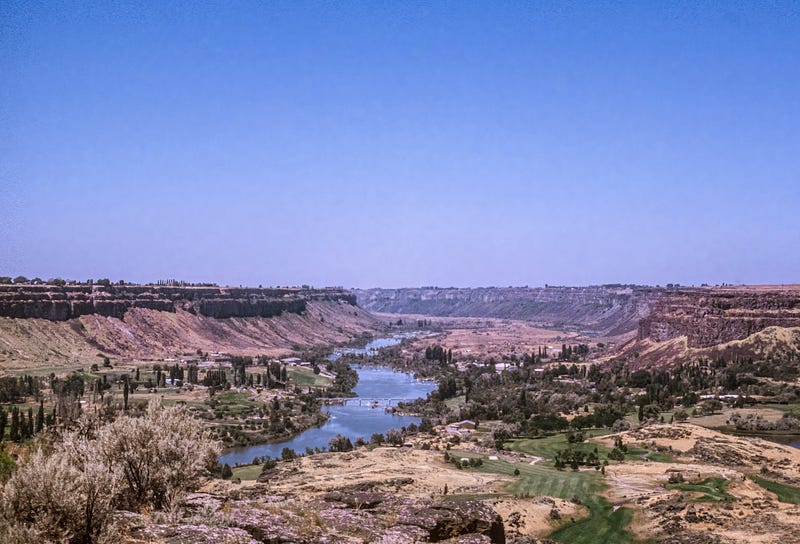
I was active in the Oregon-California Trails Association for 21 years. During that time I attended nine of the annual OCTA conventions, held somewhere on the Trail. Two of these were in Idaho. The photos in this story were all taken during the week in August 1989 when I attended the OCTA convention in Boise.
The Oregon Trail starts in Kansas City, Missouri and ends about 2,000 miles later in Oregon City, Oregon. About 400 miles of the trail goes through the state of Idaho, mostly following the Snake River.
The Snake River starts in Yellowstone National Park in Wyoming and winds through the Grand Tetons and the town of Jackson before heading west through Idaho. The river turns north just before reaching Oregon and then forms the border between Idaho and Oregon and also a tiny bit of the border between Idaho and Washington. The Snake ends when it meets the Columbia River near Kennewick, Washington.
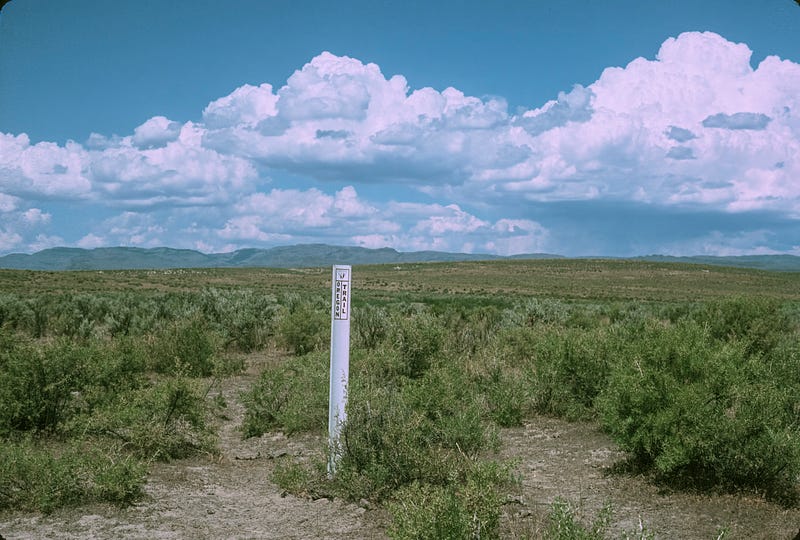
At least two days of the week-long OCTA conventions are devoted to all-day bus tours of trail landmarks. One of the bus tours I signed up for was to Three Island Crossings State Park, about 75 miles south of Boise on I-84.
OCTA members call themselves “rutnuts.” These tours usually allow at least one daily routine of hopping off the bus to walk for a few miles along the trail. We would be happy if we found a marker like the one in the photo above. And we would be ecstatic if we came across ruts formed by wagon wheels more than a century ago!
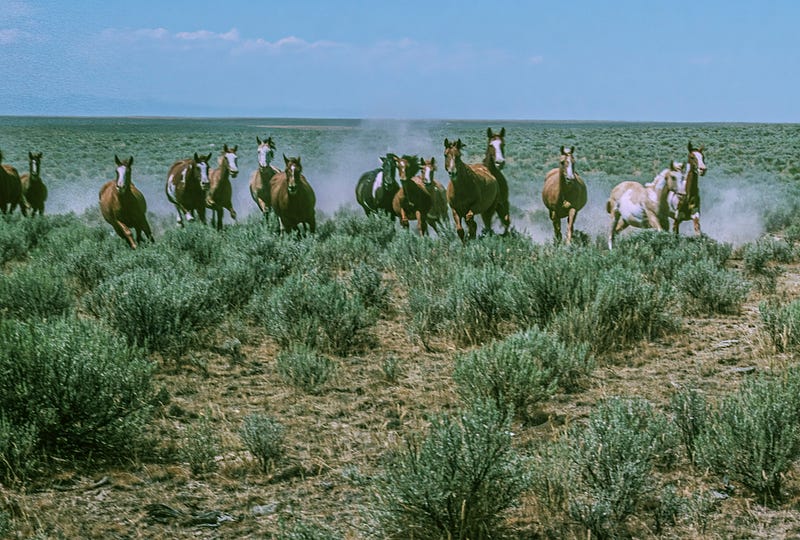
Have you ever been run down by a herd of wild horses? Well, I almost met my maker that day I joined fifty other rutnuts on a trail walk through the sagebrush. Then all of a sudden we heard a thundering noise. Kids screamed. Old ladies fainted. But I stood my ground and whipped out my camera and calmly took this shot. That’s what photographers do, right?
Luckily for all of us, there was one among us who knew a little bit about horses and had the common sense to get the herd to change their direction away from those of us who had no common sense. This all happened in a matter of seconds and then they were gone. I managed to get two more shots as they stampeded past us, but the second shot wasn’t much more than a cloud of dust.
Oh, I was just kidding about the screaming and fainting!
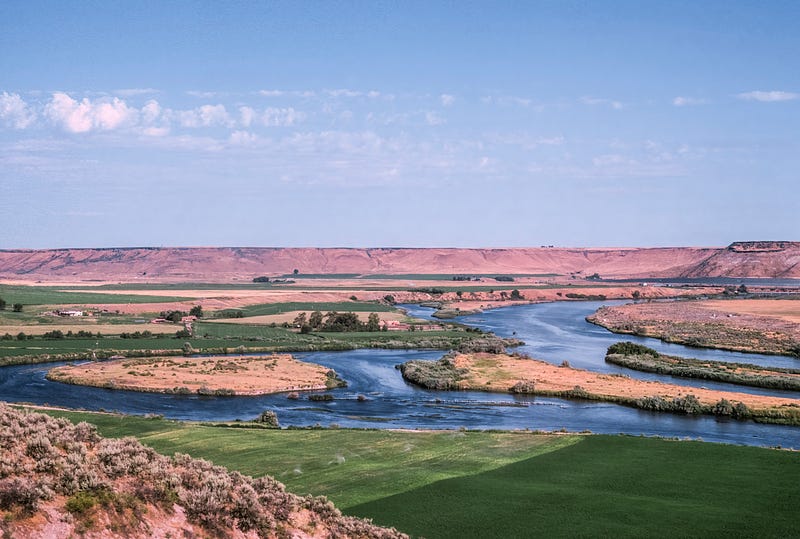
Through most of Idaho the wagon trains followed the south side of the Snake River. But here at Three Island Crossing they had to cross over to the other side because of the need for the water and grass on that side. The trail then continued on that side all the way to Fort Boise.
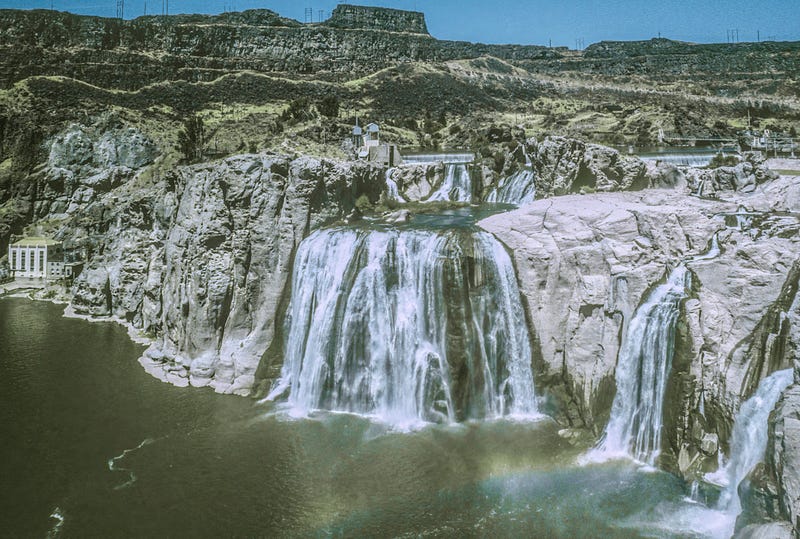
There are lots of spectacular waterfalls along the Snake River in Idaho — American Falls, Pillar Falls, Auger Falls, Twin Falls, Upper and Lower Salmon Falls — But the most magnificent is probably Shoshone Falls which is about seven miles upriver from Twin Falls. The central falls in this picture are 212 feet high. That’s higher than Niagara.
Twin Falls, by the way, is a misnomer. One of the two falls that gave the city its name was dammed up in the 1930s. So, I think the city should be renamed Single Falls!
About halfway between Twin Falls and Shoshone Falls the famous daredevil Evel Knievel in 1974 attempted his historic jump on a jet motorcycle from one rim of the Snake River Canyon to the other. He didn’t make it. But there is a plaque commemorating when and where he started his jump. In 2016 another daredevil by the name of Eddie Braun gave it a try and he was successful!
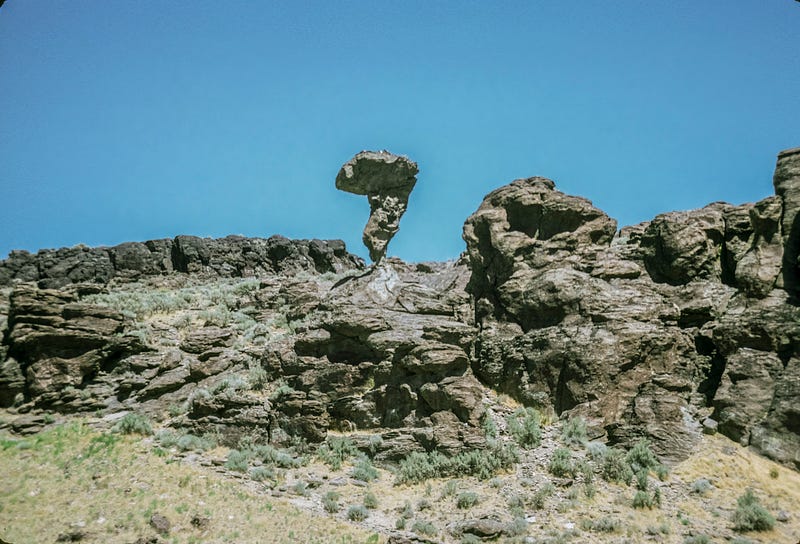
I guess just about every state has to have at least one balanced rock that looks like it is about to tip over at any minute. This one is near the town of Buhl about 16 miles west of Twin Falls.
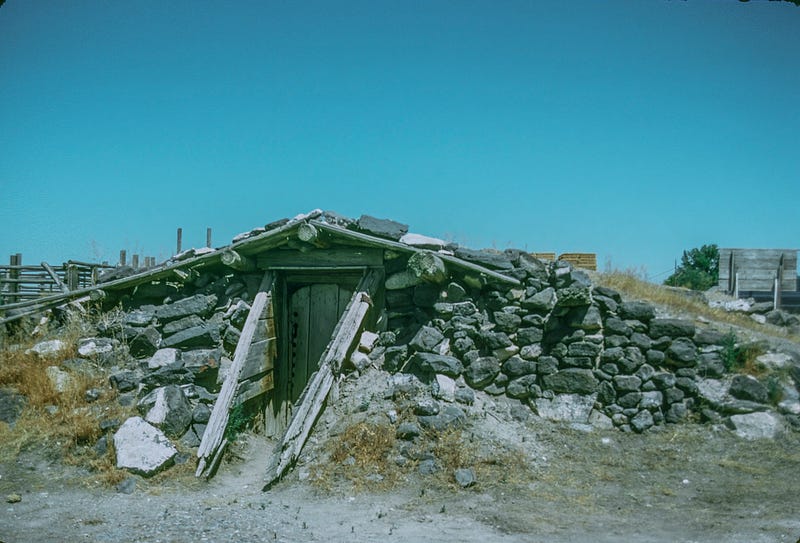
The Stricker Trading Post and Rock Creek Station can be found about 14 miles southeast of Twin Falls. This dugout was probably built around 1865.
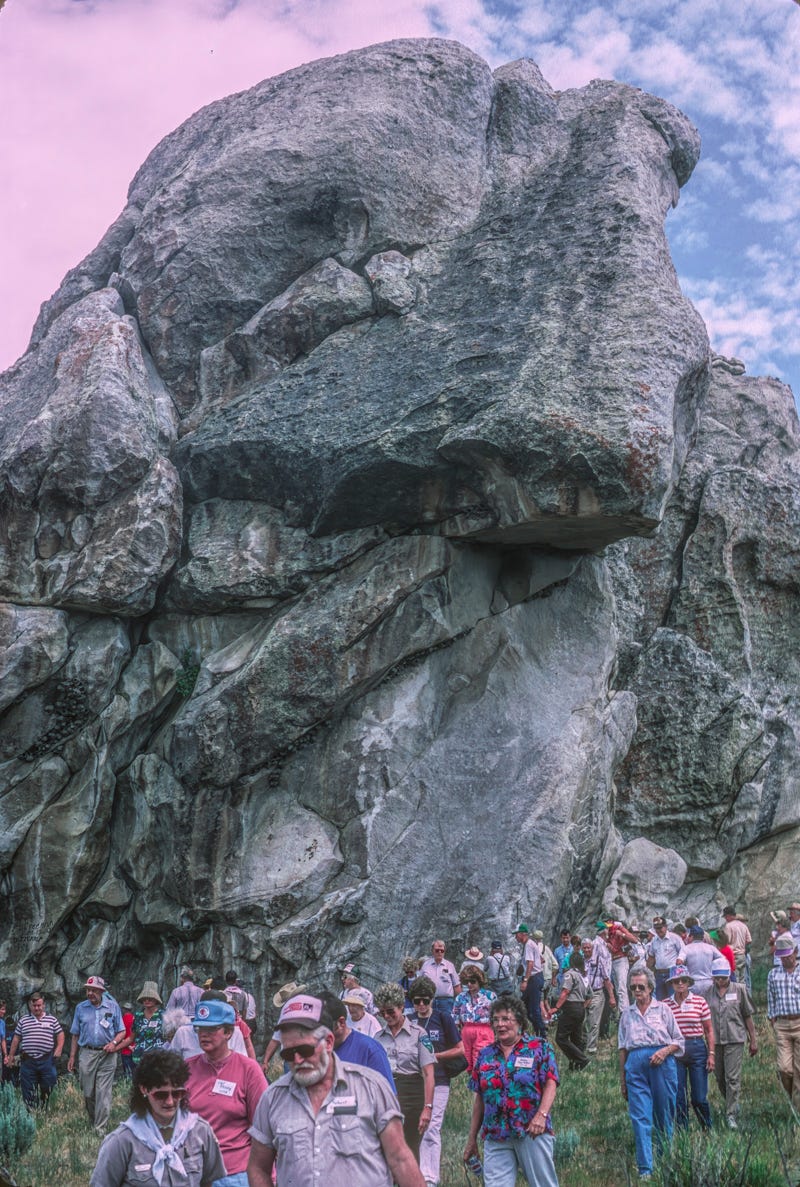
The City Of Rocks is the most popular landmark on the California Trail that veered off the Oregon Trail at the confluence of the Snake and Raft Rivers about 65 miles east of Twin Falls and then followed the Raft River into Utah. Gold was discovered in California in 1848 and by 1849 most of the Trail Pioneers took this route that eventually brought them to the Humboldt River in Nevada. They then followed the Humboldt to the Sierra Nevada mountains and the foothills where they hoped to strike it rich.
I joined this large group of OCTA conventioneers one day at our Boise convention in 1989.
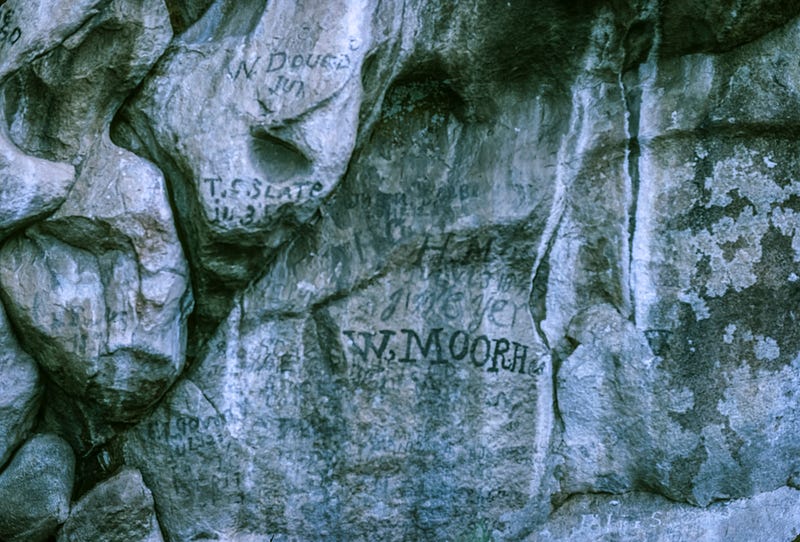
The pioneers used axle grease to write their names and the dates they came by. Most of the dates were in the 1850s, but I saw one from 1849.
I arrived in Boise one day before the convention and so spent the day exploring central Idaho.
The Goodale’s Cutoff was an alternate route to the main Oregon Trail along the Snake River. It ran for 230 miles from Fort Hall to Fort Boise more or less parallel to the Snake River but about 90 miles north of Twin Falls.
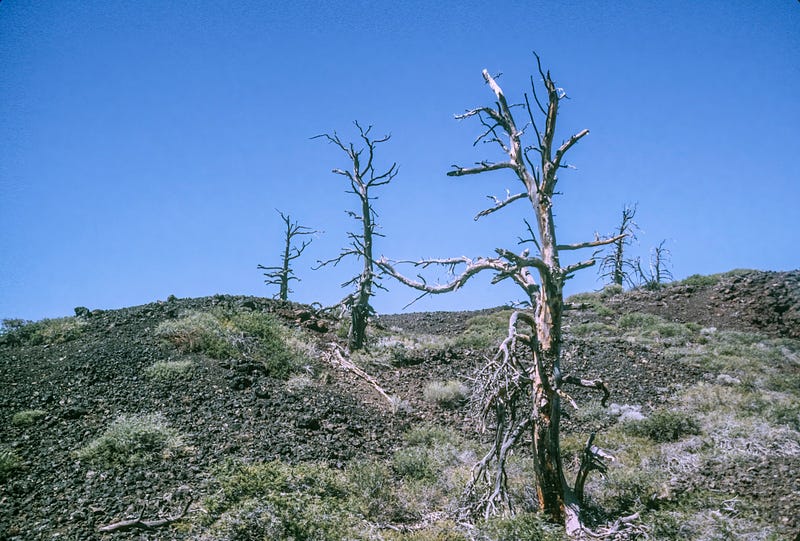
Travelers on the Goodale’s Cutoff went by expansive lava fields. Volcanic eruptions in this area began around 15,000 years ago and ended about 2,000 years ago. Some geologists believe that there will be more eruptions within the next 100 years. In the 1920s the term Craters of the Moon was coined in an attempt to gain national attention and support for preservation. In 1924 it became a national monument and the area was greatly expanded in 1970 and again in 2000. [Source: Wikipedia]
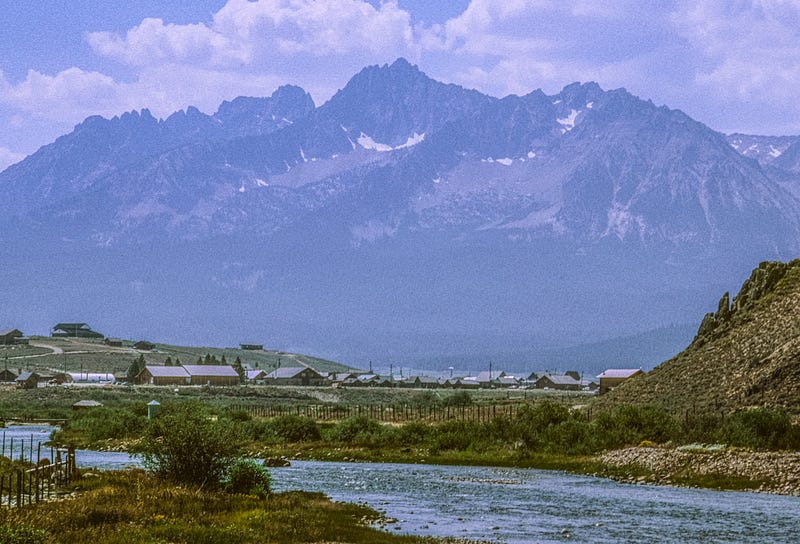
After exploring the Craters of the Moon, I drove north into the Sawtooth Mountains and visited Sun Valley and Ketchum. I drove as far as Stanley on the Salmon River where I took this picture and then turned around and headed back to Boise.
I returned to Idaho a few years later when I attended another OCTA convention at Baker City, Oregon and spent one day on a Snake River jet boat cruising up and down Hell’s Canyon on the Oregon-Idaho border. That was fun!
A few more years later my wife and I attended another OCTA convention in Pocatello where we saw a replica of the original Fort Hall. We also visited the Fort Hall Indian Reservation where we were allowed to see the spot where the original Fort Hall once stood.
See what other Globetrotters writers are coming up with for their favorite A-Z destinations. Adrienne Beaumont has just published her V story. Michael Rhodes, Anne Bonfert, and Darren Weir are way ahead of me. But I think I am still ahead of Jillian Amatt - Artistic Voyages, Nishan Fuard, Dan Carlson | Meandering Naturist, Robert G. Longpré - [he/him] - Canadian métis, and Ronald Smit. Did I miss anybody?