
My Father’s Watch
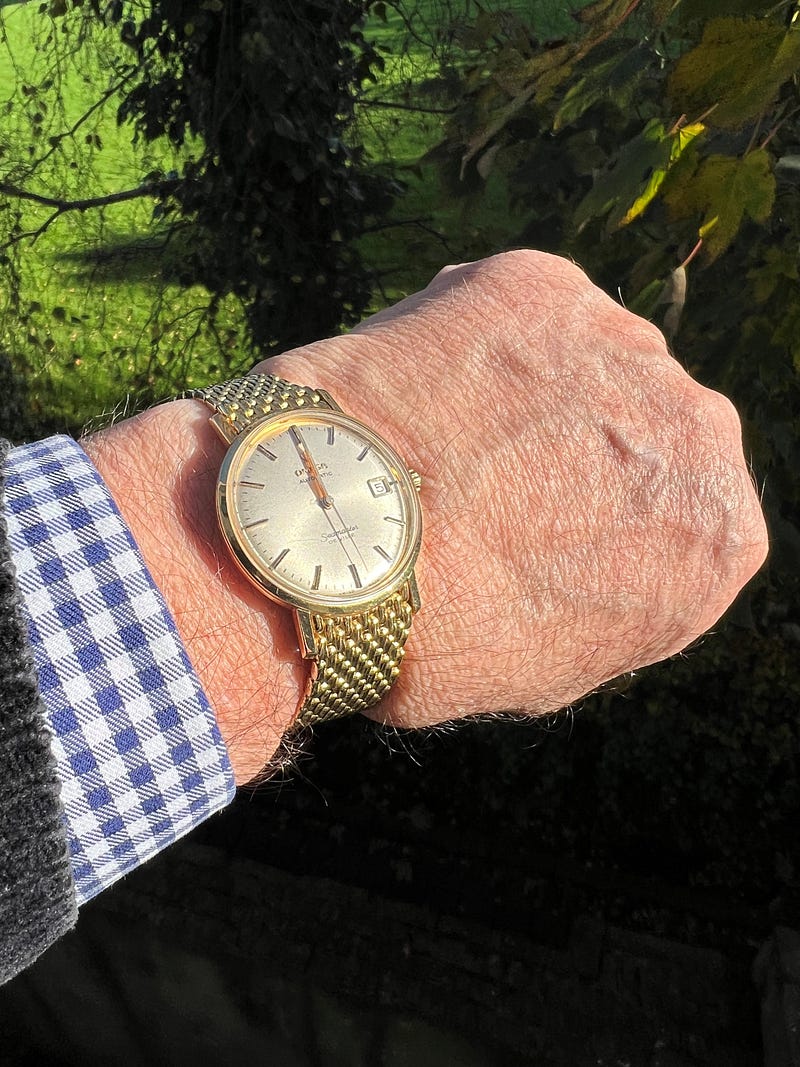
Before he died in 1990, my father asked me if I would like his watch. I did not wish to appear ghoulish and refused, which I regretted for years as he replaced his gold Omega Seamaster with something that was easier to wear.
Regret is the counterpoint to love as an emotion, but the movie moments we all remember are usually when the protagonists express regret in their path in life.
In Casablanca, Humphry Bogart achieves redemption when he sacrifices the love of his life with the lie “If that plane leaves the ground and you’re not with him, you’ll regret it. Maybe not today. Maybe not tomorrow, but soon and for the rest of your life.”
In The Shawshank Redemption, Morgan Freedman is paroled after 40 years when he finally understands the purpose of his incarceration with the answer, “There’s not a day goes by I don’t feel regret. Not because I’m in here, but because you think I should. I look back on the way I was then: a young, stupid kid who committed that terrible crime. I want to talk to him. I want to try to talk some sense to him, tell him the way things are. But I can’t. That kid’s long gone, and this old man is all that’s left. I have to live with that. Rehabilitated? It’s just a bullshit word.”
You always remember your regrets.
When I was 11, I remember sitting on my father’s knee and playing with his watch. For his 25th wedding anniversary, he got a gold watch strap. I loved that watch — it was him when he was in the prime of life.
When he was 60 he was diagnosed with pancreatic cancer — the offer of his watch as he grew weaker was refused in my denial of the inevitable.
When I was 60, I flew to Dusseldorf and purchased a 1960 gold Omega Seamaster and had a gold strap commissioned to assuage my regret.
It reminds me of him every time I wear it.
Although I loved him he was a difficult man, a Christian, homophobic, and ultra-conservative. My two aunts questioned whether I was a changeling as I was completely different. I believe he taught me what not to be.
Some toxic managers whom I have had the obligation to work with have become leaders who have changed for the better, while others have discovered to their cost that a toxic management style can be terminal.
My experience with conservative management styles enabled me to deal with toxic managers effectively.
Toxic managers take credit for their teams’ successes and blame everyone but themselves for all failures.
I get paid to take the blame for my team members’ mistakes became my mantra — their success enabled my success.
What not to be is the key to success.
I have celebrated many of my teams’ successes in my Don’t Panic blogs — those managers who fall into the category of failures I have avoided mentioning — but you know who you are.
Is this all because of the learning caused by regret for not taking up the offer of my father’s watch?


